


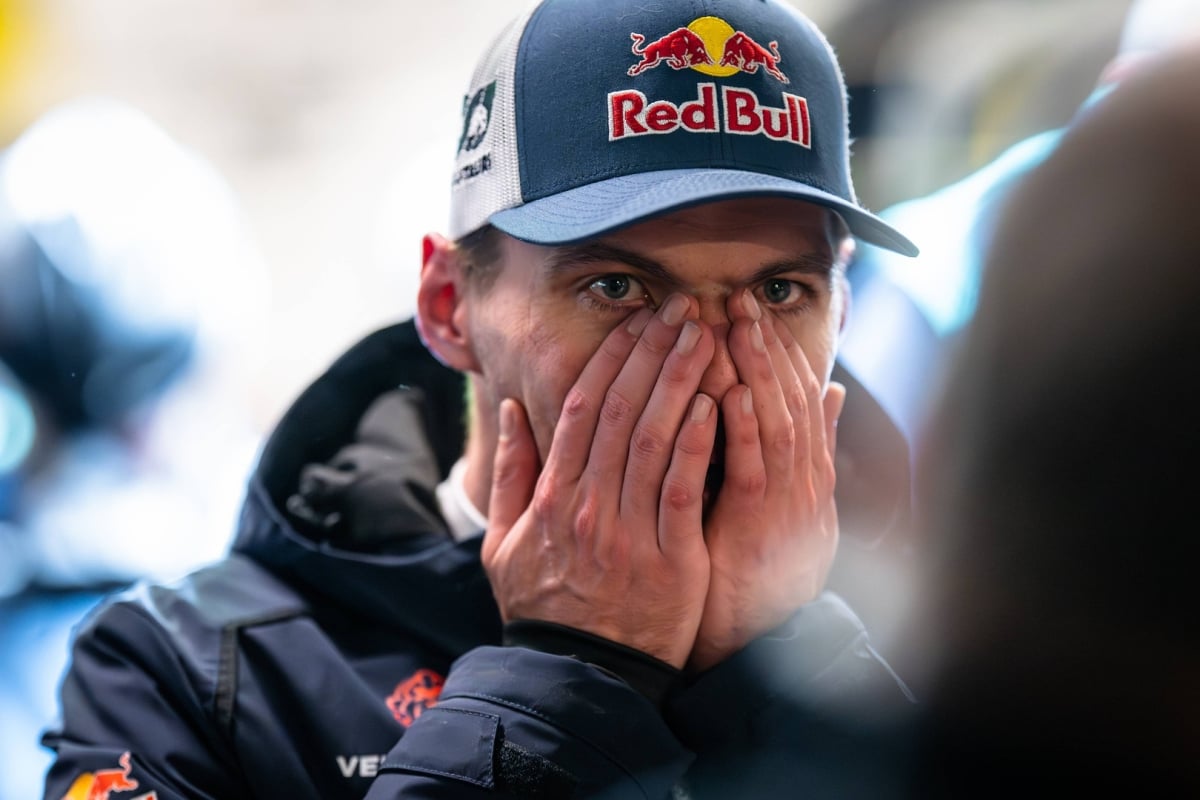

Max Verstappen Nurburgring conspiracy theory addressed by team-mate
Max Verstappen raced at the 24 hours of Nurburgring race last weekend
A bizarre theory that F1 champion Max Verstappen was the reason for the No. 3 team's issues at the Nurburgring 24 Hours has been rubbished by his team-mate.
Mercedes-AMG Team Verstappen Racing was leading the ADAC RAVENOL 24h Nurburgring for most of the race. However, the crew of Lucas Auer, Jules Gounon, Dani Juncadella, and Max Verstappen ultimately failed to clinch victory due to mechanical issues.
Since then, rumours have been circulating on social media blaming Verstappen's driving, but Juncadella has quickly dismissed these claims.
The pair of Winward Racing cars dominated the Nurburgring Nordschleife from Saturday night onward and Verstappen Racing held the top spot ahead of Team Ravenol as many GT3 challengers struggled.
Top teams like Haupt Racing Team, KCMG, Manthey, and Scherer Sport PHX all faced significant setbacks, while the Walkenhorst-Aston Martin was the only competitor able to challenge the AMGs - until a poor tyre choice in the rain stalled their charge.
READ MORE: Mercedes announce Nurburgring 24 Hours ban for F1 star
Did Verstappen take too many risks?
On Sunday afternoon, Team Ravenol celebrated victory with drivers Maro Engel, Maxime Martin, Fabian Schiller, and Luca Stolz as Verstappen Racing’s fortunes reversed in the final three hours. A series of issues culminated in a broken driveshaft.
Fans and viewers were quick to point fingers at Max Verstappen, arguing he took “too many risks” and pushed the car beyond its endurance. Even a former GP2 (now FIA Formula 2) driver from Argentina backed this theory.
Juan Cruz Alvarez summed it up on X: “In 24-hour races, you learn important lessons on the track. Preserving the car is more crucial than outright speed. If you compromise reliability at the start by pushing for mere tenths of a second advantage, you’ll pay for it. It’s no coincidence that the same names progress to the front in the final hours.”
Juncadella dismissed Álvarez’s remarks outright, and wrote: “Seriously, it’s unbelievable what you read sometimes."
When the Argentine suggested that there might be some merit to the criticism, Juncadella firmly responded: “Today’s GT3 cars are built to endure more than thirty hours at the limit. We were advised from the fourth or fifth hour on to avoid unnecessary risks, as we had only secured a modest two- to three-minute advantage in third place.”
According to his Spanish team-mate, the broken driveshaft was simply a case of bad luck and had nothing to do with how Max Verstappen was driving.
READ MORE: Verstappen plots Nurburgring return after 24 hour heartbreak
Related
More F1 news
Latest F1 news

Recommended by the editors
 Lewis Hamilton
Lewis Hamilton claims top F1 stars cannot compete with rival on 'pure talent'
 F1 News & Gossip
Christian Horner to Ferrari could fix nothing unless John Elkann makes one major change
 Bahrain Grand Prix in Malaysia
Ranking every mad thing that happened at the F1 Bahrain Grand Prix in Malaysia
 F1 News & Gossip
Former F1 star in massive crash after terrifying collision with wall







Races
-
 Grand Prix of Australia 2026
-
 Grand Prix of China 2026
-
 Grand Prix of Japan 2026
-
 Saudi Arabian Grand Prix 2026
-
 Miami Grand Prix 2026
-
 Grand Prix du Canada 2026
-
 Grand Prix De Monaco 2026
-
 Gran Premio de Barcelona-Catalunya 2026
-
 Grand Prix of Austria 2026
-
 Grand Prix of Great Britain 2026
-
 Grand Prix of Belgium 2026
-
 Grand Prix of Hungary 2026
-
 Dutch Grand Prix 2026
-
 Grand Prix of Italy 2026
-
Gran Premio de España 2026
-
 Grand Prix of Azerbaijan 2026
-
 Grand Prix of Bahrain 2026
-
 Grand Prix of Singapore 2026
-
Grand Prix of the United States 2026
-
 Gran Premio de la Ciudad de Mexico 2026
-
 Grande Prêmio de São Paulo 2026
-
Las Vegas Grand Prix 2026
-
 Qatar Grand Prix 2026
-
 Grand Prix of Abu Dhabi 2026
Follow us on your favorite social media channel
Editorial & corporate information

Avenue HQ
10–12 East Parade
Leeds
LS1 2BH
United Kingdom Regional correspondence
View contact page