


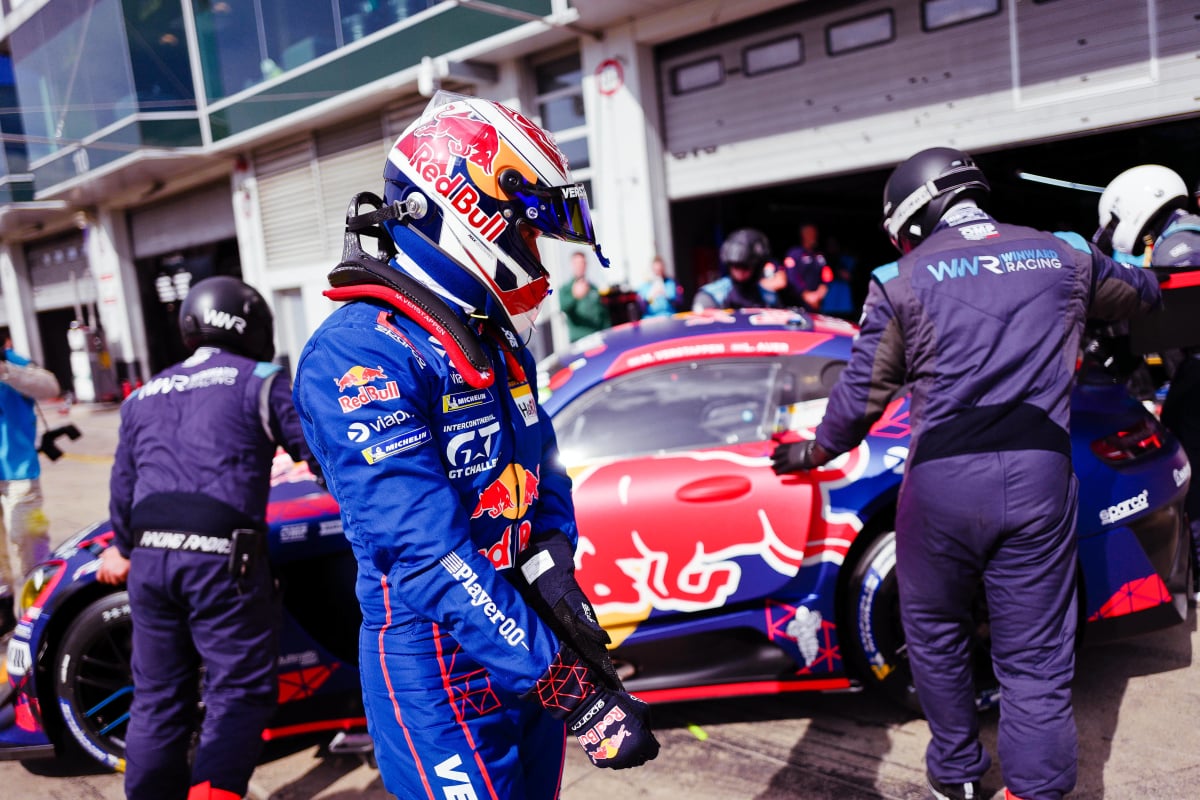

Nurburgring 24 Hours Rules: What Max Verstappen really needs to know ahead of iconic race
The iconic race comes with some quirky challenges
Max Verstappen is used to dealing with the FIA on a regular basis, but the F1 champion will face an entirely different rules challenge in the Nurburgring 24 Hours race this weekend.
The 28-year-old Dutchman will be the star attraction when four days of thrilling action take place on the terrifying Nordschleife (sometimes known as 'Green Hell') between Thursday May 14 and May 17.
Verstappen and team-mates Lucas Auer, Jules Gounon and Dani Juncadella will head a field of 161 cars in a race which tests both speed and endurance.
Throw in the potential for unpredictable weather and a field stacked with not just GT3 cars but also a mix of older models, vintage BMWs and other touring cars, and this becomes a test like no other.
Team Verstappen will also need to negotiate some unusual rules and we are here to explain just a few of them.
Nurburgring 24 Hours: Watch Top Qualifying LIVE and free today
Blue flags and lapped cars
Blue flags work differently here compared to F1 - in this race they primarily serve as a warning to slower drivers that a faster car is closing in. Unlike in F1 though, a slower driver isn’t expected to immediately pull over for someone like Verstappen or another GT3 competitor.
In this race and the Nürburgring Langstrecken-Serie (NLS), lapped drivers are trained to stick to the racing line - arguably the most predictable driving behaviour. It then falls to the faster drivers to execute safe overtakes
Last year, this rule came into sharp focus when Manthey-Porsche crossed the finish line first, only to lose the win due to a penalty for collision between Kévin Estre and a slower Aston Martin.
Multi-minute pitstops
Pitstops at the Nürburgring 24 Hours race take considerably longer than those in F1. While teams in that series can change a full set in about two seconds, a Nürburgring pitstop can last several minutes. The extended stops are essential for safety, allowing crews to handle tasks beyond just changing tyres. Drivers might need to swap seats, refuel, or complete necessary repairs during a stop.
The minimum pit duration depends on the length of the previous stint. A stint of 11 laps requires a pitstop lasting over four minutes, while a stint of seven laps demands roughly three minutes. For the final scheduled pitstop, the time is determined by how much longer the race will be.
Code 60 and slow zones
Unlike many racing series, the Nurburgring 24 Hours race does not feature traditional safety car periods - the circuit is far too long for that system to work reliably. Instead, race organisers rely on “slow zones” and Code 60 measures.
When incidents occur which require marshals to enter the track or for tow trucks and ambulances to offer assistance, a Code 60 is activated in that sector. Marked with purple flags displaying the number “60,” drivers must slow to 60 kmh, ensuring the safety of everyone involved.
Sometimes, teams spend hours repairing catch fences, all under Code 60 conditions without the race being halted by red flags.
In a slow zone, the speed limit is set to 120 kmh. The sector preceding a Code 60 area automatically becomes a slow zone, allowing drivers to reduce speed gradually from racing pace to 120 kmh before reaching the area where they must slow down further to 60 kmh. Violating these rules can lead to severe penalties, including the loss of a racing licence.
Digital transformation at the Nordschleife
The Nurburgring has undergone a two-year upgrade to modernise the Nordschleife. This ambitious project added 100 new cameras and 46 LED panels, backed by 80 kilometres of new power and data cables. The system, which cost a staggering 12million Euro, will be integrated into a race for the first time this coming weekend.
These LED panels are designed to enhance daytime safety - they provide highly visible signals over several hundred meters, compensating for glare from the sun that can obscure traditional flags.
Unlike the LED displays used in low-light conditions, these daytime panels are purely supplementary and hold no official regulatory status - marshal flag signals remain the top priority.
Nurburgring 24 Hours: Full 161-car entry list including Max Verstappen
Related
More F1 news
Latest F1 news
Recommended by the editors
 Christian Horner
Christian Horner claims Red Bull F1 team is cooked without him: 'It's lost its mojo'
 Azerbaijan Grand Prix
F1 Azerbaijan Grand Prix 2026 results: Final classification with all penalties applied from Baku
 Michael Schumacher
Michael Schumacher's wife makes devastating admission: 'I have to cry'
 Max Verstappen
Max Verstappen confirms grid penalty coming after Baku breakage







Races
-
 Grand Prix of Australia 2026
-
 Grand Prix of China 2026
-
 Grand Prix of Japan 2026
-
 Saudi Arabian Grand Prix 2026
-
 Miami Grand Prix 2026
-
 Grand Prix du Canada 2026
-
 Grand Prix De Monaco 2026
-
 Gran Premio de Barcelona-Catalunya 2026
-
 Grand Prix of Austria 2026
-
 Grand Prix of Great Britain 2026
-
 Grand Prix of Belgium 2026
-
 Grand Prix of Hungary 2026
-
 Dutch Grand Prix 2026
-
 Grand Prix of Italy 2026
-
Gran Premio de España 2026
-
 Grand Prix of Azerbaijan 2026
-
 Grand Prix of Bahrain 2026
-
 Grand Prix of Singapore 2026
-
Grand Prix of the United States 2026
-
 Gran Premio de la Ciudad de Mexico 2026
-
 Grande Prêmio de São Paulo 2026
-
Las Vegas Grand Prix 2026
-
 Qatar Grand Prix 2026
-
 Grand Prix of Abu Dhabi 2026
Follow us on your favorite social media channel
Editorial & corporate information

Avenue HQ
10–12 East Parade
Leeds
LS1 2BH
United Kingdom Regional correspondence
View contact page