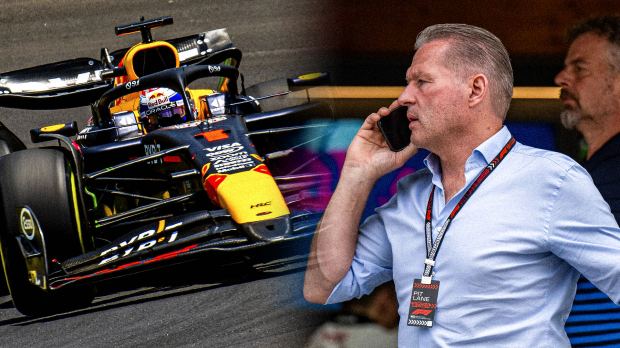

Jos Verstappen responds strongly to GPFans' call to abolish new F1 engines
Jos Vertstappen responded to a GPFans' question on the new regulations
Jos Verstappen isn’t holding back when it comes to the current state of Formula 1.
The father of Max Verstappen made it clear on GPFans that he’s fed up with the direction the sport is heading in.
As the pinnacle of racing embarks on a new era with predominantly electric power units, the disgruntled former F1 star himself between 1994 and 2003 appears to have reached his boiling point.
The spark for Jos’s response was a claim about the future of the sport: “F1 must ditch the new power units.”
Without mincing words, he expressed wholehearted agreement. In a brief yet forceful “AGREE,” he joined the online debate from GPFans' Dutch team over this year’s engine specifications.
His comment also serves as a public show of support for his son, who, after the season opener in Australia, already denounced the current format as “anti-F1.”
F1 HEADLINES: Mercedes could 'block' Horner return, Verstappen rages

Problems with Energy Management
Criticism of the new engines, designed with a 50-50 split between the combustion engine and electric power, is mounting.
Drivers complain that they lose vital speed on the straights when the battery runs dry. This phenomenon, known as super clipping, forces pilots to manage energy extremely early in a lap to recharge for the next stint.
Max believes the sport is now more about conserving energy than outright speed—and he’s not having it. His father’s resounding support only underlines the frustration.
According to Jos, this predicament is exactly what Max warned about years ago. While the four-time world champion’s concerns were initially brushed aside, this season’s reality seems to confirm his fears.
Mercedes’ current dominance, illustrated by George Russell taking the championship lead shows just how much the new engine regulations have upended the traditional pecking order.
Growing Pressure on the FIA
The backlash isn’t limited to the Verstappens. Other drivers have also raised concerns about the handling of the new cars. With so much attention paid to battery levels, genuine racing feels like it’s taking a back seat. Increasingly, voices from the paddock are calling for a bigger role for the combustion engine to keep fans excited with higher top speeds and less constant deceleration.
The FIA now faces the tough challenge of preserving the essence of F1 while staying on a sustainable path.
Chinese Grand Prix
There’s little time for the drivers to dwell on these issues, as the action shifts to Shanghai for the Chinese Grand Prix this coming weekend.
The event promises added challenges, marking the first sprint race of the season. For Verstappen and Red Bull Racing, the task will be to reconnect with the leaders on the Shanghai International Circuit while tackling problems with the Red Bull-Ford power unit.
F1 2026 Regulations: Every new rule and car change explained





 Grand Prix of Australia 2026
 Grand Prix of China 2026
 Grand Prix of Japan 2026
 Saudi Arabian Grand Prix 2026
 Miami Grand Prix 2026
 Grand Prix du Canada 2026
 Grand Prix De Monaco 2026
 Gran Premio de Barcelona-Catalunya 2026
 Grand Prix of Austria 2026
 Grand Prix of Belgium 2026
 Grand Prix of Hungary 2026
 Grand Prix of Italy 2026
 Grand Prix of Azerbaijan 2026
 Grand Prix of Bahrain 2026
 Grand Prix of Singapore 2026
 Gran Premio de la Ciudad de Mexico 2026
 Grande Prêmio de São Paulo 2026
 Qatar Grand Prix 2026
 Grand Prix of Abu Dhabi 2026