


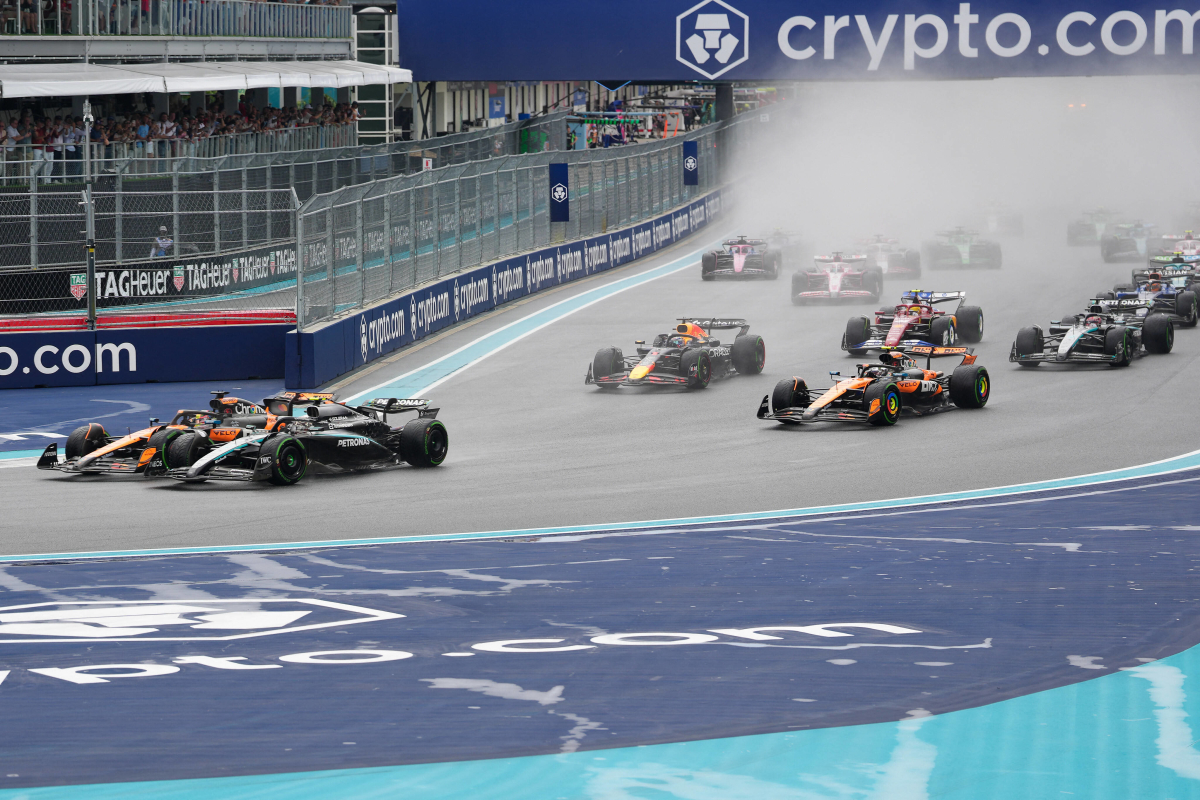

FIA announce Miami Grand Prix 'rain hazard' as F1 braced for chaos
The FIA announced a 'rain hazard' for Sunday's Miami Grand Prix
With forecasts looking increasingly bleak, the FIA has taken the expected step of declaring a 'rain hazard' for Sunday's Miami Grand Prix.
Sounds very dramatic, doesn't it? While the weather might very well be dramatic though, the announcement isn't quite the big scary race-changer that the 'rain hazard' phrasing might suggest.
This is a new rule for the 2026 season, and the reason for that will become clear shortly. That does mean that this is the first time a rain hazard has been declared under the new rules though, so here we go.
The short version is: this can allow a very, very minimal amount of work on the cars in order to avoid excessive skid plank wear. Er. That's it. This has, to be clear, nothing to do with the meeting that's being held later on Saturday to discuss changing the race's start time.
READ MORE: Will Miami GP be cancelled? Lightning threat poses risk to F1 race
What's a rain hazard in F1, anyway?
Glad you asked! A rain hazard being declared means that the sport's 'official weather service' has given a forecast that there's at least a 40% probability of precipitation at some point in the race. Given that most weather services have been hovering at around 60% for the race's duration...big tick in that column.
The hazard needs to be declared no later than two hours before qualifying – no problem there – and if the cars are in parc ferme when a rain hazard is declared, work detailed in 'FIA-F1-DOC080' can be undertaken.
That's very much not a setup change concession for performance, though. This is because teams set up their cars with the assumption that their new active aero will be in play, reducing downforce on fast straights. If it's raining and the active aero is reduced to zero or partial activation, then those cars will be sucked down onto the track more in the speedy sections, chipping away at their skid planks and risking disqualification.
To prevent a farcical situation with half the field disqualified after post-race inspections, teams under a rain hazard are allowed to change active front aero settings, which could see them reduce corner downforce and prevent plank wear in that way.
They will also, more simply, be allowed to adjust the ride height of their cars.
Got it? Good.
Now settle in for qualifying while we all wait to find out if the race is going to be brought forward a few hours (at which point, it's worth noting, the forecast might be even more bleak than later in the day).
F1 HEADLINES: Ferrari fumble hard at Miami Grand Prix as FIA punishment confirmed
Related
More F1 news
Latest F1 news



Recommended by the editors
 Miami Grand Prix Qualifying
F1 Qualifying Results: Miami Grand Prix times and grid positions
 Miami Grand Prix Sprint
Mercedes F1 star hit with LATE penalty at Miami Grand Prix
 Miami Grand Prix Sprint
F1 Sprint Results Today: 2026 Miami Grand Prix times and positions
 Miami Grand Prix Sprint
Mercedes suffer nightmare start as Ferrari pounce in Miami







Races
-
 Grand Prix of Australia 2026
-
 Grand Prix of China 2026
-
 Grand Prix of Japan 2026
-
 Grand Prix of Bahrain 2026
-
 Saudi Arabian Grand Prix 2026
-
 Miami Grand Prix 2026
-
 Grand Prix du Canada 2026
-
 Grand Prix De Monaco 2026
-
 Gran Premio de Barcelona-Catalunya 2026
-
 Grand Prix of Austria 2026
-
 Grand Prix of Great Britain 2026
-
 Grand Prix of Belgium 2026
-
 Grand Prix of Hungary 2026
-
 Dutch Grand Prix 2026
-
 Grand Prix of Italy 2026
-
Gran Premio de España 2026
-
 Grand Prix of Azerbaijan 2026
-
 Grand Prix of Singapore 2026
-
Grand Prix of the United States 2026
-
 Gran Premio de la Ciudad de Mexico 2026
-
 Grande Prêmio de São Paulo 2026
-
Las Vegas Grand Prix 2026
-
 Qatar Grand Prix 2026
-
 Grand Prix of Abu Dhabi 2026
Follow us on your favorite social media channel
Editorial & corporate information

Avenue HQ
10–12 East Parade
Leeds
LS1 2BH
United Kingdom Regional correspondence
View contact page