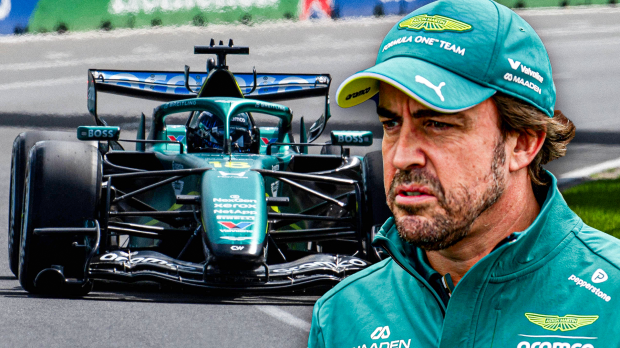

Fernando Alonso admits Aston Martin could be excluded from Chinese Grand Prix
The spectre of the 107 percent rule looms large again for Aston Martin

Two-time F1 champion Fernando Alonso has hinted at further trouble for Aston Martin at this weekend's Chinese Grand Prix, that is if the team are allowed to compete in Sunday's race at all.
At the season-opening Australian GP last weekend, both Alonso and his team-mate Lance Stroll had their track time severely disrupted, with Alonso forced to withdraw from FP1 due to power unit issues and Stroll unable to take to the circuit at all on Saturday.
On Sunday, neither driver completed a full-length grand prix after team principal Adrian Newey had revealed that both Alonso and Stroll had shared concerns they might suffer from permanent nerve damage if they attempted to complete too many consecutive laps in their new AMR26.
This was because of vibrations coming from the Honda PU, which has so far been the source of a lot of the team's misery as they look to have cemented themselves as the least competitive team on the grid after the introduction of the new chassis and power unit regulations.
So, with such a quick turnaround from the Australian GP into the first sprint weekend of the season in China, what can Alonso and Stroll expect from Aston Martin this time out?
F1 HEADLINES: Aston Martin short on parts as Alonso preps for Chinese GP nightmare
Alonso: 'We are at square one'
Having been summoned to appear in the Chinese GP FIA driver press conference along with Haas driver Esteban Ocon and Alpine's Pierre Gasly on Thursday, Alonso was asked what a positive weekend would look like in Shanghai for his struggling Silverstone squad.
The 44-year-old replied: "I think obviously when we are able to do laps without any issues, I think they are very important laps because even now here with Esteban and Pierre, they were not optimised for Australia and apparently it was the same case for everybody, and they are, I don’t know, maybe 10 times ahead of us.
"If they completed 1,000 laps since Barcelona test, we completed maybe 100, so we are nine or 10 times behind. So, if they are still not perfectly optimised, imagine ourselves.
"We are at square one, so we really need the laps, we really need to be able to practice and to find the window on the car and the chassis side.
"That will obviously be very important for the weekend, and I will be happy if we leave China with a more or less normal free practice, more or less normal quali, accumulating laps and probably attempting the full race on Sunday, if we are allowed."
Having a driver admit that their team may not be allowed to complete in a race isn't something you hear at every media day, but Alonso is right to be cautious about Aston Martin's chances of making it to the start line.
This is thanks to the 107 per cent rule, which was first introduced ahead of the 1996 F1 campaign and remained in play until 2003. So why would it be relevant for Aston Martin in 2026?
What is the 107 per cent rule?
The 107 per cent rule was reintroduced to the sport in 2011 in order to police whether cars are even fast enough to start a grand prix.
This may seem dramatic, but slow cars have proved to be a hazard on track time and time again in F1, and present a seriously dangerous risk of getting in the way of other cars going full throttle during a grand prix.
The safety precaution allows the stewards to prevent a driver and their team from taking part if they do not finish within 107 per cent of the fastest time in Q1 during a qualifying session.
If this minimal lap time is not met, a driver is deemed to not be fast enough to be granted permission by the stewards to start the race. Still confused? See our full breakdown of the 107 per cent rule here.
READ MORE: Honda chief furious over Aston Martin fiasco as daily Newey meetings revealed




 Grand Prix of Australia 2026
 Grand Prix of China 2026
 Grand Prix of Japan 2026
 Saudi Arabian Grand Prix 2026
 Miami Grand Prix 2026
 Grand Prix du Canada 2026
 Grand Prix De Monaco 2026
 Gran Premio de Barcelona-Catalunya 2026
 Grand Prix of Austria 2026
 Grand Prix of Belgium 2026
 Grand Prix of Hungary 2026
 Grand Prix of Italy 2026
 Grand Prix of Azerbaijan 2026
 Grand Prix of Bahrain 2026
 Grand Prix of Singapore 2026
 Gran Premio de la Ciudad de Mexico 2026
 Grande Prêmio de São Paulo 2026
 Qatar Grand Prix 2026
 Grand Prix of Abu Dhabi 2026