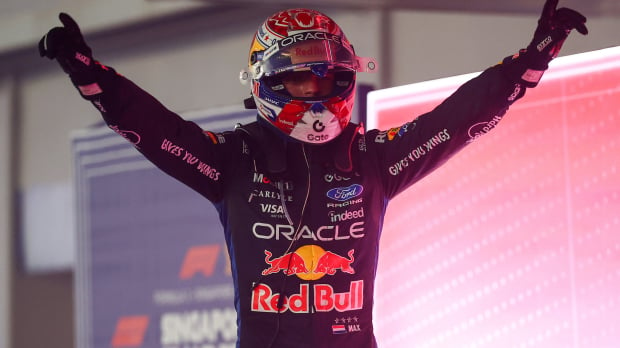

Red Bull chief lifts lid on the 'diva' behind Max Verstappen's F1 success
Interesting stuff!
Red Bull Powertrains (RBPT) has made significant strides with its Formula 1 power unit this season – but denied any physical hardware upgrades under the ADUO system, the team have instead achieved considerable progress through intensive calibration work.
That breakthrough – and an aerodynamic upgrade which debuted in Baku – helped Max Verstappen secure wins at both the Malaysian and Singapore Grands Prix.
The FIA has already twice labeled Red Bull’s internal combustion engine as the performance benchmark this year and, under the somewhat controversial ADUO rules, an engine manufacturer only gets extra development leeway if it lags by at least two percent behind the top performer.
This means the Milton Keynes outfit are not allowed to introduce any new hardware components to their power units this season. While Ferrari has implemented both of its permitted ADUO upgrades, neither Red Bull nor Mercedes (who only have one upgrade allowed) has submitted any new homologations – Mercedes, for now, are keeping their engine updates under wraps.
F1 HEADLINES: Verstappen punished as Hamilton detective role revealed
Challenging calibration work at RBPT
Although the power unit’s hardware remains frozen, Red Bull Powertrains has reaped significant gains from dialling in power output, fuel consumption, energy recovery, and deployment.
Engineers in Milton Keynes, in close collaboration with fuel supplier Exxon Mobil and the chassis department, started focusing on software and calibration even before the season began.
Technical Director Ben Hodgkinson told The Race, “At our original point in the pre-season, when we were planning to freeze the spec, we weren't really happy with the performance levels. So we made the decision to just keep going, which was giving us less and less time to do durability runs and do all the calibration work that we needed to do."
“We've sort of found that the most powerful engine that we can create has made a combustion system that is quite challenging to make sure you always get the maximum performance out of it,” he added.
“That's put an awful lot of pressure onto the calibration team to try and make sure that it's always working at that right level.”
The Brit noted that the team is now reaping the rewards of these efforts every weekend: “We actually started the season with quite immature calibrations. But they have got better and better throughout every single race.”
Breakthrough in Sepang
After the Baku weekend, a pivotal turnaround unfolded on track. A chassis upgrade delivered more downforce and a more consistent aerodynamic platform, allowing Verstappen to achieve a better balance in his car. Combined with significant calibration improvements between Baku and Sepang, this marked RBPT’s power unit’s very first F1 win in Malaysia.
“It enabled the engine to operate closer to its top performance at all times. We have an engine that sometimes falls short of its potential, but if you can keep it at its best throughout a lap, we’re in a very strong position,” explained Hodgkinson, who expects even more visible gains from further refinements as the season progresses.
Verstappen continued this strong performance in Singapore. The Dutch driver grabbed the 50th pole of his career, won the sprint race, and celebrated his first career victory at the Marina Bay Street Circuit on Sunday.
During Saturday’s sprint, Lewis Hamilton noted that it was challenging to pressure the Red Bull driver, saying: “Catching the most powerful engine on the grid isn’t easy."
Mercedes team principal Toto Wolff – who earlier praised the Red Bull power unit during Bahrain test days – also acknowledged that the competition in engine performance is fierce.
“You can’t see that it’s lagging," he said. "They have done it very well. The ICE seems to be very competitive. Obviously, you can see that with ADUO, but also in terms of energy recovery and energy deployment there. It’s pretty good.”
Engine regulations for 2027
Next season, power units will undergo another major overhaul. Red Bull is already taking lessons learned from this year into its 2027 car. The balance between the combustion engine and electric power will shift from roughly 53/47 to 58/42.
With a five percent increase in fuel flow, the combustion engine’s maximum output will rise from 400 kW to 420 kW, while the maximum turbo boost pressure will climb from 4.8 bar to 5.0 bar in 2027 and eventually to 5.5 bar in 2028.
Hodgkinson said his team is using the upcoming changes to make their power unit more user-friendly. “And actually, it's not all down to calibration to solve that. You can make some hardware changes that make it a bit easier too, or a bit less of a diva, to try and use some terminology that's often used in F1.
“Our combustion system could be described as a bit of a diva, and we need to make it slightly easier to extract the best out of it. So that's some of the changes that we're making for next year, and hopefully we can get a nice step on in performance.”
In light of Verstappen’s recent win in Singapore, Wolff also anticipates a fierce battle next season. "One thing is for sure: next year it's full-on the fight between the teams and Red Bull is part of that."
READ MORE: Christian Horner makes bombshell Masi Abu Dhabi 2021 admission
READ MORE: Max Verstappen punished by stewards for GT World Challenge incident at Portimao





 Grand Prix of Australia 2026
  Grand Prix of China 2026
  Grand Prix of Japan 2026
  Saudi Arabian Grand Prix 2026
  Miami Grand Prix 2026
  Grand Prix du Canada 2026
  Grand Prix De Monaco 2026
  Gran Premio de Barcelona-Catalunya 2026
  Grand Prix of Austria 2026
  Grand Prix of Belgium 2026
  Grand Prix of Hungary 2026
  Grand Prix of Italy 2026
  Grand Prix of Azerbaijan 2026
  Grand Prix of Bahrain 2026
  Grand Prix of Singapore 2026
  Gran Premio de la Ciudad de Mexico 2026
  Grande Prêmio de São Paulo 2026
  Qatar Grand Prix 2026
  Grand Prix of Abu Dhabi 2026