

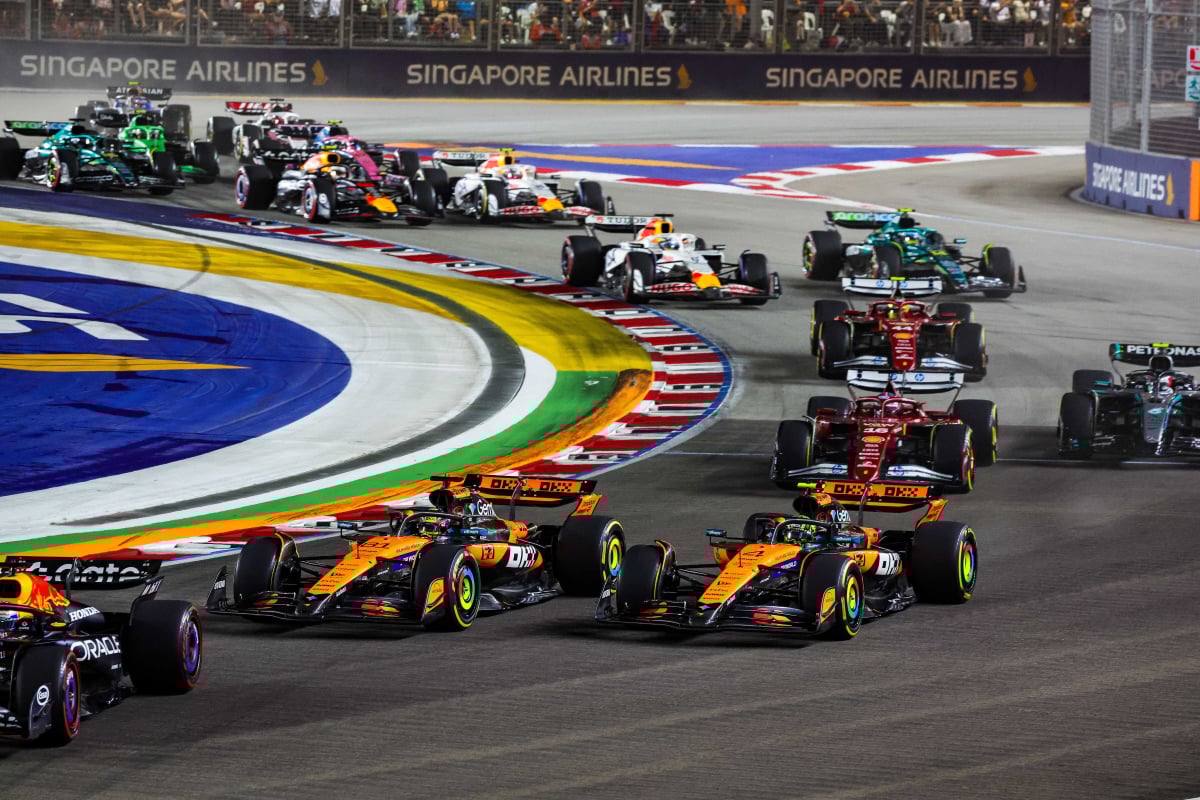

Singapore haze raises concerns ahead of 2026 F1 Grand Prix
The air quality is causing concerns in Singapore

Air quality in Singapore has deteriorated to unhealthy levels just days before Formula 1 arrives at the Marina Bay Street Circuit for the 2026 Singapore Grand Prix.
All five regions of Singapore recorded air quality in the unhealthy range by midday on Tuesday, with central Singapore the worst affected.
At noon local time, the 24-hour Pollutant Standards Index (PSI) stood at 133 in central Singapore, 117 in the east, 113 in the west, 110 in the north and 101 in the south.
Singapore's National Environment Agency (NEA) classifies a 24-hour PSI reading of 101 to 200 as "unhealthy", meaning every region had crossed the threshold.
For context, readings between 0 and 50 are considered good and 51 to 100 moderate. The next category, "very unhealthy", begins at 201, while anything above 300 is classified as hazardous.
The figures therefore show that Singapore is currently in the lower part of the unhealthy range rather than approaching very unhealthy or hazardous conditions.
However, air quality remained a concern later on Tuesday. By 4pm, one-hour PM2.5 readings were elevated in all five regions, reaching 103 micrograms per cubic metre in central Singapore, 87 in the east, 77 in the west, 71 in the south and 63 in the north.
The NEA classifies one-hour PM2.5 readings of 56 to 150 as elevated, 151 to 250 as high and anything above 250 as very high.
The distinction is important. The 24-hour PSI is a rolling measure used for assessing overall air quality and planning activities, whereas the one-hour PM2.5 reading gives a more immediate indication of current conditions.
The deterioration comes just days before F1 track action begins in Singapore on Friday, adding another potential environmental factor for organisers to monitor.
F1 HEADLINES: Honda chief OUT as Aston Martin investment laid bare
Why is there smoke haze in Singapore?
The haze affecting Singapore is largely the result of smoke from fires elsewhere in Southeast Asia being carried across national borders.
Scattered hotspots have been detected in both Kalimantan and Sumatra in Indonesia, while moderate transboundary smoke haze has been observed covering parts of Singapore, Peninsular Malaysia and southern and central Sumatra.
Singapore's NEA said dry conditions have prevailed across much of the southern ASEAN region, allowing fires and smoke haze to persist.
Prevailing winds across the region are expected to blow predominantly from the southeast to south, creating a continued risk of haze reaching Singapore.
Conditions could improve in areas that receive rain, but the haze situation may remain elevated in locations experiencing prolonged dry weather.
That combination of regional fires, prolonged dry conditions and winds carrying smoke towards Singapore is responsible for the deterioration in air quality being experienced ahead of the Grand Prix.
How bad is the Singapore haze?
The current readings are significant enough for Singapore's official health guidance to change, but they are still well below the country's most severe air-quality categories.
| Singapore region | 24-hour PSI | Air quality level |
|---|---|---|
| Central | 133 | Unhealthy |
| East | 117 | Unhealthy |
| West | 113 | Unhealthy |
| North | 110 | Unhealthy |
| South | 101 | Unhealthy |
Singapore's PSI scale is:
- 0-50: Good
- 51-100: Moderate
- 101-200: Unhealthy
- 201-300: Very unhealthy
- Above 300: Hazardous
With Tuesday's readings sitting between 101 and 133 at midday, Singapore was therefore at the lower end of the unhealthy category.
Central Singapore was experiencing the poorest air quality, with its PSI of 133 sitting 32 points above the threshold at which conditions become unhealthy.
READ MORE: Why Lewis Hamilton keeps angering F1 rivals as FIA take action
Could the haze affect the Singapore Grand Prix?
Singapore Grand Prix organisers had already prepared for the possibility of worsening haze before this year's event.
A Singapore GP spokesperson confirmed in August that haze forms part of the event's contingency planning, which has been developed alongside government agencies and other stakeholders.
Should conditions create problems relating to visibility, public health or the operation of the event, organisers would consult the relevant authorities before decisions were taken. Medical assistance and N95 masks can also be made available at the circuit if required.
The government's interagency Haze Task Force has said relevant agencies will work with Singapore GP on measures according to different PSI and PM2.5 levels, with the health and safety of spectators, staff, drivers and crew among the considerations.
There is, however, currently no indication that this weekend's Singapore Grand Prix will be cancelled or that the schedule will be changed because of the haze.
Singapore has also experienced unhealthy air quality during an F1 weekend before.
Haze affected the 2019 Singapore Grand Prix as smoke from fires in Indonesia reached the city-state. Around 268,000 spectators attended across the weekend.
What does unhealthy air quality mean for F1 drivers and fans?
Singapore's official guidance states that when the 24-hour PSI is between 101 and 200, healthy people should reduce prolonged or strenuous outdoor physical exertion.
Children, elderly people and pregnant women are advised to minimise prolonged or strenuous outdoor exertion, while people with chronic heart or lung conditions should avoid it.
When one-hour PM2.5 levels are elevated, healthy people are advised to reduce strenuous outdoor activity for the following hour. That guidance makes the situation particularly relevant to Formula 1.
The Singapore Grand Prix already places drivers under considerable physical strain because of the combination of high temperatures, humidity, cockpit heat and the demanding nature of the Marina Bay Street Circuit.
Drivers can spend close to two hours racing at high intensity, while team personnel, marshals and spectators can spend considerably longer outdoors during the course of the weekend.
Singapore will also host an F1 Sprint for the first time in 2026, meaning competitive running will take place on both Saturday and Sunday following just one practice session on Friday.
There is no evidence at present that the current haze levels make it unsafe for F1 drivers to compete, but the combination of strenuous physical activity and unhealthy air quality gives organisers another factor to monitor.
READ MORE: Christian Horner reveals why Adrian Newey relationship was never the same again
Related
More F1 news
Latest F1 news




Recommended by the editors
 Singapore Grand Prix
Singapore haze raises concerns ahead of 2026 F1 Grand Prix
 F1 News & Gossip
True cost of Williams F1 revival revealed as losses almost halved
 Lewis Hamilton
Why Lewis Hamilton keeps angering F1 rivals as FIA take action
 Lewis Hamilton
Lewis Hamilton claims top F1 stars cannot compete with rival on 'pure talent'







Races
-
 Grand Prix of Australia 2026
-
 Grand Prix of China 2026
-
 Grand Prix of Japan 2026
-
 Saudi Arabian Grand Prix 2026
-
 Miami Grand Prix 2026
-
 Grand Prix du Canada 2026
-
 Grand Prix De Monaco 2026
-
 Gran Premio de Barcelona-Catalunya 2026
-
 Grand Prix of Austria 2026
-
 Grand Prix of Great Britain 2026
-
 Grand Prix of Belgium 2026
-
 Grand Prix of Hungary 2026
-
 Dutch Grand Prix 2026
-
 Grand Prix of Italy 2026
-
Gran Premio de España 2026
-
 Grand Prix of Azerbaijan 2026
-
 Grand Prix of Bahrain 2026
-
 Grand Prix of Singapore 2026
-
Grand Prix of the United States 2026
-
 Gran Premio de la Ciudad de Mexico 2026
-
 Grande Prêmio de São Paulo 2026
-
Las Vegas Grand Prix 2026
-
 Qatar Grand Prix 2026
-
 Grand Prix of Abu Dhabi 2026
Follow us on your favorite social media channel
Editorial & corporate information

Avenue HQ
10–12 East Parade
Leeds
LS1 2BH
United Kingdom Regional correspondence
View contact page