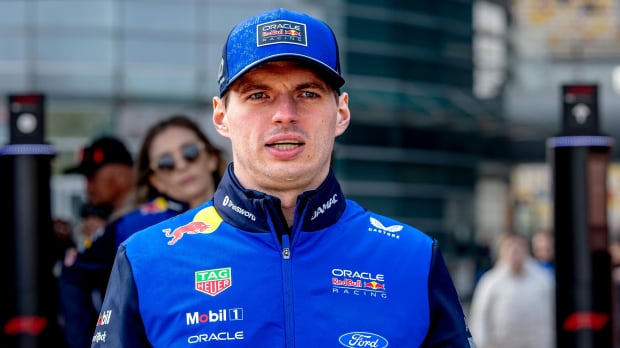

Max Verstappen claims F1 rule changes haven't gone far enough
Max Verstappen delivers his verdict on the F1 rule changes ahead of the Miami Grand Prix

Four-time champion Max Verstappen has opened up about his future in F1 and shared his thoughts on the recent rule changes introduced by the FIA.
The Red Bull star left fans in Japan on tenterhooks when, just before a five‐week spring break, it was reported that he was 'seriously considering' retirement.
Verstappen has been one of the more vocal opponents of the new regulations, which now split power evenly between electric and combustion sources.
The Dutchman has been unhappy that drivers now have to ease off the throttle in corners to recharge their batteries, dubbing the new cars as 'anti-racing' and comparing the sport at times to Mario Kart.
READ MORE: Will Miami GP be cancelled? Lightning threat poses risk to F1 race
Verstappen opens up on F1 future
Speaking to NU.nl in Miami, however, Verstappen provided little updates on his long-term future in F1.
"There’s nothing new to report on that front. I’ve been focusing on other things over the last few weeks, and I’m taking my time to think it over," he explained.
Verstappen also responded to the FIA's tweaks to the rules, although deemed them to be minor.
He added: "I hope that next year we can see more significant changes. It takes more than a few adjustments to get back to full-speed racing."
"Looking ahead, the conversations we’ve had with them were very positive. I also hope that in a few years, even if I’m no longer on the grid, the drivers’ opinions will still count. They seem to have a clear vision of what it takes to make Formula 1 a truly great spectacle."
What are the FIA changes to the F1 rules?
A number of refinements have been agreed between F1, the FIA, teams and the drivers relating to safety, qualifying and race starts.
Qualifying
In a statement, the FIA confirmed that: "Adjustments to energy management parameters, including a reduction in maximum permitted recharge from 8MJ to 7MJ, aimed at reducing excessive harvesting and encouraging more consistent flat-out driving. This change targets a maximum superclip duration reduced to approximately 2-4 seconds per lap.
"Peak superclip power increased to 350 kW, previously being 250kW, further reducing the time spent recharging, and reducing driver workload on energy management. This will also be applied in race conditions.
"The number of events where alternative lower energy limits may apply has been increased from eight to 12 races, allowing greater adaptation to circuit characteristics."
Race
The FIA also responded to concerns following Ollie Bearman's crash at the Japanese GP, and added: "The maximum power available through the Boost in race conditions is now capped at +150 kW (or the car’s current power level at activation if higher) limiting sudden performance differentials.
"MGU-K deployment is maintained at 350 kW in key acceleration zones (from corner exit to braking point, including overtaking zones) but will be limited to 250 kW in other parts of the lap.
"These measures are designed to reduce excessive closing speeds while maintaining overtaking opportunities and overall performance characteristics."
Race starts
On race starts, the FIA wrote: "A new 'low power start detection' system has been developed, capable of identifying cars with abnormally low acceleration shortly after clutch release.
"In such cases, an automatic MGU-K deployment will be triggered to ensure a minimum level of acceleration and mitigate start-related risks without introducing any sporting advantage."
"An associated visual warning system is being introduced, activating flashing lights (rear and lateral) on affected cars to alert following drivers.
"A reset of the energy counter at the start of the formation lap has also been implemented to correct a previously identified system inconsistency."
F1 HEADLINES: Hamilton given Ferrari replacement warning, Wolff's emotional plea




 Grand Prix of Australia 2026
 Grand Prix of China 2026
 Grand Prix of Japan 2026
 Saudi Arabian Grand Prix 2026
 Miami Grand Prix 2026
 Grand Prix du Canada 2026
 Grand Prix De Monaco 2026
 Gran Premio de Barcelona-Catalunya 2026
 Grand Prix of Austria 2026
 Grand Prix of Belgium 2026
 Grand Prix of Hungary 2026
 Grand Prix of Italy 2026
 Grand Prix of Azerbaijan 2026
 Grand Prix of Bahrain 2026
 Grand Prix of Singapore 2026
 Gran Premio de la Ciudad de Mexico 2026
 Grande Prêmio de São Paulo 2026
 Qatar Grand Prix 2026
 Grand Prix of Abu Dhabi 2026