



F1 ruined more than half a century of history with one bone-headed decision
Stupid, patronising and short-sighted
Want to hear something that's stupid, but true? Alex Albon's 2025 points total in F1 would've been enough to finish just three points behind champion Mika Hakkinen in 1999.
That's, notably, despite little details like 'not finishing a single race on the podium', and 'being eighth in the 2025 championship, with seventh place having more than double his points'.
Fortunately, almost every F1 fan knows that Alex Albon wouldn't actually have been caught up in the '99 title battle with Hakkinen and Eddie Irvine. If you used the scoring system from the time, the Williams driver would've amassed a less than princely nine points, rather than 73. That would've put him 11th, which is much more sensible.
That's kind of the problem here.
F1 HEADLINES: F1 teams head to Nurburgring as FIA approve new race
F1 threw away the sport's history with one decision
Obviously nobody's daft enough to sincerely compare those two seasons in isolation. But it does play into the actual thesis of this piece, which is pretty simple.
F1 made a terrible decision to change its points system so dramatically in 2010, and less than two decades on it's helping erase the sport's history.
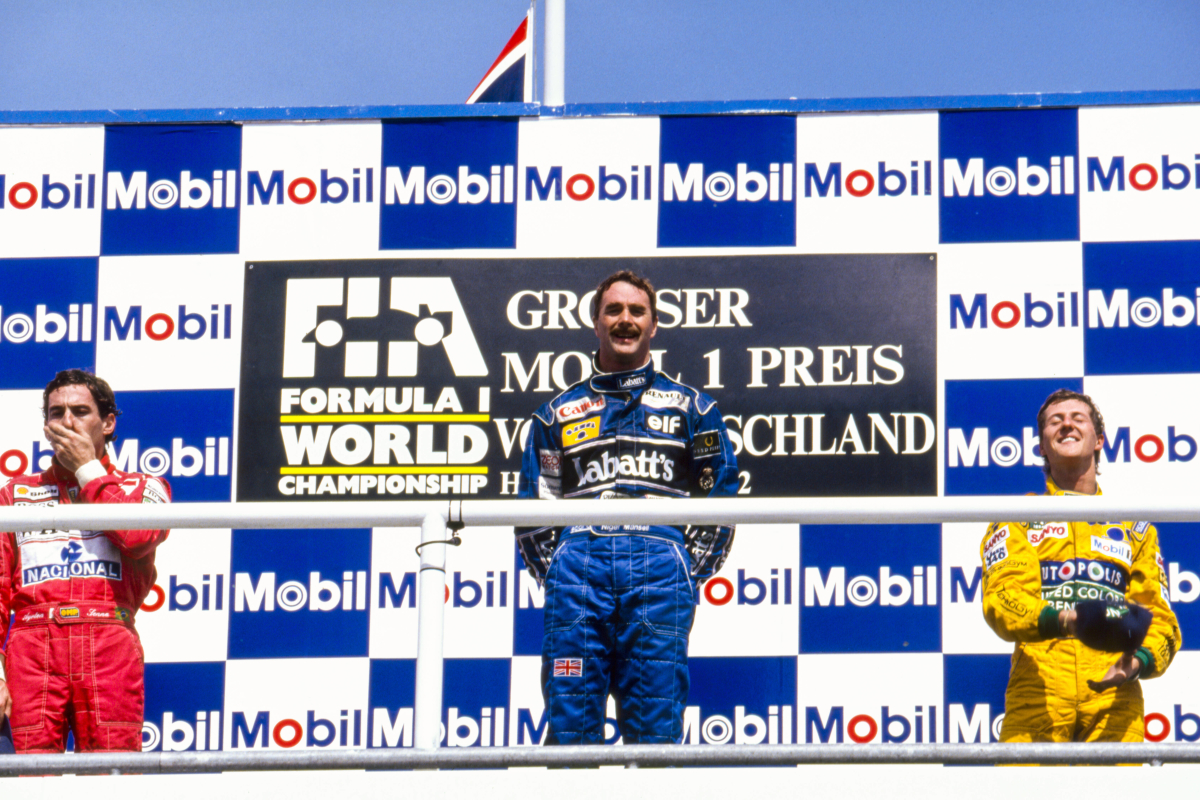
For anyone who hasn't gone back through the archives lately, F1 awarded between eight and 10 points to a race winner for its entire history until 2010. Nine points from 1961 to 1990, and then 10 points from 1991 to 2009. That makes the record books look fairly consistent – Niki Lauda won with 72 points in 1984, Hakkinen won with 76 15 years later, so on and so forth.
There were some slight differences when it came to the 'best X results count' era, but the every era was recognisably similar to those that came before. Lauda and Hakkinen, a treble world champion and a two-time title winner, finished their careers within 0.5 points of each other. Jackie Stewart and Damon Hill both ended their careers on 360 points. You could, in effect, look at the all-time points standings and get a rough idea of how drivers stacked up through F1 history.
Then came the 2010s, and rapid calendar expansion arriving hand-in-hand with the absolutely child-brained 'bigger numbers are better' points system. Those two things in tandem have absolutely broken F1's link to its history.
Historical comparisons are inherently absurd now. Daniel Ricciardo has the 10th most race starts of any driver in the sport's history, and he only drove 11 complete seasons.
Valtteri Bottas has more points than all but five drivers in the history of the sport! If you just looked at the list of title-less drivers and their career points totals without context, you'd be forgiven for thinking he was the unluckiest F1 driver ever! After all, his 1,797 points are 231 more than seven-time world champion Michael Schumacher.
Surely, you'd never expect to find out that the Finn was just a slightly above average driver who happened to come to the sport at exactly the right time in history, when mediocrity was rewarded with outsized points totals because the people who run F1 think that their fans are functional morons who need to see bigger numbers next to their favourite drivers' names to get excited.
It's points...but it's not just points
The calendar expansion is almost as much of an issue, but has a much more simple explanation. The people who run the sport are greedy and want to squeeze every penny out of their asset with TV deals and hosting fees. That, at least, is merely a creeping evil lingering over the sport rather than just being straight-up patronising.
Take Schumacher's career, for example. For most of it, and even stretching back long before it to the early 1970s, F1 seasons held pretty steady at 16 races a year – give or take one more or less here and there.
That started to tick up into the high teens for his final two years at Ferrari and comeback at Mercedes from 2010-12, culminating in him concluding his career with F1's first 20-race season. Schumacher retired less than 15 years ago. That's how recent his career was.
Now consider that, and know that if he'd had the dubious benefit of a 24-race calendar for his whole career, he'd have entered 130 more grands prix. For what it's worth, that works out to nearly 40 extra career wins at the rate he won races.
There are a full 50% more races on the calendar now than there were for the majority F1 history. This isn't how a sport is supposed to work.
Lewis Hamilton has more than eight times as many career points as Ayrton Senna.
This is a sport that has contorted itself so much in the last decade and a half that its historical records are utterly worthless when trying to compare any modern driver to any of its legendary greats.
Some sports have done some of this. There's more Test cricket played now than ever before, so totting up total runs of a modern player and comparing that sum to someone 70 years ago is a fool's errand. However, one run has never stopped being worth one run – so batting average still works as a historic comparison. The link to the past still exists.
F1 has committed the cardinal sin of sporting record-keeping and changed both the volume of competition and the scoring system. The 25 points for a win era is essentially its own separate thing in the history books now, completely disconnected from the 60 years of greatness that came before. That, in its own little way, is a sporting tragedy.
READ MORE: F1 World Champions: The full list from Farina to new king Lando Norris
Related
More F1 news
Latest F1 news



Recommended by the editors
 F1 History
F1 ruined more than half a century of history with one bone-headed decision
 F1 News & Gossip
Lewis Hamilton and Max Verstappen withdraw help from F1 star
 F1 News & Gossip
Aston Martin F1 boss finds Honda 'peace talks' absurd
 Max Verstappen
F1 'doesn't need' Max Verstappen - legend claps back







Races
-
 Grand Prix of Australia 2026
-
 Grand Prix of China 2026
-
 Grand Prix of Japan 2026
-
 Grand Prix of Bahrain 2026
-
 Saudi Arabian Grand Prix 2026
-
 Miami Grand Prix 2026
-
 Grand Prix du Canada 2026
-
 Grand Prix De Monaco 2026
-
 Gran Premio de Barcelona-Catalunya 2026
-
 Grand Prix of Austria 2026
-
 Grand Prix of Great Britain 2026
-
 Grand Prix of Belgium 2026
-
 Grand Prix of Hungary 2026
-
 Dutch Grand Prix 2026
-
 Grand Prix of Italy 2026
-
Gran Premio de España 2026
-
 Grand Prix of Azerbaijan 2026
-
 Grand Prix of Singapore 2026
-
Grand Prix of the United States 2026
-
 Gran Premio de la Ciudad de Mexico 2026
-
 Grande Prêmio de São Paulo 2026
-
Las Vegas Grand Prix 2026
-
 Qatar Grand Prix 2026
-
 Grand Prix of Abu Dhabi 2026
Follow us on your favorite social media channel
Editorial & corporate information

Avenue HQ
10–12 East Parade
Leeds
LS1 2BH
United Kingdom Regional correspondence
View contact page