



FIA storm after Mercedes F1 disqualification verdict
Mercedes appear to have been given a reprieve by the FIA

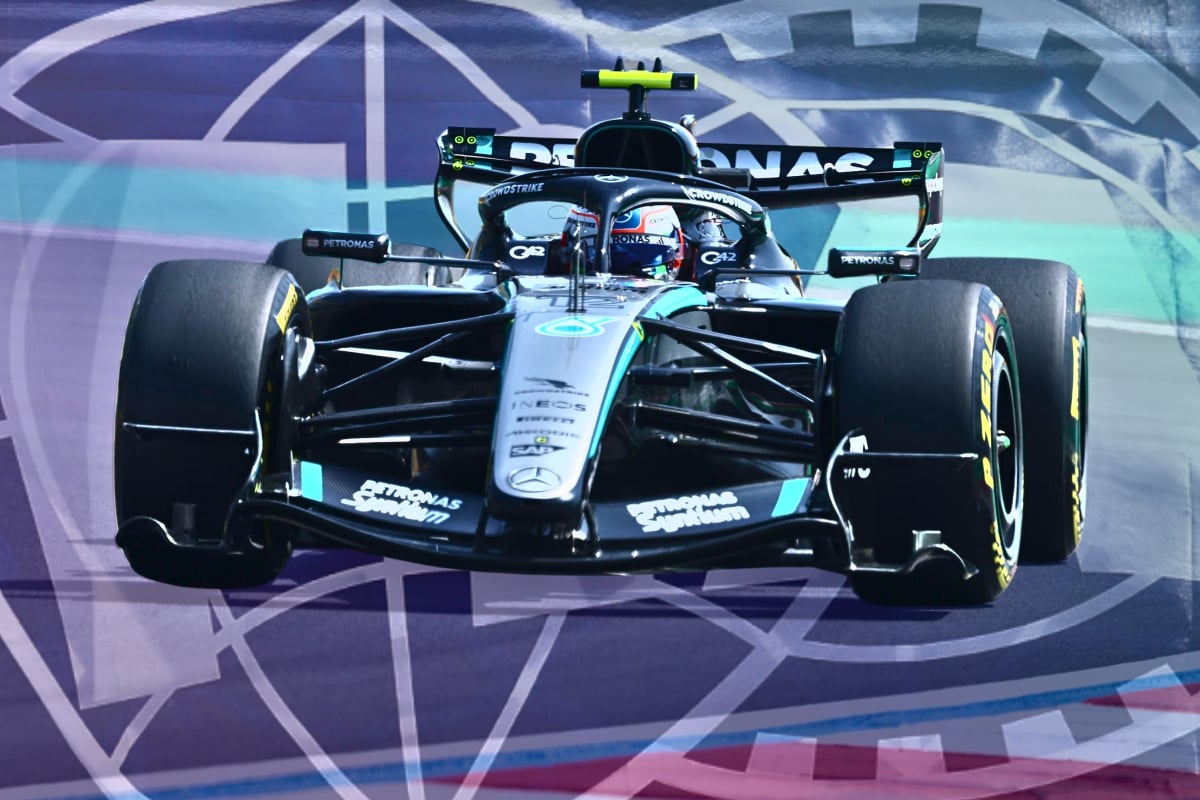
Mercedes admitted ahead of the Japanese Grand Prix that something was amiss with their W17 car after the race in China.
Instead of the team being banned, the FIA accepted their explanation thus allowing Kimi Antonelli to keep his first ever F1 win after leading home team-mate George Russell. It's a decision that could have far-reaching consequences.
The 2026 cars now feature active aerodynamics. Both the front and rear wings can adjust based on the driving mode. In the corners, the wings retract to generate downforce, while on the straights in 'Straight Mode' zones they extend to reduce drag and boost top speeds.
F1 HEADLINES: Max Verstappen kicks out journalist as brutal Aston Martin timeline revealed
Evidence of technical infraction
This season’s regulations run to an astonishing 259 pages, and several rules specifically address active aerodynamics.
Article 3.10.10.o in section C requires that a front wing transition between 'straight' and 'cornering' modes in no more than 400 milliseconds. The same 400-millisecond rule applies to the rear wing under Article 3.11.6.d.
GPFans soon discovered that Mercedes’ front wing took roughly 800 milliseconds to close—a clear breach of the rules.
This delay was especially notable when George Russell raced alongside Ferrari’s Charles Leclerc in turn 29 at the Shanghai International Circuit.
Despite concerns raised by Ferrari and McLaren, and in light of this non-compliance, no penalty was imposed as the F1 circus headed to Suzuka.
FIA satisfied with Mercedes' explanation
In Japan, Mercedes explained that a miscalculation in determining the necessary hydraulic pressure caused the delay in the wing’s movement.
Their hydraulic system, responsible for operating the wing, did not meet the required performance in China. After discussions with the team, the FIA deemed the explanation acceptable.
When every DSQ is just another calculation error
This scenario raises baffling questions. Mercedes openly acknowledged that their car did not fully comply with the technical regulations, yet the FIA chose not to issue a formal warning or disqualification.
Typically, breaking such a rule would lead to disqualification, a norm observed even at the Nurburgring with Verstappen Racing recently. Allowing this 'calculation error' to pass sets a troubling precedent and creates another grey area in the regulations.
Last year, McLaren were given a double disqualification in Las Vegas over worn floor boards, a miscalculation in ride height that rightfully cost Lando Norris and Oscar Piastri their positions. So if minor errors can lead to disqualification there, why is Mercedes getting off lightly?
Recall the 2021 Hungarian Grand Prix: under challenging conditions, Esteban Ocon won while Sebastian Vettel was second. Vettel’s car was later disqualified due to a fuel sampling issue, once again blamed on a so-called 'calculation error.'
In the end, a car is either within the regulations or it isn’t. It’s clear that the Mercedes was on the wrong side in China, making it all the more remarkable that neither Kimi Antonelli’s nor Russell’s cars were disqualified.
GPFans has reached out to the FIA for comment.
READ MORE: Lance Stroll's brutal Aston Martin F1 takedown: 'Worst piece of s*** I’ve ever driven'
Related
More F1 news
Latest F1 news

Recommended by the editors
 Latest F1 News
FIA storm after Mercedes F1 disqualification verdict
 Max Verstappen
F1 champion Max Verstappen reacts after disqualification heartbreak
 Japanese Grand Prix
F1 Practice Today: Japanese Grand Prix 2026 start times, schedule, TV channel and FREE live stream
 Christian Horner
How Adrian Newey and Christian Horner can still work together in F1







Races
-
 Grand Prix of Australia 2026
-
 Grand Prix of China 2026
-
 Grand Prix of Japan 2026
-
 Grand Prix of Bahrain 2026
-
 Saudi Arabian Grand Prix 2026
-
 Miami Grand Prix 2026
-
 Grand Prix du Canada 2026
-
 Grand Prix De Monaco 2026
-
 Gran Premio de Barcelona-Catalunya 2026
-
 Grand Prix of Austria 2026
-
 Grand Prix of Great Britain 2026
-
 Grand Prix of Belgium 2026
-
 Grand Prix of Hungary 2026
-
 Dutch Grand Prix 2026
-
 Grand Prix of Italy 2026
-
Gran Premio de España 2026
-
 Grand Prix of Azerbaijan 2026
-
 Grand Prix of Singapore 2026
-
Grand Prix of the United States 2026
-
 Gran Premio de la Ciudad de Mexico 2026
-
 Grande Prêmio de São Paulo 2026
-
Las Vegas Grand Prix 2026
-
 Qatar Grand Prix 2026
-
 Grand Prix of Abu Dhabi 2026
Follow us on your favorite social media channel
Editorial & corporate information

Avenue HQ
10–12 East Parade
Leeds
LS1 2BH
United Kingdom Regional correspondence
View contact page