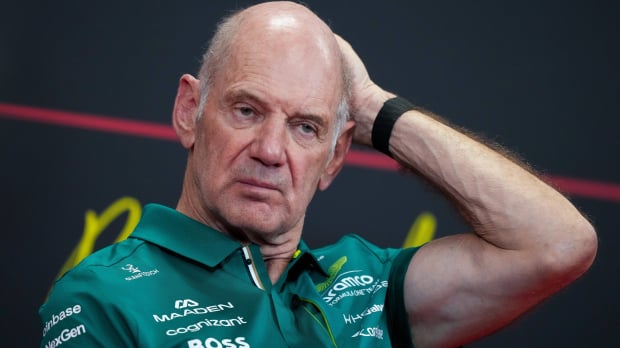

Adrian Newey admits stunning Aston Martin revelation: 'Almost no aerodynamic research'
It's been a difficult season for the team

Adrian Newey has revealed that Aston Martin had conducted almost no aerodynamic research for the new 2026 F1 regulations when he arrived at the team in March 2025.
The sport ushered in a major regulations overhaul for this season, with new rules set in place for both the power units and aerodynamics of the cars.
READ MORE: Ferrari president visits McLaren as rumours grow over new boss for Lewis Hamilton
To stop the big teams with deep pockets from getting a major head start, the FIA banned any wind tunnel testing or CFD (Computational Fluid Dynamics) simulations on any 2026 car models up to a point, ruling that the only testing allowed was using a 'scale model that substantially complies with the 2023, 2024 or 2025 F1 technical regulations'. This ban was in place from December 1, 2023, through to January 1, 2025.
Newey arrived at Aston Martin two months later, but at that stage, he says that the team had conducted next to no aerodynamic research for the 2026 season.
The Aston Martin chief previously revealed that the team did not get a car in the wind tunnel until mid-April, in fact, which he admitted at the time was months behind their rivals, who would have done so as soon as it hit January 1.
F1 HEADLINES: Hamilton Ferrari regret as Elkann visit ramps up Maranello rumour mill
Adrian Newey on high-rake Aston Martin philosophy
After that delay, the season did not start brightly for Aston Martin, with issues on both the aerodynamic and power unit side seeing them struggle greatly.
A huge overhaul to the AMR26 then came at the Hungarian Grand Prix ahead of the summer break, with a host of aerodynamic changes, including backing away from the high-rake approach. Speaking to the media at the US GP, Newey was asked about the team's decision to do so, and how they ended up with that approach in the first place.
"It’s a good observation," Newey explained. "So, when I arrived, it was early March, then, almost no aerodynamic research had been done at that point.
"When you then look at release dates for all the prime parts coming up before the August break, and then bodywork and so forth, wings, etcetera, coming up in, I don’t know, somewhere around November time, then we had a very short, condensed research period.

"I looked at the regulations and felt that it could suit a high-rake solution, which is what we pursued."
Newey says that approach had good points and bad, but the team are happier with the 'middle ground' solution they have now adopted.
"In truth, I think it had some strengths, but it also had some weaknesses," he continued.
"We’ve now come back to what I would call a middle ground, which we feel is quite a good solution."
Aston Martin struggles continue
Despite the change of approach and improvements on the aero side of things, Aston Martin are of course still plagued by their power unit of choice.
The Honda engine has been a real letdown so far this year, and even recent upgrades to it have not remedied the situation.
Lance Stroll even claimed that it was costing the team one second per lap when speaking to the media after Friday's practice sessions at COTA.
"The car's not too bad," Stroll told F1TV after the session. "We're missing a lot of power.
"I think we're losing a second. That's a lot of time."
READ MORE: Jeremy Clarkson slammed for 'completely unacceptable' comments at US Grand Prix




 Grand Prix of Australia 2026
 Grand Prix of China 2026
 Grand Prix of Japan 2026
 Saudi Arabian Grand Prix 2026
 Miami Grand Prix 2026
 Grand Prix du Canada 2026
 Grand Prix De Monaco 2026
 Gran Premio de Barcelona-Catalunya 2026
 Grand Prix of Austria 2026
 Grand Prix of Belgium 2026
 Grand Prix of Hungary 2026
 Grand Prix of Italy 2026
 Grand Prix of Azerbaijan 2026
 Grand Prix of Bahrain 2026
 Grand Prix of Singapore 2026
 Gran Premio de la Ciudad de Mexico 2026
 Grande Prêmio de São Paulo 2026
 Qatar Grand Prix 2026
 Grand Prix of Abu Dhabi 2026