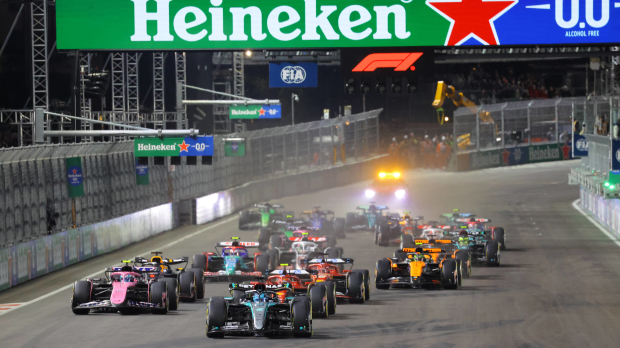

Why F1 Races Can Change in an Instant: The Strategy Behind the Unpredictability
A Formula 1 race can look settled one minute and completely different the next. A driver might have a comfortable lead, the tyres appear to be holding up, and the team has everything under control. Then someone stops on track, the virtual safety car comes out, and suddenly the entire race looks different.
It's one of the reasons F1 is so difficult to predict. Having the fastest car certainly helps, but it doesn't guarantee anything on Sunday afternoon.
A Race Can Be Won or Lost in the Pit Lane
Ask any F1 fan about a frustrating race and there's a good chance they'll mention a questionable pit stop.
Pit Stop Timing and Tyre Strategy
Teams spend hours analysing tyre degradation, track temperatures and potential safety car periods. Formula 1 has even introduced new real-time strategy insights to help fans understand the decisions teams face during a race. Yet even with all that information, the people on the pit wall still have to make their calls in seconds.
Take the undercut. A driver comes in early for fresh tyres, hoping to gain enough time to jump a rival when they eventually stop. It sounds straightforward, but traffic or a poorly timed safety car can ruin the plan.
GPFans has previously explained how the undercut and overcut work in F1, highlighting why the timing of a pit stop can be just as important as outright speed. And sometimes, staying out is the bigger risk.
Why Race Predictions Keep Changing
Consider a driver leading with 15 laps remaining. On paper, they look like the obvious winner. But what happens if their tyres are already struggling while the car behind is closing the gap?
A 70% chance of victory could quickly become 45% after a safety car or an unexpected pit stop. Those percentages are illustrative, but they show how quickly the situation can change.
This is where sports prediction markets offer another perspective on live events. Rather than treating the race result as a fixed expectation, traders can follow changing probabilities as new information becomes available. Platforms such as MagicMarkets, which operates in the space often described as in-game betting markets, bring this probability-based approach to sports trading.
The idea is simple enough: a position reflects a view of what might happen, while its price can change as the event unfolds. Of course, a probability is never a guarantee, particularly in a sport where one mechanical failure can change everything.
The Details That Make F1 So Difficult to Call
It's rarely just one thing that decides an F1 race. Several factors can turn a comfortable lead into a fight for points, sometimes within a single lap.
Weather and Track Conditions
Weather is another major factor. A few drops of rain might seem harmless, but choosing the wrong moment to switch tyres can cost a driver several positions. Conditions can also vary between different parts of the circuit, making the decision even harder.
Safety Cars and Race Interruptions
A safety car can wipe out a driver's hard-earned lead in seconds. It can also give rivals a chance to change tyres while losing less time than they would during a normal racing lap.
Driver Errors and Mechanical Problems
Then there's the human element.
Drivers make mistakes. Teams misjudge tyre life. Engineers sometimes disagree with the person behind the wheel. Even a perfectly planned strategy can fall apart when something unexpected happens. A mechanical failure can end a driver's afternoon regardless of how well the team has prepared.
We've seen plenty of races where the fastest driver didn't finish first. Sometimes the winning move isn't an aggressive overtake at all. It's simply making the right call while everyone else hesitates.
For fans following the race closely, these moments are often more interesting than the final result itself.
The Chequered Flag Is the Only Certainty
Modern F1 teams have access to extraordinary amounts of data, but no simulation can account for every possibility.
That's what makes the sport worth watching. A race that looks predictable after qualifying can become a completely different contest by lap 30. And until the chequered flag falls, there's always a chance that one more twist is waiting around the corner.




 Grand Prix of Australia 2026
 Grand Prix of China 2026
 Grand Prix of Japan 2026
 Saudi Arabian Grand Prix 2026
 Miami Grand Prix 2026
 Grand Prix du Canada 2026
 Grand Prix De Monaco 2026
 Gran Premio de Barcelona-Catalunya 2026
 Grand Prix of Austria 2026
 Grand Prix of Belgium 2026
 Grand Prix of Hungary 2026
 Grand Prix of Italy 2026
 Grand Prix of Azerbaijan 2026
 Grand Prix of Bahrain 2026
 Grand Prix of Singapore 2026
 Gran Premio de la Ciudad de Mexico 2026
 Grande Prêmio de São Paulo 2026
 Qatar Grand Prix 2026
 Grand Prix of Abu Dhabi 2026