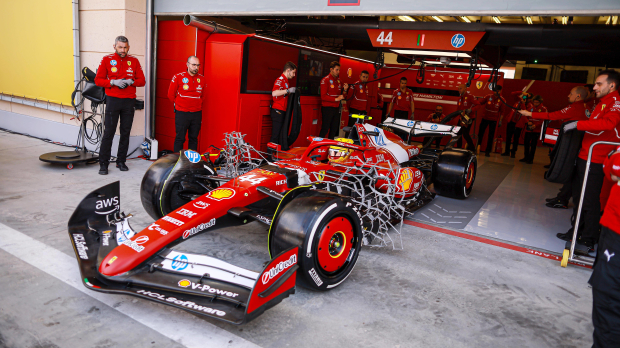

F1 Explained: What are aero rakes?
Iwasa sported rakes on his Red Bull on Friday

Aero rakes are en vogue during F1 pre-season testing, but you will sometimes also see them during free practice sessions at Grand Prix race weekends as well.
Red Bull prodigy Ayumu Iwasa sported rakes on his RB22 on Friday when he replaced four-time world champion Max Verstappen for the first session of the weekend at the Italian Grand Prix.
The rakes definitely stand out visually, but what function do they actually perform? We have the lowdown for you.
F1 HEADLINES: Lewis Hamilton stuns at Monza as Leclerc confirms Ferrari exit talks
What are aero rakes and why are they important?
Aero rakes resemble metal fences that are mounted on the car. The aero rakes consist of sensors that can measure pressure and temperature, for example, but can also measure how the airflow flows from, for example, the tyres or the front wing.
Teams can compare data from the wind tunnel with data from the aero rakes to come up with a better aerodynamic setup for a particular circuit.
This is going to be particularly important this year, with wholesale aerodynamic regulation changes sweeping into the sport which teams have been working on via their factories, wind tunnels and simulators for much of the last year, but have had limited time out on track up till now.
From the data from the aero rakes, teams can see how different settings change the car's performance.
In this way it can be determined whether, for example, the front wing needs to be adjusted a little for more downforce.
Former Ferrari engineer Rob Smedley explained to F1TV during last year's pre-season testing in Bahrain: "[The] information then goes back to the aerodynamics team, and they can then use that data in order to then optimise and improve the upstream flow structure generation.
"The data that comes back from the aero rakes is very quick - it’s almost real time. Teams have developed software that takes the raw data and spits out these really interesting images and video files.
"Some of the stuff, you can act on immediately. So if you’re doing a ‘front wing polar’, for example, which means stepping through from a low angle up to the maximum angle of the front wing, then we’re able to see if that front polar is healthy. Or we can see if there’s a point where the front wing ‘falls over’, as we term it, where we’re not generating the downforce on the front anymore. You might be getting a stall or a semi-stall, and at that point, the information from the aero rakes is telling the race engineers to stay away from that area of running the car.
"Equally, there are sometimes more fundamental things that we pick up from the aero rakes that we can’t solve at the track, and that then goes back to the aerodynamics team and they can deliberate on how to solve these fundamental problems and to put these flow structures in a more optimised position."
READ MORE: Charles Leclerc confirms Ferrari exit talks as F1 star honest about 'other opportunities'
READ MORE: Red Bull have a 'brilliant' new signing but it's 'a massive mistake for Aston Martin'




 Grand Prix of Australia 2026
  Grand Prix of China 2026
  Grand Prix of Japan 2026
  Saudi Arabian Grand Prix 2026
  Miami Grand Prix 2026
  Grand Prix du Canada 2026
  Grand Prix De Monaco 2026
  Gran Premio de Barcelona-Catalunya 2026
  Grand Prix of Austria 2026
  Grand Prix of Belgium 2026
  Grand Prix of Hungary 2026
  Grand Prix of Italy 2026
  Grand Prix of Azerbaijan 2026
  Grand Prix of Bahrain 2026
  Grand Prix of Singapore 2026
  Gran Premio de la Ciudad de Mexico 2026
  Grande Prêmio de São Paulo 2026
  Qatar Grand Prix 2026
  Grand Prix of Abu Dhabi 2026