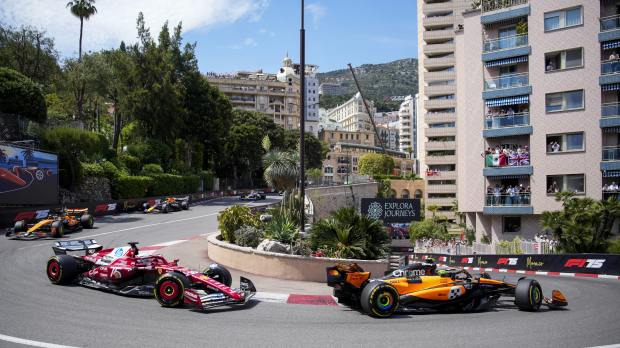

F1 is killing itself as Monaco Grand Prix change highlights huge problem
Another day of F1 nonsense

Have you ever seen Formula 1 in such a state? The racing series which prides itself on being the pinnacle of motorsport now looks such a shadow of its former self.
Sadly F1's demise has been a steady decline which starts all the way back in 2010. A series of small rule changes and gimmicky introductions since then have led us down a path to where the Monaco Grand Prix alterations are so ludicrous, you had to double check if it was April 1.
I'll get to those in a moment but we have to go back to 2010 to understand why this sport has fallen so far.
F1 HEADLINES: FIA rule can stop driver swap, Mercedes battle crosses line
F1's slippery slope
When did F1 ban refuelling?
In 2010 refuelling was banned. Not the end of the world, and probably done with good intention. There were of course safety risks with it. But what we lost was teams having an alternate way to run strategy and the 'gain' of bigger cars to fit bigger fuel tanks. Bigger cars mean longer cars and an increased overtaking difficulty.
To combat this, in 2011 we get DRS and the reintroduction of KERS, the former to improve straight line speed on certain parts of the track at certain times, and the latter given a six-second burst of extra power per lap. F1 is already in gimmick territory.
When did F1 introduce hybrid engines?
In 2014 the last sound of F1 disappears with the V8s and in come the turbo hybrid engines that sound like a vacuum cleaner. Nostalgic searches exponentially increase for Juan Pablo Montoya's 2004 qualifying lap at the Italian Grand Prix with his V10 BMW powered Williams.
As the years go on, so does tyre supplier Pirelli's increased inability to produce a decent rain tyre, to the point that the full wet tyre is never raced in green flag conditions, and that it's not unusual for safety car starts to a race to clear water from the track until its nearly bone dry, to the point drivers need slicks again.
In addition to this, increased spray from cars makes visibility even worse and thus the excitement of a potential wet race is now replaced by a dreaded indefinite delay filled by having to watch Racing Bulls play Red Bull at Connect-4 on Twitter, or some mechanics playing with paper boats in the pitlane.
F1's new controversial rules
After 11 years of F1 and the FIA holding its ears about fans wanting proper engines again, the sport doubles down on its commitment to hybrid technology by running a 50/50 engine. These include push to pass overtake zones creating racing where overtakes result in a driver breezing past another just by having more juice in the battery at the time.... or straight into the back of another driver because of an unexpected speed boost.
These rules are hated so much that the four-time world champion Max Verstappen threatens to quit, and the sport is forced to change so that the balance of engine to electric is 60/40 in the former's favour.
Monaco Grand Prix changes
Except two races into this tweak a situation pops up where the short straights and constant breaking of the Monaco Grand Prix circuit, mean the cars could actually become too overpowered and they have to be slowed down.
So for the Monaco Grand Prix, all engines are going to be clipped so they can only produce a certain amount of power which will be done by an engine mode called Rev 1 according to The Race.
As ever safety is the reason for this as the MGU-K will taper off from its 350kW cap at 200km/h, this is 90km/h down on the standard 'base' mapping.
Now try and explain this to someone who isn't a hardcore F1 fan (and even some hardcore fans). It's more boring than an afternoon with Father Stone.
Ferrari's Charles Leclerc is one the supporters of this saying: “I think Monaco is actually going to be one of those races where these cars might be very good.
“First, we have now lighter cars, which for a track like Monaco, I think this has its benefits.
“The electric side is going to be a lot less big in Monaco, just because we'll be recharging quite a bit with all the corners that there are. So I think, yeah, I'm quite excited for Monaco. I think it should be a good track for these cars.”
If the F1 cars have been designed for tracks like Monaco then the sport has failed. We shouldn't be watching cars superclipping on straights at tracks like Monza, Spa and Silverstone just so we can have ideal car conditions at Monaco (although as proven, too ideal.)
F1 has lost its soul
F1 is in a mess following a build up of decisions that leave it in a sorry state as a spectacle. How can we be having engine rule changes every other race in a sport already riddled with faux racing?
Look at what we have lost. The V10/V8 sound of F1, small nimble cars, exciting 'proper' wet races, variations in pit-stop strategy, genuine overtakes without the need for battery gimmicks, racing that doesn't rely on endless 'modes' to create overtakes, and a stable engine rule that doesn't need changing every week.
F1's appeal to the mainstream has taken away much of the fun and replaced it with complicated nonsense that ironically casual audiences have no interest in as much as many F1 petrolheads.
The kicker here is F1 and Liberty Media continues to profit from the sport which continues to thrive. While some fans may be able to enjoy today's rules and regulations, they really don't know just how good we had it.
F1 chief Stefano Domenicali recently admitted that the sport is looking to go back to V8 engines in the future. It will be the step in the right direction and it cannot come soon enough.
READ MORE: The FIA technicality that stops Cadillac replacing Valtteri Bottas




 Grand Prix of Australia 2026
  Grand Prix of China 2026
  Grand Prix of Japan 2026
  Saudi Arabian Grand Prix 2026
  Miami Grand Prix 2026
  Grand Prix du Canada 2026
  Grand Prix De Monaco 2026
  Gran Premio de Barcelona-Catalunya 2026
  Grand Prix of Austria 2026
  Grand Prix of Belgium 2026
  Grand Prix of Hungary 2026
  Grand Prix of Italy 2026
  Grand Prix of Azerbaijan 2026
  Grand Prix of Bahrain 2026
  Grand Prix of Singapore 2026
  Gran Premio de la Ciudad de Mexico 2026
  Grande Prêmio de São Paulo 2026
  Qatar Grand Prix 2026
  Grand Prix of Abu Dhabi 2026