


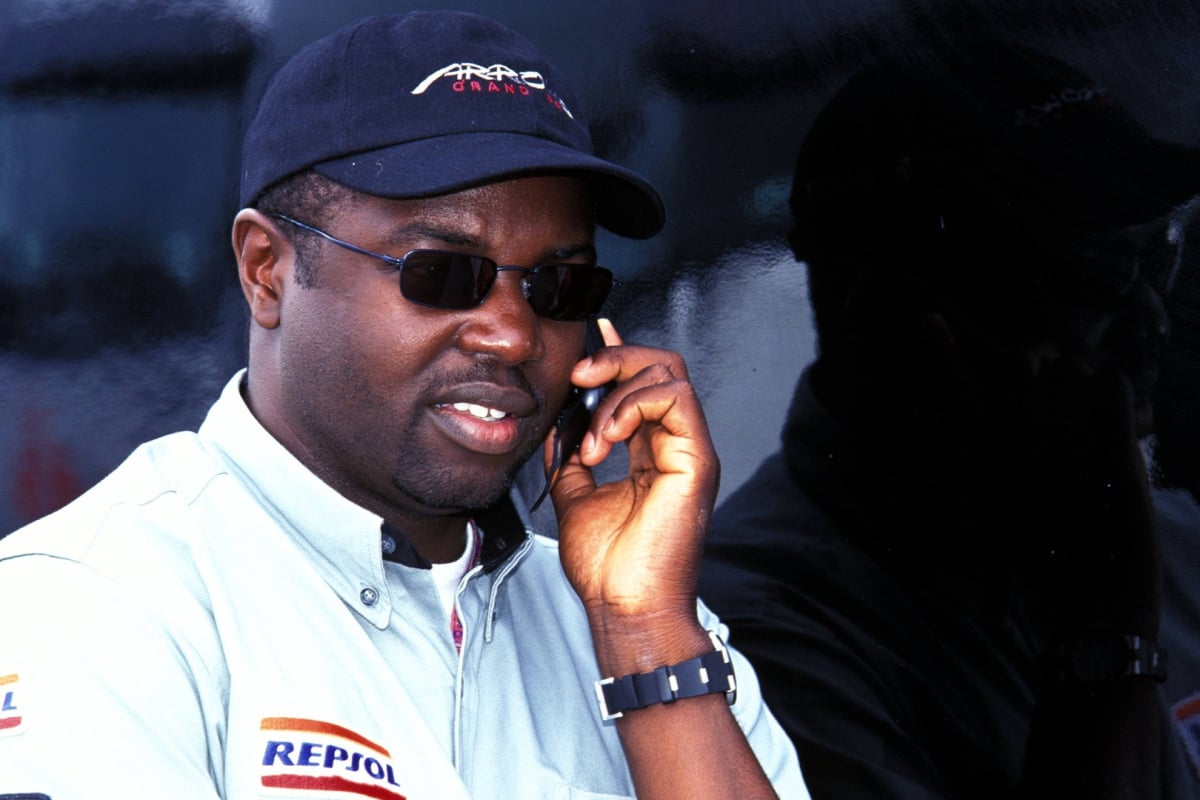

F1 team scammed by Nigerian prince
This might just be the craziest F1 story you've never heard of
In the 76-year history of the F1 championship, there have been some quirky figures and teams, none more so than the tale of a team being scammed by a Nigerian prince.
Arrows is one of those midfield squads who have become a cult favourite since their F1 exit, and much like Minardi and Jordan, the outfit competed in the premier class of motorsport for almost 25 years.
But, things took a sudden downturn starting in 1999. And it can all be traced back to a certain Nigerian prince.
How the Arrows story began
Arrows Grand Prix International was founded in November 1977 by Italian businessman Franco Ambrosio; former F1 drivers Alan Rees and Jackie Oliver; designer Dave Wass; and technical director Tony Southgate.
The first letters of their surnames formed 'AROWS', giving birth to the team, and less than three months later, on January 29, 1978, Riccardo Patrese took to the grid at the Brazilian Grand Prix as their first driver.
The FA1 car they introduced was essentially a copy of the Shadow DN9. Southgate had designed it as an advisor for Shadow, not as an employee, so he believed he owned the rights. However, halfway through the season the London High Court banned the FA1. Fortunately, Wass’ self-designed A1 arrived just in time, saving Arrows from missing any races in their debut season.
F1 HEADLINES: McLaren want Red Bull contract halted, Verstappen calls the shots
A positive start on track
With the legal battle behind them, Arrows quickly focused on earning points. Patrese impressed with podium finishes at the 1978 Swedish Grand Prix, the 1980 United States West, and the 1981 San Marino GP.
A further podium came in Brazil in 1981, along with a pole position at Long Beach’s street circuit. After years with the sturdy Ford Cosworth DFV-V8, Arrows switched in 1984 to a deal with BMW and their turbocharged four-cylinder engine. Thierry Boutsen took second place at Imola the following year.
The 1988 season proved to be their best, as Eddie Cheever and Derek Warwick accumulated 23 points, Cheever’s third at Monza contributing to a sixth-place finish in the constructors’ standings.
The team smoothly transitioned from BMW turbos back to naturally aspirated Ford Cosworth engines, finishing seventh in 1989 after Cheever scored a podium in his home race at the Phoenix street circuit.
Footwork swoops in for 1990 takeover
Japanese logistics company Footwork Express began sponsoring Arrows in 1990, and just a year later, took over the team entirely.
They signed a deal with Porsche, but the German V12 was both slow and unreliable. After just six races, the team reverted to the Ford Cosworth-V8, yet results remained elusive.
With strong Japanese connections, Arrows signed Mugen-Honda as their engine supplier for 1992, and Michele Alboreto along with the returning Warwick managed to pick up valuable points.
From 1995, Footwork switched to the Hart V8 built by British engineer Brian Hart. Gianni Morbidelli even secured a podium in the season finale in Adelaide. In 1996, Jos Verstappen (father of the now four-time F1 champion Max Verstappen) was signed and scored the team’s only point in Argentina.
Early that year, touring car champion Tom Walkinshaw—who had also been Benetton’s engineering director when Michael Schumacher nabbed his first two world titles—took over shares from Rees.
Walkinshaw held 40 per cent, his partner Peter Dambrough 11 per cent, while Oliver retained the remaining 49 per cent. The Footwork name eventually faded, and by 1997, the team reclaimed the Arrows moniker.
Arrows missed the mark
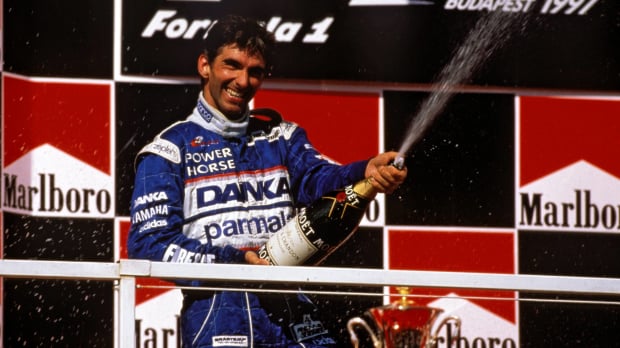
Defending World Champion Damon Hill left Williams after 1996 and with not much choice over his next team, took a seat at Arrows for 1997, now powered by the Yamaha V10.
Walkinshaw had grand plans to turn Arrows into championship contenders. To cover Hill’s hefty salary, Pedro Diniz was hired as the second driver and his father owned the thriving Brazilian supermarket chain Pao de Acucar.
At the Hungarian Grand Prix, Hill appeared poised for a sensational win until a hydraulic problem in the final lap cost him speed, allowing Jacques Villeneuve to overtake him. That second-place finish turned out to be Arrows’ final podium.
Hill then moved to Jordan, and in 1998 with Diniz and Mika Salo, Arrows finished seventh in the constructors’ standings. Legendary designer John Barnard left after a dispute with Walkinshaw, whose financial troubles mounted, and a planned $40 million share sale to Zakspeed fell through.
Arrows even acquired engine manufacturer Hart to become their own supplier, a move that came at a steep cost. Later, Diniz took his supermarket money to Sauber, leading Arrows to sue him - though they lost the case.
Enter a Nigerian Prince
In 1999, Pedro de la Rosa secured a seat with Arrows thanks to funding from oil giant Repsol, while Toranosuke Takagi joined with backing from auto parts manufacturer PIAA.
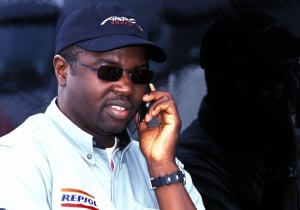
Still, their support wasn’t enough to guarantee the team’s future. Enter Malik Ado-Ibrahim, a Nigerian businessman claiming royal blood, who promised a $125 million investment (the equivalent of nearly $240 million today).
This would allow Oliver, who still owned 49 per cent of the team, to be bought out. Walkinshaw and Ado-Ibrahim would share 55 per cent, with banking giants Morgan Grenfell acquiring the remaining 45 per cent. An investment bank was even engaged to facilitate the Nigerian prince’s funds.
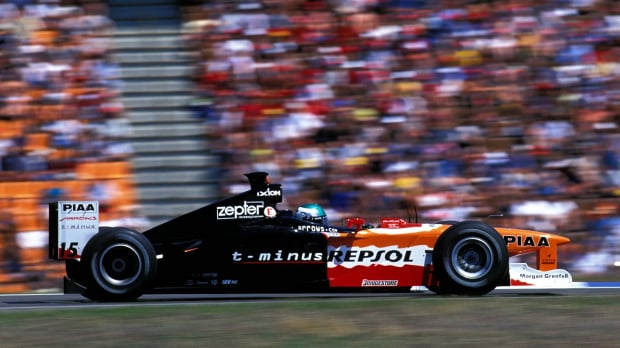
Once the deal was finalised, the sponsor 'T-Minus' appeared on the Arrows A20. The idea was to raise money through energy drink sales and partnerships with luxury automotive and fashion brands. In reality, no one was lining up for a counterfeit Nigerian Lamborghini. T-Minus turned out to be nothing more than an empty promise and the plan to essentially build an empire off the back of an energy drinks brand was scrapped (until Red Bull came along of course).
The Nigerian Prince does an Irish goodbye
The 1999 season turned out to be one of Arrows’ worst.
De la Rosa managed to pick up a point with a sixth-place finish in the season opener in Australia, and Takagi ended up seventh, thanks largely to numerous retirements.
Only eight of the 22 drivers managed to finish, a stark contrast to Michael Schumacher’s Ferrari carving out an eighth-place finish despite setbacks including a puncture, a broken front wing, and steering issues.
The Arrows drivers struggled for the rest of the season, often proving slower than those in Minardi and BAR.
The Prince does a vanishing act
And what about the Nigerian prince? In the latter half of the season, Ado-Ibrahim vanished from the F1 paddock.
An Arrows employee later revealed: "The T-Minus brand never transferred a dime throughout the season” and that it was "merely a pipe dream concocted by the prince."
The Morgan Grenfell bank had to lend a significant sum to keep Arrows afloat, which only added to the mounting debts.
The T-Minus stickers remained visible until the European Grand Prix at the Nurburgring, when Dutch software company Baan stepped in as sponsor for the final races in Malaysia and Japan.
Communication issues compounded and Takagi, who spoke no English, found it hard to connect with the British engineers.
Although Dutch driver Tom Coronel tested for a 2000 seat, eventually Jos Verstappen replaced Takagi. The unreliable A20 was converted into the Arrows AX3 three-seater. Meanwhile, Ado-Ibrahim reinvented himself as the CEO of Nigus Enfinity, venturing into electric cars and even unsuccessfully running for Nigeria’s presidency in 2023.
Jos Verstappen secures Arrows F1 point
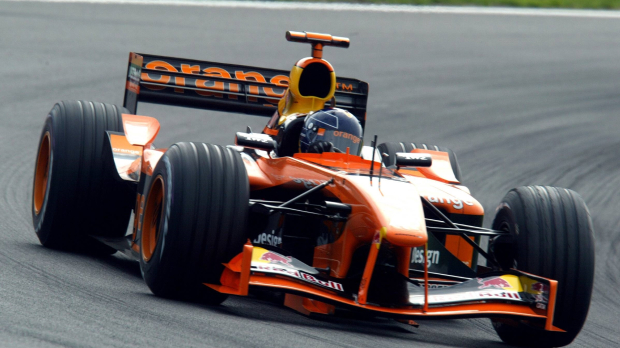
Starting in 2000, Arrows received support from French telecom giant Orange and scrapped their in-house engine program.
Instead, they turned to Supertec, a Dutch company that prepared older Renault engines for F1. Surprisingly, this power unit provided impressive straight-line speed, netting the team a handful of points.
Arrows finished seventh in the constructors’ standings with seven points. Verstappen achieved a fifth-place finish in Canada and narrowly missed a podium in Italy by seven seconds, while de la Rosa recorded two sixth-place finishes at the Nurburgring and Hockenheim.
When Renault Sport took over Supertec to focus on their own team for 2002, Arrows switched for 2001 to Asiatech – a power unit taken over from Peugeot – which proved uncompetitive.
Verstappen managed the team’s only point that season with a sixth-place finish in Austria. In a dramatic, rain-soaked Malaysian Grand Prix, he battled with Mika Hakkinen, Michael Schumacher, and Jarno Trulli before eventually slipping back to seventh.
Arrows bids farewell to F1
Behind the scenes, matters worsened for Arrows.
Paul Stoddart was expected to inject funds with his airline, European Aviation, but he later opted to invest in Minardi instead.
Meanwhile, Eurobet - a sponsor owned by investment bank Morgan Grenfell - suffered significant losses, leaving Arrows without crucial support.
Red Bull stepped in with a deal to invest more money on the condition that Enrique Bernoldi earned a 2001 seat. However, Bernoldi failed to score any points.
The Cosworth-powered A23 would be the last F1 car built by Arrows. Designed for Verstappen, who even had a contract for 2002, he was replaced at the last minute by Heinz-Harald Frentzen due to better sponsorship money.
That year marked Arrows’ final season in F1. Along with an ongoing lawsuit from Diniz, Arrows even faced legal action from Verstappen over a breach of contract.
Though the A23 wasn’t the slowest car on the grid and Frentzen did manage to score two points, the mounting debts sealed Arrows’ fate.
The German Grand Prix, the 12th of 17 races in 2002, became the team's final outing. At the preceding Magny-Cours event in France, Bernoldi and Frentzen even deliberately set slow qualifying laps to conserve resources, but it wasn’t enough to finish the season.
Both Craig Pollock of BAR and Dietrich Mateschitz of Red Bull attempted a takeover, yet Walkinshaw’s asking price was simply too high.
Eventually, Stoddart bought the intellectual rights to the A23 and used them as inspiration for his Minardi PS04B in 2004.
Two years later, Super Aguri acquired the remaining Arrows A23 chassis and rebranded them as the Super Aguri SA05 for the first half of the 2006 F1 season. Unfortunately, Super Aguri didn’t last long in F1 either and declared bankruptcy after just four races in 2008.
READ MORE: Ferrari made one 'big mistake' with Hamilton F1 signing
Related
More F1 news
Latest F1 news
Recommended by the editors







Races
-
 Grand Prix of Australia 2026
-
 Grand Prix of China 2026
-
 Grand Prix of Japan 2026
-
 Grand Prix of Bahrain 2026
-
 Saudi Arabian Grand Prix 2026
-
 Miami Grand Prix 2026
-
 Grand Prix du Canada 2026
-
 Grand Prix De Monaco 2026
-
 Gran Premio de Barcelona-Catalunya 2026
-
 Grand Prix of Austria 2026
-
 Grand Prix of Great Britain 2026
-
 Grand Prix of Belgium 2026
-
 Grand Prix of Hungary 2026
-
 Dutch Grand Prix 2026
-
 Grand Prix of Italy 2026
-
Gran Premio de España 2026
-
 Grand Prix of Azerbaijan 2026
-
 Grand Prix of Singapore 2026
-
Grand Prix of the United States 2026
-
 Gran Premio de la Ciudad de Mexico 2026
-
 Grande Prêmio de São Paulo 2026
-
Las Vegas Grand Prix 2026
-
 Qatar Grand Prix 2026
-
 Grand Prix of Abu Dhabi 2026
Follow us on your favorite social media channel
Editorial & corporate information

Avenue HQ
10–12 East Parade
Leeds
LS1 2BH
United Kingdom Regional correspondence
View contact page