



F1 Explained: What is turbo lag?
A problem from F1 past has returned

Concerns are emerging over one new facet of the 2026 F1 cars that could cause problems for teams on the grid - a turbo lag.
One of the major changes brought by the 2026 regulations is that the electric power from the battery will provide half of the total output, generated via the MGU-K.
Elsewhere in the 2026 power unit, the MGU-H has been removed due to its complexity and expense, but its removal has delivered a negative consequence.
The MGU-H not only stored additional electrical power but as its own electric motor, it solved the problem of turbo lag, which could once again become an issue in 2026.
What is turbo lag on F1 cars?
A turbo lag describes the delay between pressing the accelerator and receiving the extra power from the turbo, unable to spin quickly enough to provide an instant boost.
The turbine needs extra time to reach high revs because of insufficient exhaust energy to accelerate the turbines to provide the required pressure for the boost.
This can result in poor throttle response in corners, followed by an instant increase in power and acceleration on straights. With the MGU-H, drivers didn't have to worry because the turbine remained at high revs when they braked or lifted off the throttle, but without it in 2026 it could be an issue.
F1 cars in the 1980s suffered especially with this, but were eventually outlawed in 1989 because turbocharged engines were deemed too powerful, dangerous and expensive.
F1 2026 Regulations: What is straight mode?
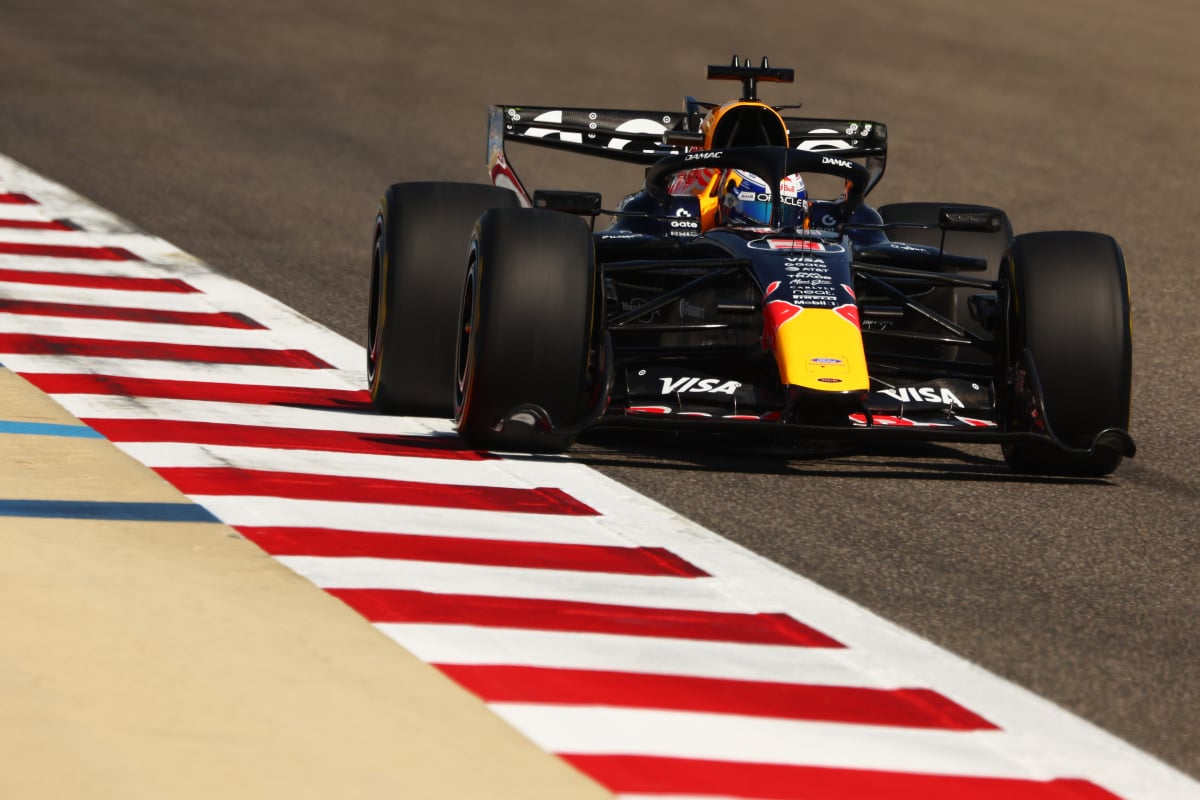
Turbo lag could be a problem for Red Bull
Red Bull are one team said to be struggling with a turbo lag problem, and it has been reported that the lag was responsible for Isack Hadjar's crash during the Barcelona shakedown.
Delivering his overview of the 2026 regulations to BBC Sport, Norris prophesised the return of the turbo lag, and said: "The biggest challenge is how you can recover the batteries as well as possible, and that's when it comes down to using the gears, hitting the right revs.
"Obviously, you've got some turbo lag now, which we've never really had before. All of these little things have crept back in, but I don't think that changes too much.
"In a perfect world, I probably wouldn't have [all] that in a race car, but it's just F1. Sometimes you have these different challenges."
When does the 2026 F1 season start?
The 2026 F1 season isn't faraway now, and will get underway on March 6 for the Australian Grand Prix in Melbourne.
Lights out for Australian GP on Sunday, March 8, is at 3pm local time (AEDT), 4am GMT, and 11pm ET.
F1 Engine Compression Ratio: What is it and why is it so controversial?
Related
More F1 news
Latest F1 news





Recommended by the editors
 Nurburgring
Nurburgring LIVE: NLS3 schedule, times and FREE live stream after Max Verstappen mania
 Adrian Newey
Adrian Newey ‘wasting talent’ at Aston Martin
 GT World Challenge Europe
Lance Stroll GT3: How to watch Aston Martin F1 star in action at Paul Ricard for FREE
 FIA News
FIA reveals deadline for F1 2026 regulation 'tweaks'







Races
-
 Grand Prix of Australia 2026
-
 Grand Prix of China 2026
-
 Grand Prix of Japan 2026
-
 Grand Prix of Bahrain 2026
-
 Saudi Arabian Grand Prix 2026
-
 Miami Grand Prix 2026
-
 Grand Prix du Canada 2026
-
 Grand Prix De Monaco 2026
-
 Gran Premio de Barcelona-Catalunya 2026
-
 Grand Prix of Austria 2026
-
 Grand Prix of Great Britain 2026
-
 Grand Prix of Belgium 2026
-
 Grand Prix of Hungary 2026
-
 Dutch Grand Prix 2026
-
 Grand Prix of Italy 2026
-
Gran Premio de España 2026
-
 Grand Prix of Azerbaijan 2026
-
 Grand Prix of Singapore 2026
-
Grand Prix of the United States 2026
-
 Gran Premio de la Ciudad de Mexico 2026
-
 Grande Prêmio de São Paulo 2026
-
Las Vegas Grand Prix 2026
-
 Qatar Grand Prix 2026
-
 Grand Prix of Abu Dhabi 2026
Follow us on your favorite social media channel
Editorial & corporate information

Avenue HQ
10–12 East Parade
Leeds
LS1 2BH
United Kingdom Regional correspondence
View contact page