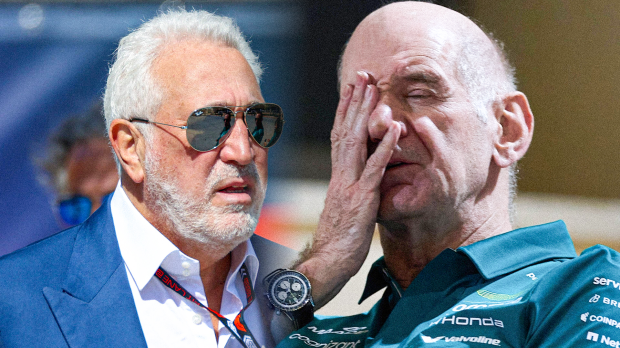

Adrian Newey has built an Aston Martin rocketship - but there is one huge problem
Stunning data must be maddening for Aston Martin

Extraordinary GPS data has revealed the staggering extent of Honda's power unit struggles at Aston Martin, suggesting Fernando Alonso could have been fighting for pole position with a more competitive engine.
Analysis from respected F1 journalist Mark Hughes indicates that Alonso lost more time to Max Verstappen on the straights at Sepang than the total gap between their qualifying laps, highlighting the massive potential of Adrian Newey's AMR26 chassis.
Aston Martin have struggled throughout 2026, and the expensively-assembled squad headed by design genius Newey sit 10th in the Constructors' standings with just seven points to show for their efforts.
Those grim numbers come despite the massive Newey upgrades to the AMR26 chassis which have at least allowed the brilliantly ageless Alonso to score points in recent races - notably a sensational P8 at the Bahrain Grand Prix in Malaysia.
WATCH LIVE: Max Verstappen in GT World Challenge at Portimao today
Aston Martin have a Honda power struggle
The real issue for Aston Martin is that Honda power unit, with year one of their engine partnership continuing to prove both embarrassing and maddening.
Even before the start of the season, Newey revealed that the power unit gave off vibrations so bad that drivers Alonso and Lance Stroll risked permanent nerve damage.
Those bad vibrations are gone, but they have hardly been replaced by good vibrations, with driveability and sheer lack of pace leaving the likes of Alonso massively frustrated by the lack of progress.
The optimism that came out of Sepang was replaced by more misery in Singapore, with Alonso asking for his power unit to be replaced due to a broken turbo, a diagnosis which was contradicted by Honda.
Stunning F1 data reveals Aston Martin's hidden potential
Now the new data revealed by Hughes - writing for The Race - appears to highlight the vast chasm of performance between chassis and power unit.
The GPS data suggests that Aston would have been fighting for pole positions at the last two races had they enjoyed power parity.
Hughes writes: "The following is quite a reductive stat but a significant one. Comparing Max Verstappen's pole time at Sepang to Fernando Alonso's 12th-fastest time, the Aston Martin driver is 2.090s behind despite having surrendered 2.238s to the Red Bull on the full-throttle parts of the lap. The inference is that with power parity Alonso could've been on pole by a tenth and a half.
"What is even more eye-opening is that despite the huge disappointment of Singapore, where Alonso went out in Q1 convinced the turbo was broken, the car's corner performance was even more competitive than at Sepang."
So the conclusions appear both clear and grim. While Newey appears to have done exactly what Aston Martin paid him to do - design a chassis with genuine front-running potential - the Honda power unit is still way off the pace.
The signs from Japan are not promising
Earlier this week Spanish insider Antonio Lobato said that billionaire team owner Lawrence Stroll "must be climbing the walls" at the lack of progress from Honda, amid reports the Canadian was en route to Sakura for high-level talks.
The reports coming out of Japan right now do not exactly hint at massive improvements on the way either. Former Honda exec Yasuaki Asaki believes recent leadership changes do not bode well for the Aston Martin project.
He claimed: "My guess is that, within Honda, while discussing what would happen if they continued development under the conventional system, they got a clear picture of what the PU would look like in 2027, and concluded that at the current development speed, they would never be able to catch up with their rivals, and that something had to be done."
The figures make for extraordinary reading, and while Hughes sounds a note of caution that the data does not tell us everything, they do raise the very question he himself later asked on social media: "Just how bad can that Honda be?"
READ MORE: Christian Horner makes bombshell Masi Abu Dhabi 2021 admission




 Grand Prix of Australia 2026
  Grand Prix of China 2026
  Grand Prix of Japan 2026
  Saudi Arabian Grand Prix 2026
  Miami Grand Prix 2026
  Grand Prix du Canada 2026
  Grand Prix De Monaco 2026
  Gran Premio de Barcelona-Catalunya 2026
  Grand Prix of Austria 2026
  Grand Prix of Belgium 2026
  Grand Prix of Hungary 2026
  Grand Prix of Italy 2026
  Grand Prix of Azerbaijan 2026
  Grand Prix of Bahrain 2026
  Grand Prix of Singapore 2026
  Gran Premio de la Ciudad de Mexico 2026
  Grande Prêmio de São Paulo 2026
  Qatar Grand Prix 2026
  Grand Prix of Abu Dhabi 2026