




How F1 Creates 35-Place Penalties
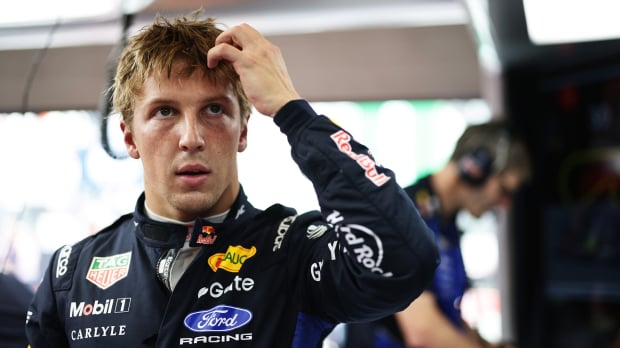
Liam Lawson qualified 14th at Monza, then picked up a 35-place grid penalty.
With only 22 cars on the grid, the number looked strange even by Formula 1 standards.
Lawson was never going to start 49th. The figure came from several separate power-unit penalties being added together before the grid was set.
Five component changes built the total
Lawson went beyond his season allocation on several power-unit elements during the Italian Grand Prix weekend.
The FIA applied each one separately:
- Internal Combustion Engine: 5 places
- Turbocharger: 5 places
- Exhaust: 5 places
- MGU-K: 10 places
- Power Unit Ancillary Component: 10 places
Add them together and you get 35.
The final grid doesn’t keep counting backwards forever, though. Once the accumulated penalty goes beyond 15 places, the driver is moved to the back under the current regulations. The Italian Grand Prix hub shows how crowded the penalty list became at Monza, with several drivers carrying grid drops into the race.
A 35-place penalty doesn’t mean 35 actual positions
This is where the wording can be misleading.
The FIA still records every individual offence, even after a driver has already crossed the threshold that sends them to the back.
So a driver can officially receive 20, 30 or 35 places while the practical punishment is much simpler.
Once Lawson had more than 15 places to serve, he was heading to the rear of the field anyway.
His weekend changed again later. Red Bull altered the rear wing after qualifying, which meant Lawson ultimately started from the pit lane rather than taking up a normal grid position.
Qualifying matters
A huge penalty doesn’t automatically turn qualifying into a wasted session.
Several penalised drivers can be involved at once, which changes how the back of the grid is ordered. Monza had plenty of that.
Kimi Antonelli carried a 30-place penalty and Alex Albon had 20 places to serve. With multiple cars being moved, the final starting order looked very different from the qualifying classification.
Teams also still want useful running before Sunday. Qualifying gives them another chance to understand the car on low fuel and see where the pace sits before race strategy takes over.
Penalties can change expectations after Saturday
A grid penalty confirmed after qualifying can completely alter how a driver’s race looks.
Someone who appeared to have a strong starting position can suddenly be facing traffic from the rear. That affects overtaking requirements, tyre strategy and the amount of risk needed early in the race.
The same new information also feeds into prediction markets. CBS Sports’ coverage of the polymarket sign up bonus also explains how Polymarket contracts work, with prices moving as traders react to new information.
In F1, a confirmed engine penalty is exactly the kind of update that can change expectations once qualifying is already over.
Power-unit limits are what create these penalties
Formula 1 restricts the number of major power-unit components a driver can use across the season.
Once that allocation is exceeded, additional parts bring grid penalties.
Formula 1’s guide to power-unit penalties explains that the first extra component of a particular type can carry a 10-place drop, while later excess parts generally bring five places.
Change several components during the same weekend and the total climbs quickly.
That’s what happened with Lawson at Monza. The 35 places weren’t one enormous punishment handed down for a single offence. They were several penalties stacked together.
The number tells you how it was built
Once a penalty passes 15 places, the actual grid consequence stops matching the headline figure.
The FIA still needs to record which components went beyond the allocation and what penalty each one carried. That is why numbers bigger than the entire grid continue to appear.
Lawson’s 35-place drop looked absurd at first glance, but the calculation itself was straightforward.
Five component penalties were added together. The grid rules then decided where he could actually start.
Related
More F1 news
Latest F1 news


Recommended by the editors
 F1 News & Gossip
Aston Martin 'approach made' for shock Charles Leclerc swoop from Ferrari
 F1 2027
F1 2027 Grid with six seats still open and one massive question mark
 Aston Martin
Aston Martin to unleash one last upgrade that will 'dramatically improve' F1 lap times
 F1 News & Gossip
Lewis Hamilton 'certain' to be hit with F1 penalty in new Ferrari blow







Races
-
 Grand Prix of Australia 2026
-
 Grand Prix of China 2026
-
 Grand Prix of Japan 2026
-
 Saudi Arabian Grand Prix 2026
-
 Miami Grand Prix 2026
-
 Grand Prix du Canada 2026
-
 Grand Prix De Monaco 2026
-
 Gran Premio de Barcelona-Catalunya 2026
-
 Grand Prix of Austria 2026
-
 Grand Prix of Great Britain 2026
-
 Grand Prix of Belgium 2026
-
 Grand Prix of Hungary 2026
-
 Dutch Grand Prix 2026
-
 Grand Prix of Italy 2026
-
Gran Premio de España 2026
-
 Grand Prix of Azerbaijan 2026
-
 Grand Prix of Bahrain 2026
-
 Grand Prix of Singapore 2026
-
Grand Prix of the United States 2026
-
 Gran Premio de la Ciudad de Mexico 2026
-
 Grande Prêmio de São Paulo 2026
-
Las Vegas Grand Prix 2026
-
 Qatar Grand Prix 2026
-
 Grand Prix of Abu Dhabi 2026
Follow us on your favorite social media channel
Editorial & corporate information

Avenue HQ
10–12 East Parade
Leeds
LS1 2BH
United Kingdom Regional correspondence
View contact page