


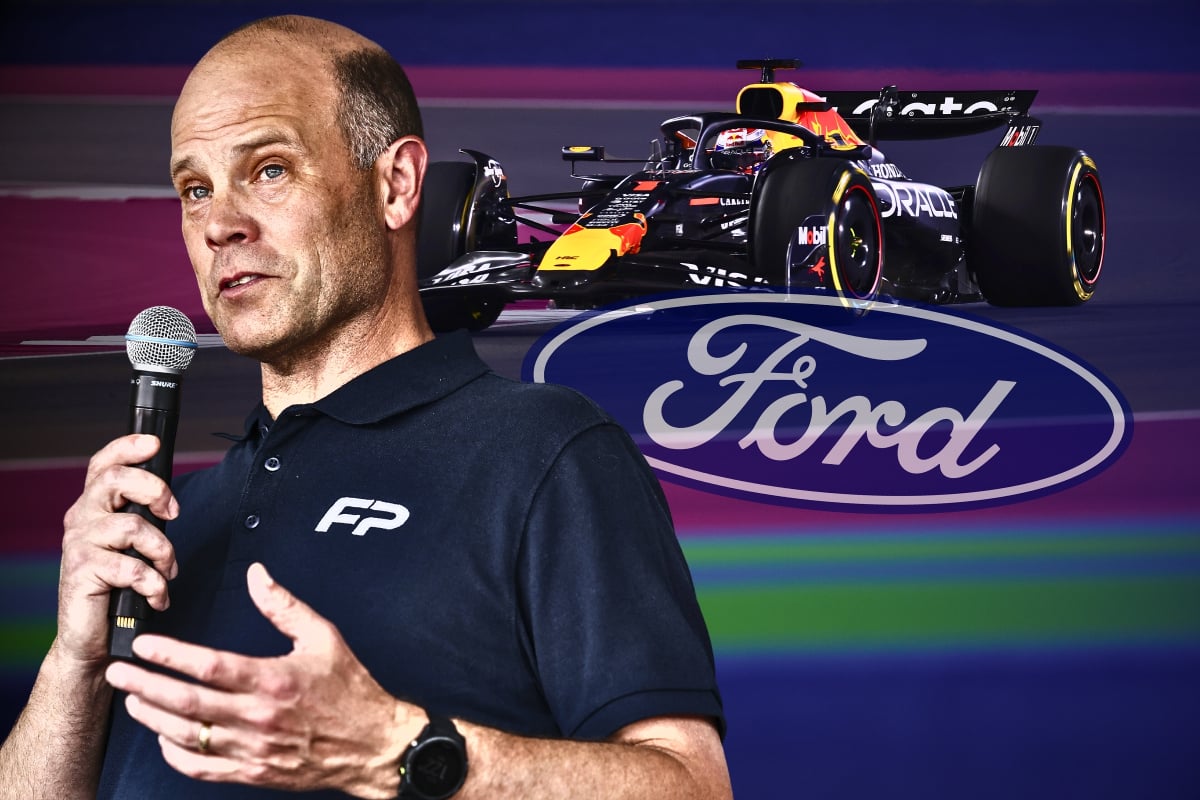


Ford admits Red Bull F1 engine change of plan
Ford are helping Red Bull with their new power unit project

Ford Motorsport global director Mark Rushbrook has suggested that there has been a change of plan in terms of the car manufacturer's role in the construction of Red Bull F1's power unit.
Red Bull Powertrains has been set up for the 2026 season onwards, meaning Red Bull are creating their own power units in conjunction with Ford.
It has meant ditching the highly successful partnership that they had with Honda between 2018-2025, a move that was confirmed back in 2021.
The move signals a new era for Red Bull, who are also now being guided by a new team principal in Laurent Mekies after the Frenchman took over the role from Christian Horner, who had been with the Milton Keynes-based outfit since 2005.
Now, Rushbrook has explained the role that Ford have played in the construction of Red Bull's 2026 power unit, suggesting that they have taken on board more responsibility than had been first planned.
"The original list was focused on the electrification part of it: the battery cell, the motor, the inverter, the software, and the calibration board," Rusbrook told Autosport. "That was primarily the list, and that has certainly been delivered.
"But what we didn't expect, and what wasn't a priority for us initially, was the combustion engine. That changed during the programme, especially as our road car cycle plan has changed.
"On our road car cycle plans, we will continue to have ICE, full hybrid, and full electric. So, it became increasingly important for us to be part of the combustion engine development as well.
"As we were working on the electric part of it, and we saw what was going on with the combustion engine, we saw an opportunity to participate and contribute. A lot of the actual parts that are being made in Dearborn now are on the combustion engine side of the power unit. Those parts are being made daily and shipped daily.
"It wasn't necessarily that things were lacking, but as you have the technical minds together, and they're working on certain things, they overhear or get asked questions. What would Ford do in this situation? And that's where we were able to say, we can actually help, and we have been able to contribute to that part."
What are F1's new power unit regulations?
F1 engines will remain a 1.6-litre V6 turbo hybrid, but the internal combustion engine output has been cut and electrical power tripled, basically meaning there is a 50-50 split between the two power sources.
The car’s Energy Recovery System (ERS) can now recharge the battery with twice as much energy per lap, as F1 says goodbye to the MGU-H.
Sustainability was at the forefront of these changes, and they are part of F1's quest to achieve net zero carbon emissions by 2030, and they will also be aided by the use of sustainable fuels.
These 'advanced sustainable fuels' were already trialled in F2 and F3 in 2025, and the fuel is made from sources such as carbon capture, municipal waste and non-food biomass, to adhere to the stricter guidelines.
The rule changes have helped to attract huge-name manufacturers including Ford, Audi, and eventually General Motors who will power the Cadillac outfit from 2028 onwards.
READ MORE: Lewis Hamilton's major weakness could end F1 career
Related
More F1 news
Latest F1 news
Recommended by the editors
 FIA News
How the FIA can fix F1 at crunch talks
 Lewis Hamilton
Lewis Hamilton reveals Ferrari have F1 masterplan to beat Mercedes
 Max Verstappen
Max Verstappen exit rumours swirl as disgruntled F1 star arrives at rival series
 F1 Today
F1 News Today: Worrying Lewis Hamilton admission emerges, new Mercedes threat looms







Races
-
 Grand Prix of Australia 2026
-
 Grand Prix of China 2026
-
 Grand Prix of Japan 2026
-
 Grand Prix of Bahrain 2026
-
 Saudi Arabian Grand Prix 2026
-
 Miami Grand Prix 2026
-
 Grand Prix du Canada 2026
-
 Grand Prix De Monaco 2026
-
 Gran Premio de Barcelona-Catalunya 2026
-
 Grand Prix of Austria 2026
-
 Grand Prix of Great Britain 2026
-
 Grand Prix of Belgium 2026
-
 Grand Prix of Hungary 2026
-
 Dutch Grand Prix 2026
-
 Grand Prix of Italy 2026
-
Gran Premio de España 2026
-
 Grand Prix of Azerbaijan 2026
-
 Grand Prix of Singapore 2026
-
Grand Prix of the United States 2026
-
 Gran Premio de la Ciudad de Mexico 2026
-
 Grande Prêmio de São Paulo 2026
-
Las Vegas Grand Prix 2026
-
 Qatar Grand Prix 2026
-
 Grand Prix of Abu Dhabi 2026
Follow us on your favorite social media channel
Editorial & corporate information

Avenue HQ
10–12 East Parade
Leeds
LS1 2BH
United Kingdom Regional correspondence
View contact page