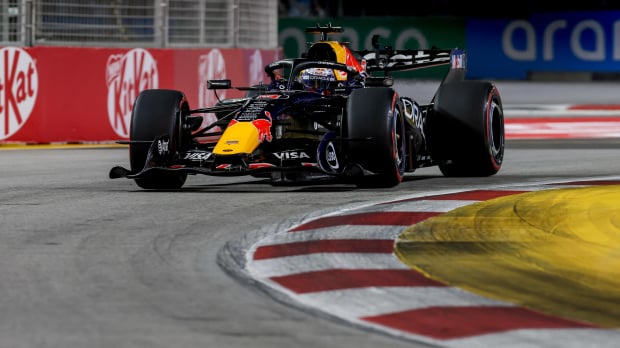

Why the Las Vegas Grand Prix is harder than its long straights suggest
The Las Vegas Grand Prix returns on 19–21 November 2026, with Formula 1 racing along the Strip under floodlights. The setting guarantees recognisable television pictures, but the challenge facing the teams is less obvious than the hotels and illuminated signs surrounding the circuit.
Over 50 laps, drivers must manage cold tyres, heavy braking and a surface that changes as the weekend develops. Straight-line speed matters, yet a car that looks competitive at the end of the longest straight can still lose considerable time through the slower corners.
The city’s gaming identity is familiar even to people whose experience is limited to an online casino. Formula 1 uses that recognisable backdrop, but the racing has its own appeal. Previous editions have shown how tyre preparation and small strategic decisions can matter as much as outright pace.
A Saturday night race means an early Sunday in Britain
The Grand Prix is scheduled to start at 8pm in Las Vegas on Saturday 21 November. For UK viewers, that means 4am on Sunday 22 November.
The published timetable places the first two practice sessions on Thursday locally, followed by final practice and qualifying on Friday. Qualifying is also scheduled for 8pm local time, equivalent to 4am on Saturday in Britain.
Those dates are worth checking carefully when planning to watch. A Saturday race in the host city does not mean a Saturday evening broadcast for European audiences. The schedule also influences preparation. Teams need to understand the car during representative evening conditions, rather than relying entirely on running completed earlier when temperatures may differ.
That makes practice useful beyond establishing a headline lap time. Engineers need to learn how quickly the tyres become effective and how the balance changes over a longer run.
The layout rewards more than engine performance
The Las Vegas Strip Circuit measures 6.201 kilometres, with a scheduled race distance of 309.958 kilometres.
Its long straights encourage teams to prioritise efficiency. Carrying unnecessary aerodynamic drag can leave a driver vulnerable when another car closes behind. However, reducing downforce has consequences. The car still needs stability under braking and sufficient grip when turning into slower corners. A setup that gains speed on the straight may require more caution elsewhere.
That compromise becomes especially important when the surface offers limited grip. A driver who brakes slightly earlier or struggles to accelerate cleanly can surrender the benefit gained over several hundred metres at full throttle.
The useful comparison is therefore the complete lap. Speed-trap figures help explain one part of performance, but they cannot establish which car will remain competitive across a race stint.
Cold conditions make tyre preparation difficult
Las Vegas presents a different temperature problem from many races on the calendar.
Cool conditions can make it harder to bring tyres into their intended operating range. A driver may begin a qualifying lap without the grip needed to attack confidently, particularly if the preparation lap has been compromised by traffic.
Pushing harder is not always the solution. Sliding across the surface can damage the tyre rather than generate useful performance.
McLaren’s previous technical briefing for the event described the risk of cold graining, where surface rubber tears and gathers into small pieces. That reduces grip and can affect both lap time and tyre wear.
The exact behaviour in 2026 will need to be established during the weekend. Previous races provide background, but teams cannot assume that an earlier compound choice or successful strategy will transfer unchanged.
Practice should reveal which cars can reach a useful tyre temperature without sacrificing performance later in the stint.
Russell’s 2024 victory showed the value of control
George Russell won the 2024 Las Vegas Grand Prix, leading a Mercedes one-two ahead of Lewis Hamilton.
His performance offered a useful example of how the circuit can reward restraint. Russell managed the opening stint while Charles Leclerc’s early attack was followed by tyre difficulties.
Afterwards, Russell identified the first stint as decisive and explained that avoiding graining became central to protecting his advantage.
That does not make the same approach inevitable this year. It demonstrates why an apparently cautious phase can be productive.
A driver who maintains a slightly slower but sustainable pace may retain more flexibility than one who attacks immediately and loses tyre performance. The difference can become visible only after several laps, when the early pace advantage has disappeared.
For viewers, watching the gaps over a stint can therefore be more revealing than reacting to a single fastest lap.
The surface improves, but the timing matters
A temporary street circuit begins the weekend with a different history of use from a permanent racing venue.
As cars complete laps, rubber is deposited and the racing line can become more usable. That track evolution complicates comparisons during practice and qualifying. A driver running later may benefit from improved conditions. Another may produce a strong lap earlier without appearing near the top of the final classification.
Teams must decide when to send their cars out while allowing enough space for tyre preparation. Waiting can bring a better surface, but it also risks traffic or an interruption before a lap is completed.
The tension is particularly sharp in qualifying. A car may have the pace to progress, yet still be eliminated if the driver cannot combine preparation, clear space and a clean lap at the right moment.
A restart can change the balance again
Any Safety Car period would create another temperature challenge. Reduced speeds can leave drivers working to keep their tyres ready for the restart.
The leader controls the resumption within the rules, while those behind must judge braking and traction with less certainty than during uninterrupted racing.
A pit stop creates a related question. Fresh tyres offer potential performance, but the driver needs to make them work before that advantage becomes useful.
That is why Las Vegas is worth watching beyond the spectacle of cars passing familiar landmarks. The long straights provide overtaking opportunities, while the slower sections expose weaknesses in preparation and balance.
The decisive moment may be a pass under braking. Its cause could have been developing for several laps, as one driver preserved grip and another gradually lost it.




 Grand Prix of Australia 2026
 Grand Prix of China 2026
 Grand Prix of Japan 2026
 Saudi Arabian Grand Prix 2026
 Miami Grand Prix 2026
 Grand Prix du Canada 2026
 Grand Prix De Monaco 2026
 Gran Premio de Barcelona-Catalunya 2026
 Grand Prix of Austria 2026
 Grand Prix of Belgium 2026
 Grand Prix of Hungary 2026
 Grand Prix of Italy 2026
 Grand Prix of Azerbaijan 2026
 Grand Prix of Bahrain 2026
 Grand Prix of Singapore 2026
 Gran Premio de la Ciudad de Mexico 2026
 Grande Prêmio de São Paulo 2026
 Qatar Grand Prix 2026
 Grand Prix of Abu Dhabi 2026