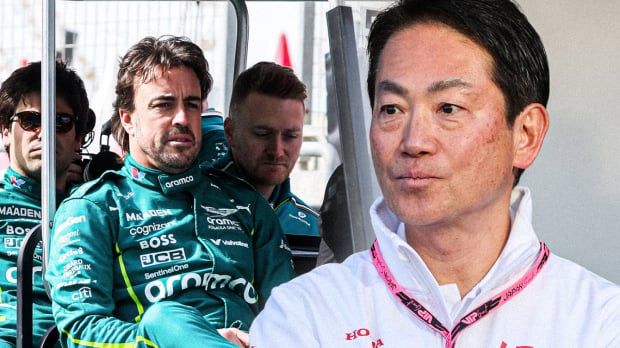

Honda boss reveals devastating mistake behind Aston Martin's F1 nightmare
It's been a rough year!

Outgoing Honda Racing Corporation president and CEO Koji Watanabe has admitted that the company 'wasted two years' in developing their F1 engine for Aston Martin.
Honda's disastrous re-entry into the F1 power unit game has been one of the louder storylines of the season, with the Adrian Newey-led team taking a leap in entirely the wrong direction with the Brit's first car for the team.
The tale of the season for Aston as a whole has been late starts, with Newey beginning work on the team's 2026 concept later than he would've liked due to the terms of his exit from Red Bull, and Honda making a relatively late decision to get back into F1.
Watanabe, who will retire from his role and be replaced by Keiichi Yasuda at the end of the year, admitted to the Japanese edition of Motorsport.com that his company's power unit for this year is 'clearly inferior' to its rivals.
F1 HEADLINES: Verstappen race ruined by penalty as Horner set for public grilling
HRC president: We can improve if we take time
"Looking back on this season, I have to say it was tough," he admitted.
"As I've said many times before, with new regulations, new teams, new fuel and oil, and drivers... everything was new, and we came with high aspirations, and that hasn't changed, but the situation is tougher than we anticipated."
He continued: "However, we must not lose our determination to win, and we must continue to make efforts to improve even a little bit in each game, towards the goals we have set, so that we can move forward. That's what I'm thinking right now."
Asked directly whether the power unit supplied to Aston Martin is inferior, he said: "Based on the performance levels measured by the FIA for ADUO, I think our PU (power unit) is clearly inferior to those of other manufacturers. Of course, we can't accurately know the numbers for our rivals' PUs, so this is assuming we trust the FIA's figures.
"As the drivers have also mentioned, the biggest issue is that it lacks power compared to others. Therefore, with the Spec 2 PU, we aimed to gradually increase that lack of power.
"We were able to achieve the power we were aiming for with Spec 2, but we made some changes to the combustion process, which resulted in the drivability being similar to the initial version of Spec 1.
"Regarding that aspect, we can improve it if we take the time, both in terms of hardware and control. We've seen improvements in drivability even in tough competition. However, we still lack power. That's something we need to work on improving."
Why is Honda's power unit so bad?
So why are Honda struggling so much? Watanabe believes the answer is painfully straightforward.
"I think the main reason was that we started development late."
Watanabe was transparent about the biggest issue facing the company in their pursuit of power unit performance: the linear progression of time.
"By making HRC a race development company, we've made sure to keep the flame of F1 alive, even at the basic research level," he said.
"So, F1 development has never completely stopped. However, when we announced our return in 2023, we had to quickly establish a development system, but that took some time.
"Our decision to re-enter the competition was delayed by a year compared to others, and it took time to get our development system in place, so we essentially wasted two years.
"During that time, we focused on developing the battery and motor, which takes time, and I think we were able to achieve our goals in that area, but that meant that the development of the ICE (engine) was delayed.
"If we had been able to start development with a complete system from the beginning, we could have allocated resources to the electric components and the engine. But initially, we were short-staffed, so we started development on the electric components first, and then focused on engine development.
"We tried to catch up by pushing forward with development, but then we ran into budget constraints and limits on operating hours, and ultimately we couldn't make up the lost time."
READ MORE: Christian Horner reveals 'dazzling' Mercedes offer
READ MORE: Ferrari under fire again over costly Hamilton strategy blunder




 Grand Prix of Australia 2026
  Grand Prix of China 2026
  Grand Prix of Japan 2026
  Saudi Arabian Grand Prix 2026
  Miami Grand Prix 2026
  Grand Prix du Canada 2026
  Grand Prix De Monaco 2026
  Gran Premio de Barcelona-Catalunya 2026
  Grand Prix of Austria 2026
  Grand Prix of Belgium 2026
  Grand Prix of Hungary 2026
  Grand Prix of Italy 2026
  Grand Prix of Azerbaijan 2026
  Grand Prix of Bahrain 2026
  Grand Prix of Singapore 2026
  Gran Premio de la Ciudad de Mexico 2026
  Grande Prêmio de São Paulo 2026
  Qatar Grand Prix 2026
  Grand Prix of Abu Dhabi 2026