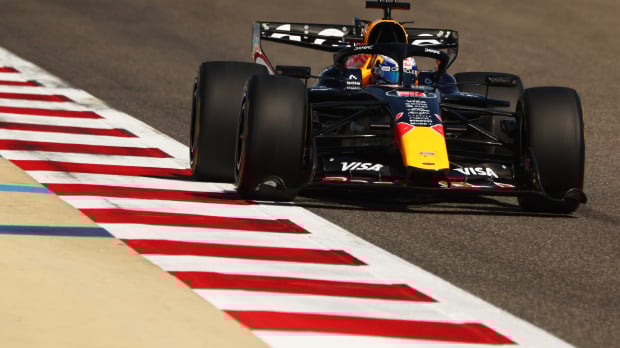


Concerns are emerging over one new facet of the 2026 F1 cars that could cause problems for teams on the grid - a turbo lag.
One of the major changes brought by the 2026 regulations is that the electric power from the battery will provide half of the total output, generated via the MGU-K.
Elsewhere in the 2026 power unit, the MGU-H has been removed due to its complexity and expense, but its removal has delivered a negative consequence.
The MGU-H not only stored additional electrical power but as its own electric motor, it solved the problem of turbo lag, which could once again become an issue in 2026.
What is turbo lag on F1 cars?
A turbo lag describes the delay between pressing the accelerator and receiving the extra power from the turbo, unable to spin quickly enough to provide an instant boost.
The turbine needs extra time to reach high revs because of insufficient exhaust energy to accelerate the turbines to provide the required pressure for the boost.
This can result in poor throttle response in corners, followed by an instant increase in power and acceleration on straights. With the MGU-H, drivers didn't have to worry because the turbine remained at high revs when they braked or lifted off the throttle, but without it in 2026 it could be an issue.
F1 cars in the 1980s suffered especially with this, but were eventually outlawed in 1989 because turbocharged engines were deemed too powerful, dangerous and expensive.
F1 2026 Regulations: What is straight mode?
FIA's rule changes ahead of the Miami GP
Start-related risks have been mitigated with a new 'low power start detection', with the FIA explaining that: "A new 'low power start detection' system has been developed, capable of identifying cars with abnormally low acceleration shortly after clutch release.
"In such cases, an automatic MGU-K deployment will be triggered to ensure a minimum level of acceleration and mitigate start-related risks without introducing any sporting advantage."
"An associated visual warning system is being introduced, activating flashing lights (rear and lateral) on affected cars to alert following drivers.
"A reset of the energy counter at the start of the formation lap has also been implemented to correct a previously identified system inconsistency."
When does the 2026 F1 season start?
The 2026 F1 season isn't faraway now, and will get underway on March 6 for the Australian Grand Prix in Melbourne.
Lights out for Australian GP on Sunday, March 8, is at 3pm local time (AEDT), 4am GMT, and 11pm ET.
F1 Engine Compression Ratio: What is it and why is it so controversial?






 Grand Prix of Australia 2026
  Grand Prix of China 2026
  Grand Prix of Japan 2026
  Saudi Arabian Grand Prix 2026
  Miami Grand Prix 2026
  Grand Prix du Canada 2026
  Grand Prix De Monaco 2026
  Gran Premio de Barcelona-Catalunya 2026
  Grand Prix of Austria 2026
  Grand Prix of Belgium 2026
  Grand Prix of Hungary 2026
  Grand Prix of Italy 2026
  Grand Prix of Azerbaijan 2026
  Grand Prix of Bahrain 2026
  Grand Prix of Singapore 2026
  Gran Premio de la Ciudad de Mexico 2026
  Grande Prêmio de São Paulo 2026
  Qatar Grand Prix 2026
  Grand Prix of Abu Dhabi 2026