


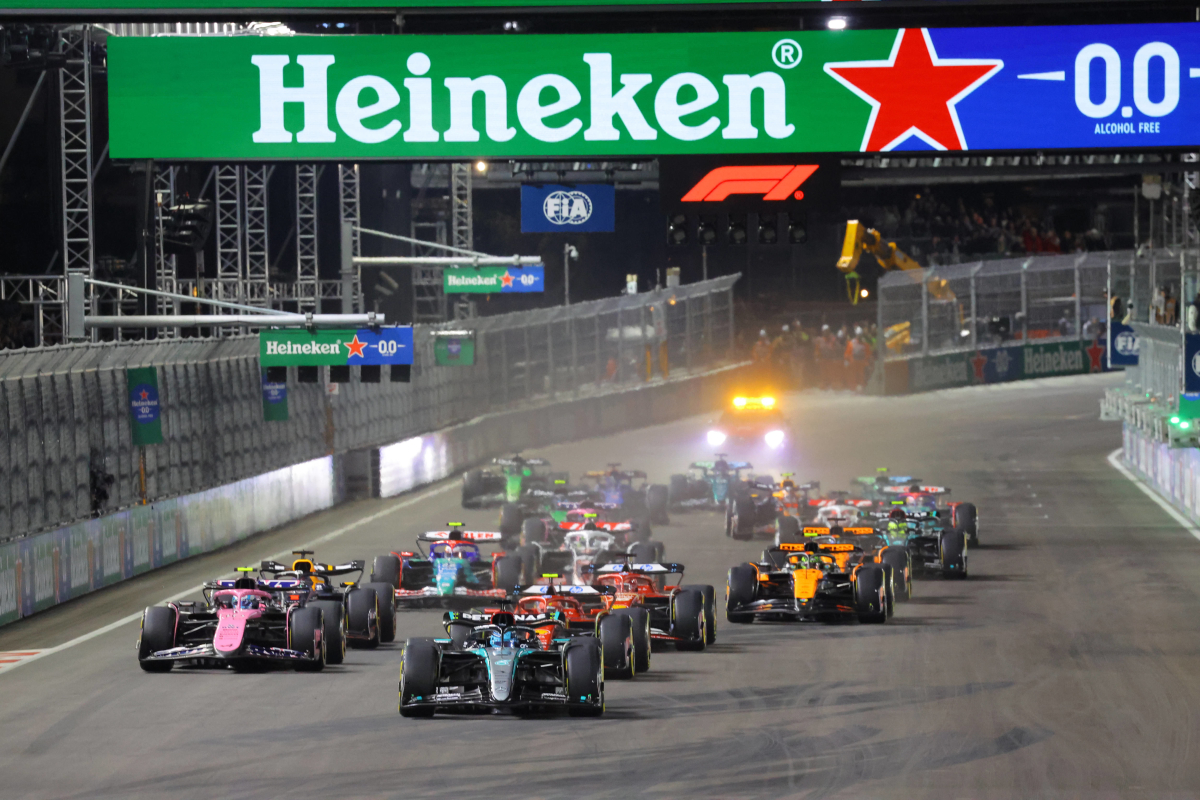
F1 start procedure explained - why is it so controversial in 2026?

'It's lights out, and away we go!'
We all know that part of F1 starts off by heart at this point, but there's an awful lot more to it than that. Unexpectedly, that's kicked off one of the season's first controversies.
It seems like the most simple thing in the world, right? Cars line up, lights go on, lights go off, cars go vroom vroom down the track until Lance Stroll crashes. There's a little more to it than that, it turns out.
We'll get into the controversy in a minute, but here are the basic start procedures first...
F1 2026: Which driver contracts expire this year?
What are F1's start procedures?
Things kick off long before the light sequence that marks the most dramatic moment of any race weekend. In fact, one key part comes a full 30-40 minutes before the lights are illuminated – the reconnaissance lap(s) on non-race tyres when the cars come out of the garage.
That's a crucial part for getting to grips with the conditions as they are on race day, after which the drivers stop near the crowded grid, hop out and have their cars pushed into their grid slots. Why? Well, you've seen Martin Brundle's gridwalks. Now imagine driving through that without accidentally breaking Sam Ryder's legs.
Once the drivers have hopped out, chatted to their engineers and refreshed themselves, it's time for everyone to sprint to the front of the grid for the anthem, stand around looking serious while that happens, then head back to the cars to get strapped in.
After that, it's time to get the blankets off the tyres and get the engines fired up as late as possible, while still getting every member of the team off the grid and behind the white lines with at least 15 seconds to go before the formation lap.
That formation lap is all about getting tyres up to temperature, keeping the engine cool, getting the clutch prepped, warming the brakes...you get the idea. Let's say 'getting the car ready to start the race', while the teams sprint back to the garage with all of their gear.
Once all 22 drivers are lined up in their grid spots, the five lights up on the gantry will illuminate one by one – with one second between each of them turning on.
When they all go out after a short but, crucially, random delay, it's time to get racing. So where's the controversy? Weirdly, it involves the fact that it takes five seconds between the drivers finishing lining up and the lights going out.
Why are F1 starts controversial for 2026?
In short, the 2026 cars struggle to get off the start line. This is a problem that the teams were well aware of coming into pre-season testing in Bahrain, but the visual of a group practice start in which only two cars got off the line put things in stark relief for anyone watching at home.
The condensed version of the start issue is that the design of the new power units means that a number of cars need to rev up hard for an extended period in order to jump off the line properly – with the potential to leave some drivers stranded on the grid if they can't get their turbos spooled up in time.
That, obviously, is dangerous, and a number of team bosses want the start procedure lengthened in order to make sure everyone can get off the line in time.
The proposed change would mean that drivers have ten seconds before the last driver arriving at the grid and the lights going out, in order to get the turbos spooled up and ready to launch.
McLaren boss Andrea Stella has said as much, telling the media: "We need to make sure that the race start procedure allows all cars to have the power unit ready to go because the grid is not the place in which you want to have cars slow in taking off the grid.
"This is of bigger interest than any competitive interest. I think all teams and the FIA should play the game of responsibility when it comes to what is needed in terms of race start procedure. I'm thinking about the timings, for instance, the timing of the lights, the timing before the lights.
There is one team that disagrees. Ferrari, it turns out, had foreseen this problem when they were designing their 2026 power unit and – after other teams apparently dismissed their warnings at the time – developed an engine which works better off the line than any other on the grid.
They even reportedly blocked a change to the start procedure when the issue was raised in the middle of 2025, with the attitude that the playing field shouldn't be levelled this late on just because their rivals chose not to develop around a problem they knew full well would arise.
The FIA and F1 Commission are likely to reach a consensus on this before lights go out in Melbourne. They haven't indicated which way they're most likely to jump but, given the safety aspect, it's hard to see them leaving things as they currently stand.
When does the 2026 F1 season start?
The first race of the season is in Melbourne on Sunday March 8 for the Australian Grand Prix. Lights out are at 3pm local time (AEDT), 4am GMT, and 11pm ET.
Meanwhile, the second week of Bahrain testing gets under way on Wednesday February 18 and then continues on Thursday February 19 and Friday February 20.
Each day is split into two sessions with a one-hour lunch break between. Times are as follows:
Session One: 10am-2pm local time (7am-11am UK, 8am-noon CET, 2am-6am Eastern).
Session Two: 3pm-7pm local time (noon-4pm UK, 1pm-5pm CET, 7am-11am Eastern).
F1 2026 REGULATIONS: What is the boost button?
Related

Latest News

F1 start procedure explained - why is it so controversial in 2026?
- 1 hour ago

F1 Explained: What is sandbagging?
- 2 hours ago

F1 track replaces iconic venue in calendar rotation agreement
- Today 12:56

Fernando Alonso gives 'confidence' verdict after Adrian Newey's Aston Martin testing disaster
- Today 11:55

VOTE: Who's more likely to retire from F1 first - Lewis Hamilton or Fernando Alonso?
- Today 10:59

Zak Brown confirms ‘strategic’ use of papaya rules
- Today 09:59
Most read

Daniel Ricciardo is back in F1, but this time it's different
- 31 january

Lewis Hamilton finally breaks his silence on Kim Kardashian dating rumours
- 12 february

Lewis Hamilton split prompts major Angela Cullen decision
- 5 february

F1 2026 WAGs: Lewis Hamilton is 'dating Kim Kardashian'?
- 2 february

F1 Testing 2026: Bahrain schedule, start times and how to watch live
- 12 february

F1 Testing Results: Bahrain timesheets as Lewis Hamilton suffers late Ferrari blow
- 13 february

F1 Standings




Races
-
 Grand Prix of Australia 2026
-
 Grand Prix of China 2026
-
 Grand Prix of Japan 2026
-
 Grand Prix of Bahrain 2026
-
 Saudi Arabian Grand Prix 2026
-
 Miami Grand Prix 2026
-
 Grand Prix du Canada 2026
-
 Grand Prix De Monaco 2026
-
 Gran Premio de Barcelona-Catalunya 2026
-
 Grand Prix of Austria 2026
-
 Grand Prix of Great Britain 2026
-
 Grand Prix of Belgium 2026
-
 Grand Prix of Hungary 2026
-
 Dutch Grand Prix 2026
-
 Grand Prix of Italy 2026
-
Gran Premio de España 2026
-
 Grand Prix of Azerbaijan 2026
-
 Grand Prix of Singapore 2026
-
Grand Prix of the United States 2026
-
 Gran Premio de la Ciudad de Mexico 2026
-
 Grande Prêmio de São Paulo 2026
-
Las Vegas Grand Prix 2026
-
 Qatar Grand Prix 2026
-
 Grand Prix of Abu Dhabi 2026
Follow us on your favorite social media channel
Corporate information
 Innovatieweg 20C
7007 CD, Doetinchem, Netherlands
+31 6 455 168 60
See the Contact page for regional correspondence addresses