



F1 Engine Compression Ratio - What is it and why is it so controversial?
Engine compression ratios have become a hot topic
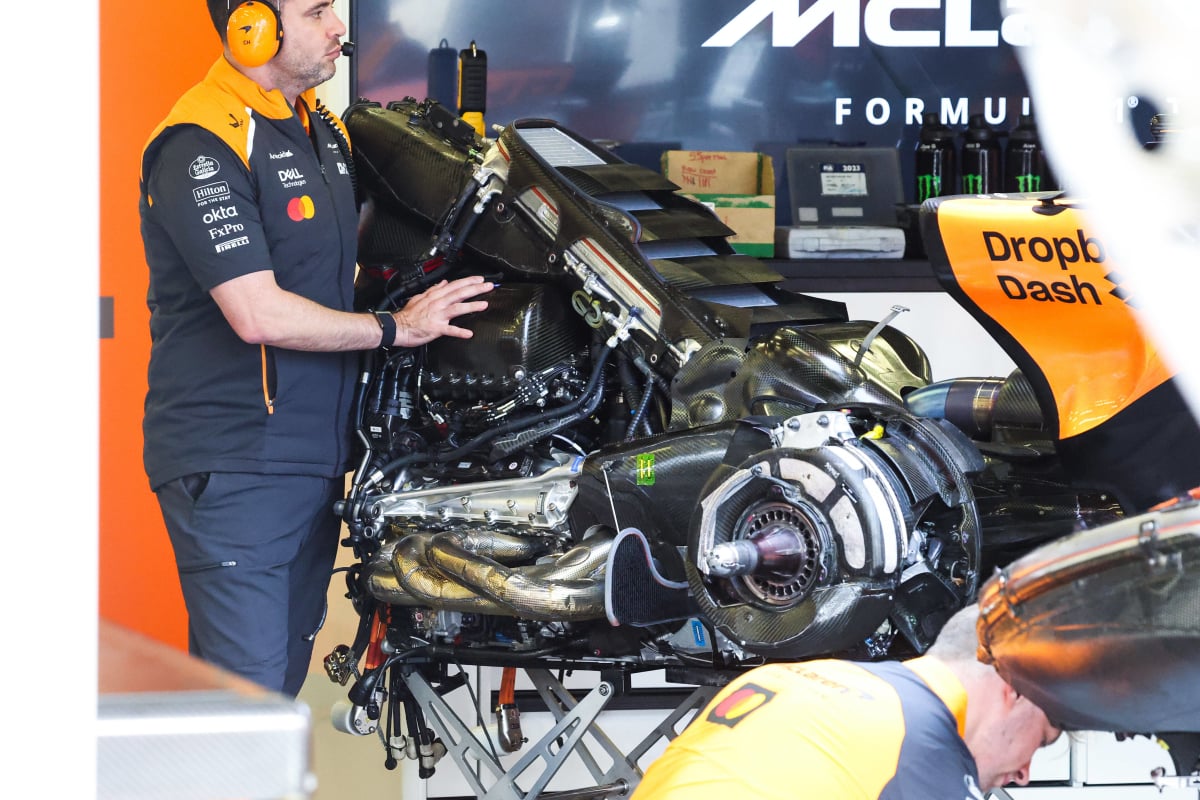
Didn't expect you'd be looking up articles online about engine compression a few months ago, did you? That's what new F1 regulations can do to you. Luckily, we're here to help.
Before we dive into the controversy surrounding Mercedes and Red Bull's engines, let's get a basic grounding in what a compression ratio...well, is.
Simply put, it's the ratio between the largest and smallest volume inside a cylinder (current F1 engines have six cylinders, known as V6 engines).
When the piston inside the cylinder is at its lowest point, it's at its maximum volume. When it's at the highest points of its stroke, it's at its minimum. The compression ratio is simply the ratio between those two volumes.
READ MORE: FIA announce official F1 vote over Mercedes compression ratio controversy
Why do engine compression ratios matter?
Great question, glad you asked!
The higher the ratio (in F1's specific case, 18:1 vs 16:1), the more the fuel and air inside the cylinder is compressed - to 1/18th of its original volume, or 1/16th (other compression ratios are available, but these are the ones germane to F1's current kerfuffle).
The more the fuel and air is compressed, the more power can be extracted from it at ignition point. In other words, the higher your compression rate, the more power you're able to extract from a given amount of fuel. Given that 'more power' is what every engine manufacturer in the sport is looking for...that matters quite a lot.
What are F1's engine compression rules?
Under the previous set of regulations, teams were allowed to run a compression ratio of 18:1. However, under new engine regulations introduced for 2026, that ratio limit is now 16:1.
That seems simple, what's the controversy?
You are just killing it with the questions today! Well, F1's measuring system is, under the regulations, done 'at ambient temperature', when the engine is cooled down and going nowhere in the garage.
The clever little elves at Mercedes have managed to get their brand new power units running at a compression rate of around 18:1 when they're hot and on track - while still passing the 16:1 ambient temperature checks.
That's a theoretical gain of about a dozen horsepower, or in the region of a quarter of a second a lap. That is...not insignificant.
Mercedes insist that their system is entirely legal. After all, it passes the tests laid down in the current rules, and that's what counts in their eyes.
The FIA have now, however, confirmed that a vote has been put to the power unit manufacturers that, if passed, would mean the ratios are measured both at high temperatures and ambient temperatures.
The power unit manufacturers have 10 days to decided which way to vote and If the vote passes, the new rules will only actually come in on August 1, meaning Mercedes would have almost six months to change their power unit.
It is believed that any vote needs at least a 4-1 majority to be passed through, and it remains unclear at this stage which way the power unit providers will vote.
FIA announce compression ratio change
Ahead of the season opening Australian Grand Prix, the FIA released a revised technical regulations document.
It states that before May 31, geometric compression ratios will only be measured at ambient temperatures, but from June 1, 2026, they will also be measured when the engine is at 130 degrees Celsius.
This means that Mercedes will not need to change their power unit design immediately, but will need to have got rid of that clever trick from the Monaco GP onwards.
What have they said?
Toto Wolff, Mercedes team principal: “I just don’t understand that some teams concentrate more on the others and keep arguing a case that is very clear and transparent.
"Communication with the FIA was very positive all along and it’s not only on compression ratio, but on other things too. Specifically in that area, it’s very clear what the regulations say. It’s very clear what the standard procedures are on any motors, even outside of Formula 1. So just get your s*** together."
Mattia Binotto, Head of the Audi F1 project: "If that's true, firstly, it certainly makes a significant difference in terms of performance and lap time. That would definitely make a difference when we get to the track and competition."
FIA single seater director Nikolas Tombazis: "As these engineers are very clever and always pushing for an advantage, some have found ways to potentially increase it [the compression ratio] when the engine is running hot, and that is the discussion we're having now.
"We've spent a lot of time discussing how we solve those issues, and our intention is of course to solve them for the start of the season. We don't want to have controversies. We want people to be competing on the track, not in the courtroom or in the stewards' room, and that's what we try to do."
Audi technical director James Key: "We have to, as we do, trust the FIA with making the right decisions here. It’s new regs. You’ve got to have a level playing field. If someone came up with a clever diffuser and you said it’s not the right thing to do, no one else can have it, but you can have it for the rest of the year – it doesn’t make sense. We’d never accept that."
F1 HEADLINES: Red Bull suffer major blow as Christian Horner plans scrapped
Related
More F1 news
Latest F1 news




Recommended by the editors
 F1 2026 Regulations
F1 2026 Regulations Explained: Every new rule, car change and key questions answered
 F1 Qualifying
F1 Qualifying explained: The new rules for 2026
 F1 on TV
F1 Commentators: Meet the Sky Sports and Channel 4 teams
 F1 2026 Explained
F1 Explained: What is the 107% rule and will it KO Aston Martin at Australian Grand Prix?







Races
-
 Grand Prix of Australia 2026
-
 Grand Prix of China 2026
-
 Grand Prix of Japan 2026
-
 Grand Prix of Bahrain 2026
-
 Saudi Arabian Grand Prix 2026
-
 Miami Grand Prix 2026
-
 Grand Prix du Canada 2026
-
 Grand Prix De Monaco 2026
-
 Gran Premio de Barcelona-Catalunya 2026
-
 Grand Prix of Austria 2026
-
 Grand Prix of Great Britain 2026
-
 Grand Prix of Belgium 2026
-
 Grand Prix of Hungary 2026
-
 Dutch Grand Prix 2026
-
 Grand Prix of Italy 2026
-
Gran Premio de España 2026
-
 Grand Prix of Azerbaijan 2026
-
 Grand Prix of Singapore 2026
-
Grand Prix of the United States 2026
-
 Gran Premio de la Ciudad de Mexico 2026
-
 Grande Prêmio de São Paulo 2026
-
Las Vegas Grand Prix 2026
-
 Qatar Grand Prix 2026
-
 Grand Prix of Abu Dhabi 2026
Follow us on your favorite social media channel
Editorial & corporate information

Avenue HQ
10–12 East Parade
Leeds
LS1 2BH
United Kingdom Regional correspondence
View contact page