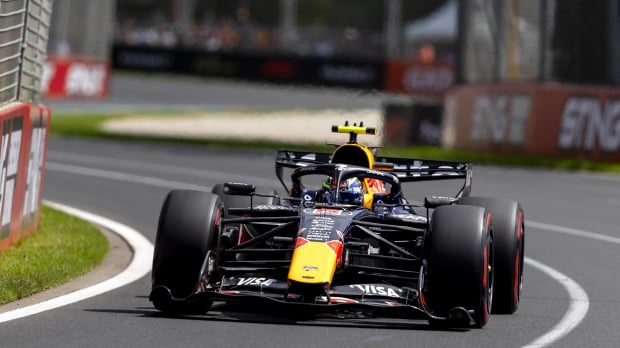

FIA announce Red Bull curfew breach at Australian Grand Prix
Max Verstappen's F1 team have been pulled up by the FIA

Red Bull have been found to be in breach of the FIA curfew at this weekend's Australian Grand Prix after F1's governing body reinstated the rule ahead of Saturday's qualifying.
The first round of the F1 2026 championship will take place on Sunday at Albert Park Circuit after extensive pre-season testing, designed to help drivers and teams prepare for the complete overhaul of chassis and power unit regulations coming into play this year.
But what the teams weren't prepared for were the travel disruptions many of them faced when heading to Melbourne this week, with some even forced into last-minute travel changes due to the ongoing situation in the Middle East.
Last Saturday, the US and Israel began a bombing campaign in Iran, with Iran then retaliating by launching strikes targeting US bases in nearby countries.
These countries included Qatar and the United Arab Emirates, who both host major international airports, forcing some F1 teams to divert their personnel travel in order to avoid affected areas.
As a result of the logistical challenges faced across the grid, the FIA made the decision to lift their curfew rule which only allows mechanics to work on an F1 car during specific time slots, with overnight work normally prohibited.
F1 HEADLINES: Hamilton avoids major crash as McLaren star tops day one of 2026 season
Red Bull caught out by FIA F1 curfew lift
However, following the unusually chaotic journey to the F1 2026 season opener, the FIA moved to scrap the regular curfew rules ahead of FP1 and FP2 on Friday.
On a regular weekend, the first restricted period commences 42 hours prior to FP1 and ends 29 hours before the scheduled start of FP1, with the second period beginning 18 hours before FP1 and ending four hours before the scheduled start of the first practice session.
This means that under normal circumstances, team personnel who intend to work on the car are not allowed within the confines of the circuit, but under the revised rules brought into play in Australia, teams were allowed to work on the cars as they pleased overnight on both Wednesday and Thursday.
This decision was made in order to ensure the teams actually made it out onto the track on Friday, with the regular curfew rules coming back into play for Friday night ahead of Saturday's final practice and qualifying.
The FIA's F1 2026 regulations state that Restricted Period Three commences 14 hours prior to the scheduled start of FP3 and ends three hours prior to the start of the third and final practice.
But Red Bull were caught out in Melbourne on Friday, with a statement from the FIA revealing: "Last night team personnel of the Oracle Red Bull Racing team, who are associated with the operation of the car, were within the confines of the circuit during the 12 and a half hour period which commenced at 21:00 on 06 March, 15 and a half hours before the scheduled start time of P3 and ends three hours before the scheduled start time of P3 at 09:30 on 07 March.
"This was the first of the four individual exceptions permitted for the Oracle Red Bull Racing team during the 2026 Formula 1 Championship season and therefore no action should be taken."
How many curfew breaches are an F1 team allowed before a penalty?
During the FIA's restricted periods, the operational personnel in question are not allowed to conduct car-related activities, which includes but is not limited to work on the F1 cars or F1 car components necessary to operate them, as well as engineers carrying out work on computers.
Failure to comply is treated as a breach, as was the case with Red Bull in Melbourne, and each team is permitted to an exception allowance throughout the season.
Six exemptions are allowed for Restricted Period One, five for Restricted Period Two and four for Restricted Period Three.
These exceptions may not be used consecutively during a single competition and in the case of a breach that incurs a penalty, both drivers must start the race from the pit lane.
READ MORE: Aston Martin crisis: Newey goes in hard on Honda




 Grand Prix of Australia 2026
 Grand Prix of China 2026
 Grand Prix of Japan 2026
 Saudi Arabian Grand Prix 2026
 Miami Grand Prix 2026
 Grand Prix du Canada 2026
 Grand Prix De Monaco 2026
 Gran Premio de Barcelona-Catalunya 2026
 Grand Prix of Austria 2026
 Grand Prix of Belgium 2026
 Grand Prix of Hungary 2026
 Grand Prix of Italy 2026
 Grand Prix of Azerbaijan 2026
 Grand Prix of Bahrain 2026
 Grand Prix of Singapore 2026
 Gran Premio de la Ciudad de Mexico 2026
 Grande Prêmio de São Paulo 2026
 Qatar Grand Prix 2026
 Grand Prix of Abu Dhabi 2026