


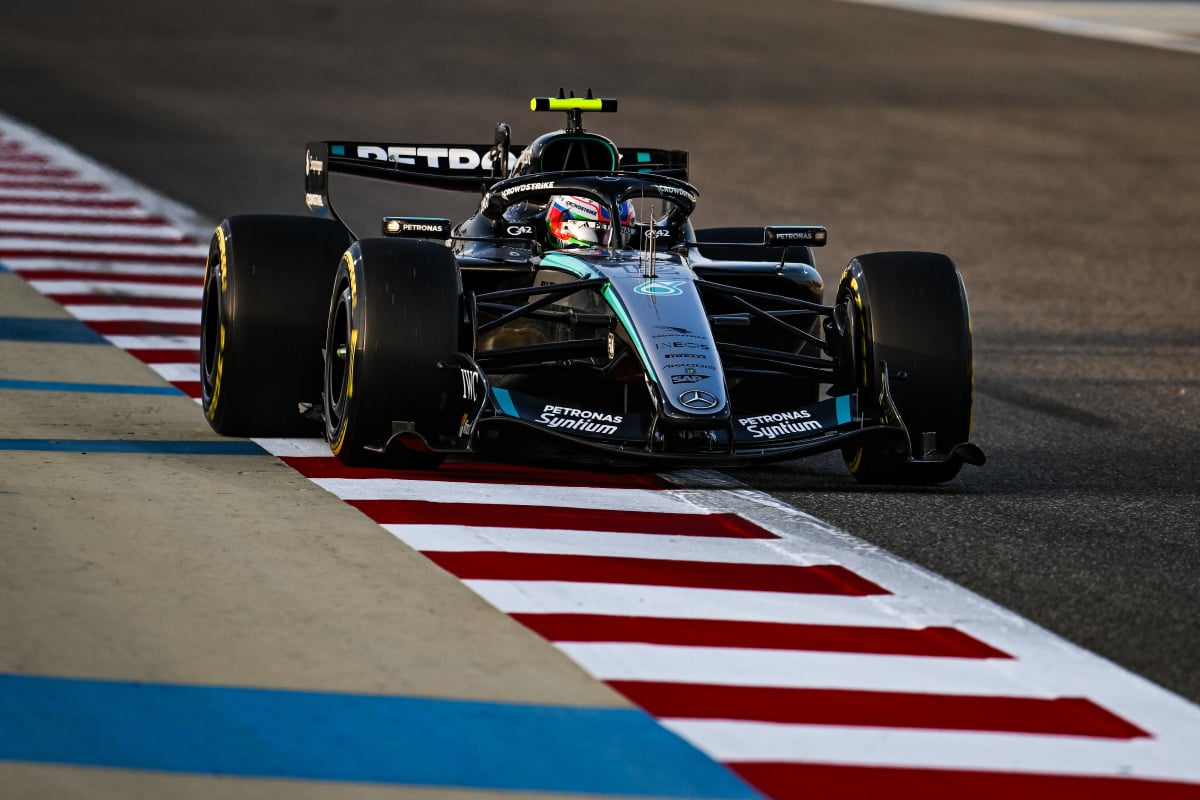
F1 2026 Regulations: What is lift and coast?

Ahead of the 2026 F1 season, GPFans have you covered as wholesale regulation changes sweep into the sport.
The comprehensive new power unit and aerodynamic car design rule changes mean that there are a number of new terms to get our heads around, as well as old F1 references which are set to be more prominent from this season.
Lift and coast falls into the latter category, with triple the amount of emphasis on electrical energy in 2026 compared to 2025 making it crucial for F1 drivers to manage their battery capacity.
Here's all you need to know about 'lifting and coasting'.
F1 Engine Compression Ratio: What is it and why is it so controversial?
What does it mean to lift and coast in F1?
Normally when heading into a corner, F1 drivers like to slow the car down as quickly and efficiently as possible, before then opening the throttle on the exit of the corner to maximise lap time.
However, when lifting and coasting, drivers ease of the accelerator several metres before the corner, before applying the brake pedal. This lets the car naturally slow itself down first before the helping hand of the brake pedal comes into effect.
The 'lift' element of lift and coast refers to when the driver lifts off the accelerator pedal, whilst 'coast' describes the motion of the car rolling without fully accelerating or braking.
Why do F1 drivers lift and coast?
There are a number of reasons why F1 drivers need to lift and coast during a grand prix or sprint race, including: fuel saving, battery management, tyre management and brake preservation.
In 2026, drivers may even need to lift and coast during qualifying laps, as to ensure that they have the full use of the 'boost button' on straight sections of the circuit.
In terms of the races, teams like to under-fuel their cars to achieve faster lap times and improve tyre life, so by 'lifting and coasting' a driver can reduce fuel consumption to ensure they don't run out by the chequered flag.
If F1 drivers attack each lap it places a lot of strain on their tyres, but lifting and coasting allows them to manage their tyre wear so they do not degrade prematurely.
Brake wear is also a concern during a F1 race, but coasting can help reduce the load on brakes to ensure they last longer.
However, if a driver is forced to 'lift and coast' it can play into the hands of their rivals, as it causes a car to lose time and a competitor is then susceptible to an overtake from the car behind.
Why will F1 drivers lift and coast so much in F1 2026?
The new power units in 2026 have an almost exact 50-50 split between electrical power and the internal combustion engine, meaning battery management will be just as important, if not more, than fuel saving.
Drivers will be looking to utilise the boost button throughout a lap as much as they possibly can, with this helping to maximise performance on the straights.
When engaged, the boost button triggers a change in power unit power settings, either returning to maximum power or a profile which has been configured by the team, allowing the car to utilise its full 450 horsepower.
In the race, this could even be used in conjunction with overtake mode if a driver is one second behind the car in front, allowing for a huge extra surge of energy.
But although these modes are brilliant and can be spread across the whole lap to help with overtaking, defending position, as well as maximising a one-off lap time in qualifying in the case of the boost mode, they can only be used if there is enough charge of the battery available.
Luckily for drivers, the new energy recovery system harvests double the amount of electrical energy than in 2025, but lifting and coasting is one way of harvesting this energy in order to ensure a full recharge of the battery.
That's why we can expect to see drivers lifting and coasting more during the 2026 season, even in qualifying.
F1 2026 Regulations: What is the boost button?
Related

Latest News

F1 2026 Regulations: What is lift and coast?
- 1 hour ago

Richard Hammond’s daughter wanted Top Gear legend to know one thing after Formula E crash
- 2 hours ago

Gianpiero Lambiase admits holding back in ‘frustrating’ Max Verstappen row
- 3 hours ago

Fernando Alonso claims Aston Martin tweaks could slash HUGE F1 time deficit
- Today 10:55

FIA 'will ban' Mercedes engine trick following rivals uproar
- Today 09:43

F1 plans to run wet tyre test in the DESERT
- Today 08:58
Most read

Daniel Ricciardo is back in F1, but this time it's different
- 31 january

Lewis Hamilton finally breaks his silence on Kim Kardashian dating rumours
- 12 february

Lewis Hamilton split prompts major Angela Cullen decision
- 5 february

F1 2026 WAGs: Lewis Hamilton is 'dating Kim Kardashian'?
- 2 february

F1 Testing 2026: Bahrain schedule, start times and how to watch live
- 12 february

F1 Testing Results: Bahrain timesheets as Lewis Hamilton suffers late Ferrari blow
- 13 february

F1 Standings




Races
-
 Grand Prix of Australia 2026
-
 Grand Prix of China 2026
-
 Grand Prix of Japan 2026
-
 Grand Prix of Bahrain 2026
-
 Saudi Arabian Grand Prix 2026
-
 Miami Grand Prix 2026
-
 Grand Prix du Canada 2026
-
 Grand Prix De Monaco 2026
-
 Gran Premio de Barcelona-Catalunya 2026
-
 Grand Prix of Austria 2026
-
 Grand Prix of Great Britain 2026
-
 Grand Prix of Belgium 2026
-
 Grand Prix of Hungary 2026
-
 Dutch Grand Prix 2026
-
 Grand Prix of Italy 2026
-
Gran Premio de España 2026
-
 Grand Prix of Azerbaijan 2026
-
 Grand Prix of Singapore 2026
-
Grand Prix of the United States 2026
-
 Gran Premio de la Ciudad de Mexico 2026
-
 Grande Prêmio de São Paulo 2026
-
Las Vegas Grand Prix 2026
-
 Qatar Grand Prix 2026
-
 Grand Prix of Abu Dhabi 2026
Follow us on your favorite social media channel
Corporate information
 Innovatieweg 20C
7007 CD, Doetinchem, Netherlands
+31 6 455 168 60
See the Contact page for regional correspondence addresses