


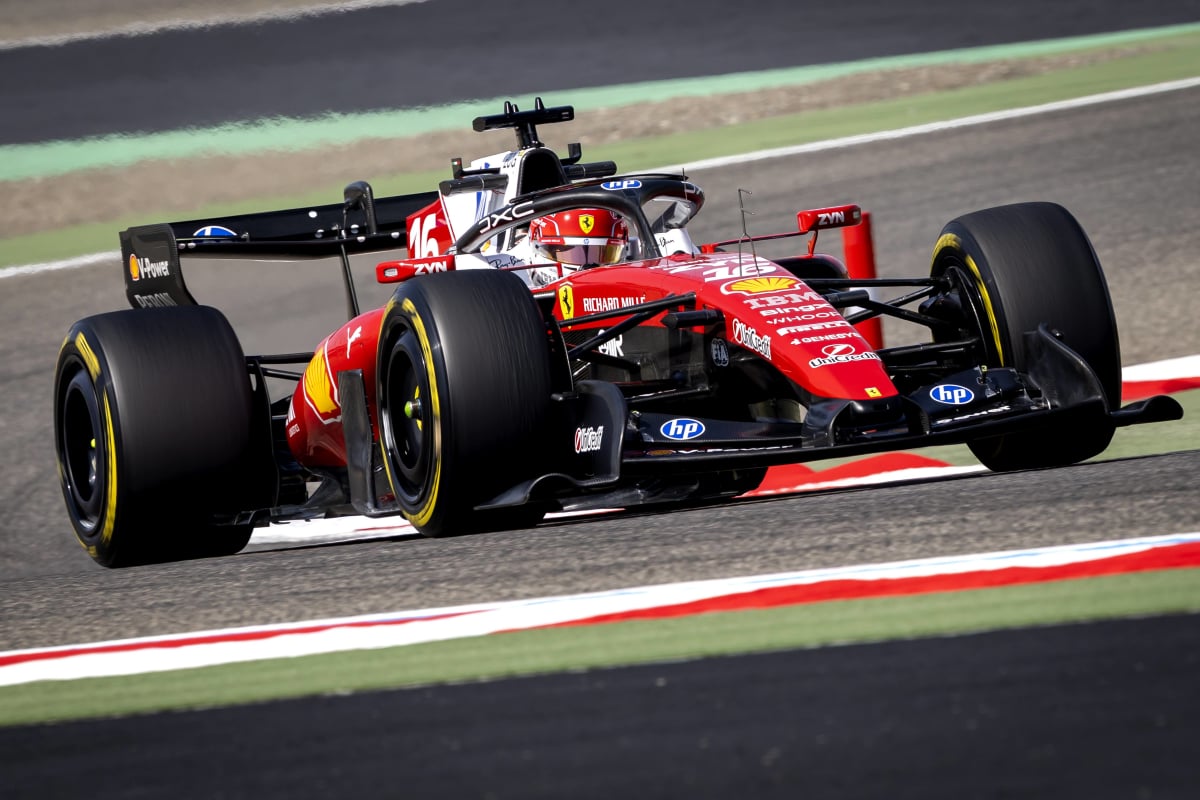
F1 2026 Regulations: What are the new mirror hazard lights?

In 2026 the new F1 regulations mean you'll be hearing some unfamiliar terms and this time we're tackling the all new hazard lights.
Yes, that's hazard lights. The sort that you might have on your road car, and for...well, not entirely dissimilar reasons.
F1 never stops looking for ways to make their sport safer, and that's exactly what they're trying to do in this instance.
Those of you blessed with being able to watch F1 with your eyes will have seen the big red lights on the back of the cars that do big flashes sometimes. We're not talking about those ones here, or the relatively new ones on the rear wing endplates.
F1 2026 REGULATIONS: What is overtake mode?
Where are F1's new hazard lights?
These new lights are embedded on the mirrors and, while you won't necessarily see them very often, they could save a driver's life.
The previous lights could essentially only be seen from behind the car. These mirror-mounted side lights are the obvious evolution of that.
Why do F1 cars have lights on their mirrors?
Simple. The old lights (which are still there – this is an addition, not a swap) were great if you were pointing in a straight line and wanted the car(s) behind to see you through rain and spray. They were not much help if you spun around.
No driver is as vulnerable in a racing car as they are when they come to a stop on the track, whether for an unexpected technical issue or after a crash. Rain and spray just exacerbates that risk, as was the case in the tragic death of Dilano van ‘t Hoff at Spa in 2023.
With lights on the mirrors, cars now have a chance to be seen through the spray no matter what direction they're pointing.
FIA single-seater director Nikolas Tombazis has said as much, explaining: "It is to counter a situation in the wet when there’s poor visibility. If a car is spinning and is in a lateral position onto ongoing traffic, these lights will help the ongoing car see the spinning car, and therefore, obviously, hopefully avoid it."
The lights will also flash in conditions where visibility is no issue if the car in question is out of the pits but travelling at under 20 km/h, indicating the status of the new electrical recovery system to the driver and marshals who may need to approach the car, for their safety.
When does the 2026 F1 season start?
The first race of the season is in Melbourne on Sunday March 8 for the Australian Grand Prix. Lights out are at 3pm local time (AEDT), 4am GMT, and 11pm ET.
Meanwhile, the second week of Bahrain testing gets under way on Wednesday February 18 and then continues on Thursday February 19 and Friday February 20.
Each day is split into two sessions with a one-hour lunch break between. Times are as follows:
Session One: 10am-2pm local time (7am-11am UK, 8am-noon CET, 2am-6am Eastern).
Session Two: 3pm-7pm local time (noon-4pm UK, 1pm-5pm CET, 7am-11am Eastern).
F1 2026 REGULATIONS: What is the boost button?
Related

Latest News

Billionaire builds $200 million race track designed by F1 icon to race wife and kids
- 36 minutes ago

F1 2026 Regulations: What are the new mirror hazard lights?
- 1 hour ago

F1 and FIA need to take urgent action to avoid Australian GP disaster
- 2 hours ago

Aston Martin insist ultra slow F1 car CAN be fixed
- 3 hours ago

F1 News Today: Max Verstappen threatens to quit as Red Bull fear they are only fourth fastest
- 3 hours ago

Formula E chief invites Max Verstappen to ditch F1
- Today 13:56
Most read

Daniel Ricciardo is back in F1, but this time it's different
- 31 january

Lewis Hamilton split prompts major Angela Cullen decision
- 5 february

F1 News Today: Adrian Newey ‘furious’ as McLaren unveil test car
- 26 january

F1 2026 WAGs: Lewis Hamilton is 'dating Kim Kardashian'?
- 2 february

Lewis Hamilton finally breaks his silence on Kim Kardashian dating rumours
- 12 february

F1 Testing 2026: Bahrain schedule, start times and how to watch live
- 12 february

F1 Standings




Races
-
 Grand Prix of Australia 2026
-
 Grand Prix of China 2026
-
 Grand Prix of Japan 2026
-
 Grand Prix of Bahrain 2026
-
 Saudi Arabian Grand Prix 2026
-
 Miami Grand Prix 2026
-
 Grand Prix du Canada 2026
-
 Grand Prix De Monaco 2026
-
 Gran Premio de Barcelona-Catalunya 2026
-
 Grand Prix of Austria 2026
-
 Grand Prix of Great Britain 2026
-
 Grand Prix of Belgium 2026
-
 Grand Prix of Hungary 2026
-
 Dutch Grand Prix 2026
-
 Grand Prix of Italy 2026
-
Gran Premio de España 2026
-
 Grand Prix of Azerbaijan 2026
-
 Grand Prix of Singapore 2026
-
Grand Prix of the United States 2026
-
 Gran Premio de la Ciudad de Mexico 2026
-
 Grande Prêmio de São Paulo 2026
-
Las Vegas Grand Prix 2026
-
 Qatar Grand Prix 2026
-
 Grand Prix of Abu Dhabi 2026
Follow us on your favorite social media channel
Corporate information
 Innovatieweg 20C
7007 CD, Doetinchem, Netherlands
+31 6 455 168 60
See the Contact page for regional correspondence addresses