



What is the F1 safety car and who is providing it in 2026?
The safety car supplier has changed for 2026

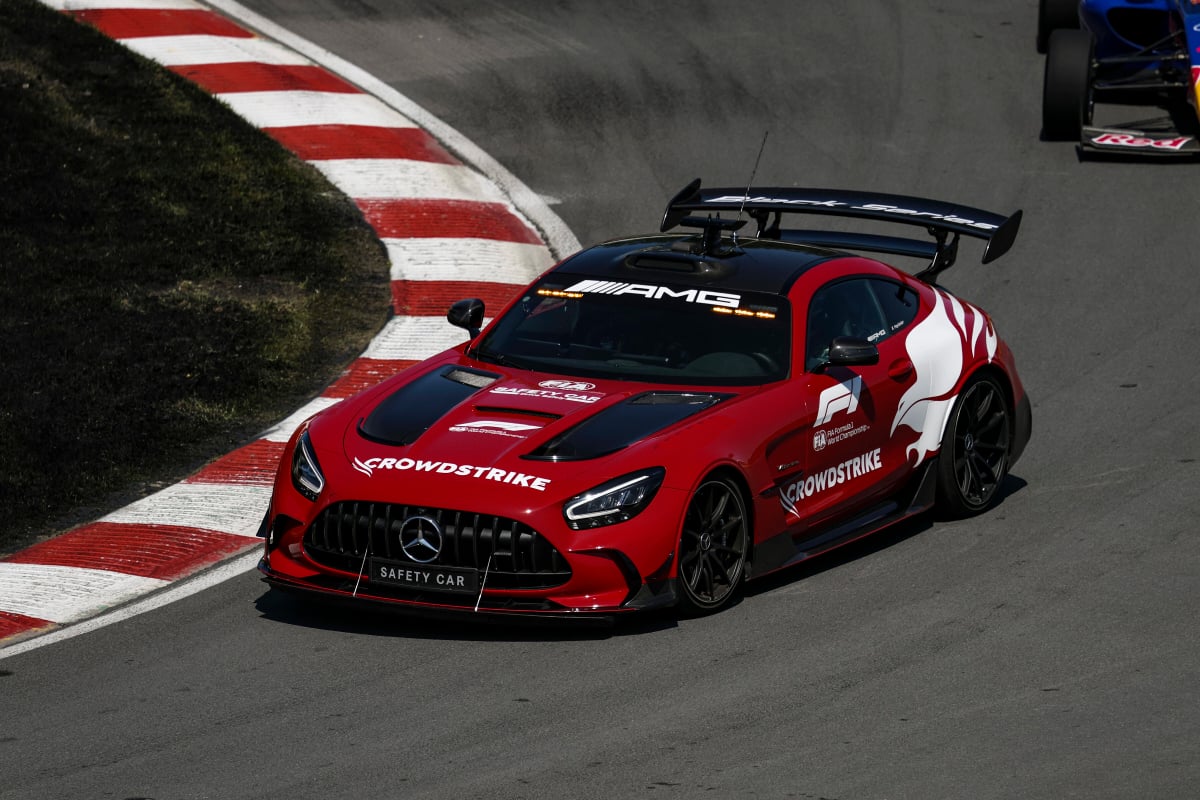
Ahead of the 2026 season, there have been some major changes announced regarding the supply of the F1 safety car. But what is the safety car, and why is it so important?
Since 1993, safety cars have been a permanent fixture in the sport, designed to control the pace of the F1 grid so that debris can be picked up, or decisions can be made about the conditions under which the cars are on track.
The safety car first appeared back at the 1973 Canadian Grand Prix, following several incidents in the hazardous conditions. To control the chaos, a Porsche 914 was deployed out on track.
That first outing didn't exactly go to plan, with the car picking up the wrong lead driver and the pack becoming jumbled up, with the eventual race winner not being crowned for several hours after the chequered flag.
Throughout the 70s and 80s, the safety car made several more cameo appearances, including at the 1982 and 1983 Monaco Grands Prix, an event that has become synonymous with the safety car over the last couple of decades.
However, it did not make another appearance in the sport after that until 1992, which was seen as a trial run, with a safety car setting the pace at the British and French Grands Prix that year.
1993 was the first year that the permanent safety car would be used, however, and since then it has continued to set the pace during chaotic conditions on track.
These days, the introduction of the safety car onto the track is signalled through the use of yellow flags and safety car boards; the letters 'SC' are also displayed on the illuminated signs.
The race director is in charge of deploying the safety car, and they will use it whenever they think that there is a risk to running the F1 cars at full speed. This might be that there's a car stranded on track, or debris strewn on the racing line, or it could be because of the weather conditions.
When it is safe to do so, the race director will send a message to all teams instructing lapped cars to overtake the field and join the back of the train.
Once the race director believes that it is ok to go racing once more, an instruction is given to inform teams that the safety car will return to the pits at the end of the current lap, at which point the lights on top of the vehicle are extinguished as a direct reference to the lead driver.
Who will be providing the F1 safety car in 2026?
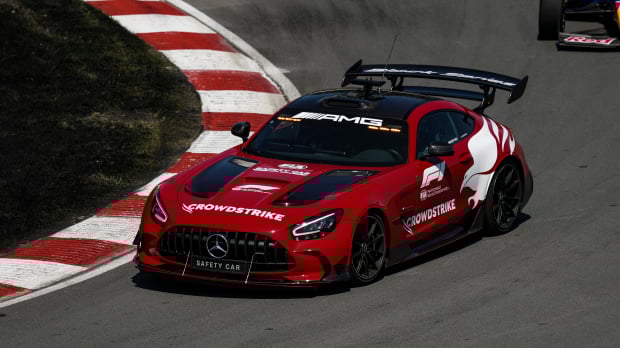
Since 2021, the providing of the F1 safety car has been shared between Mercedes and Aston Martin, with the two car manufacturers offering out a Vantage S and an AMG GT Black Series respectively in 2025.
However, Aston Martin have recently revealed that their contract with F1 has ended, and that they will not be renewing their deal to supply both safety cars and medical cars to the sport.
Instead, Mercedes will be the sole supplier of safety and medical cars from the 2026 season onwards.
What is a Virtual Safety Car?
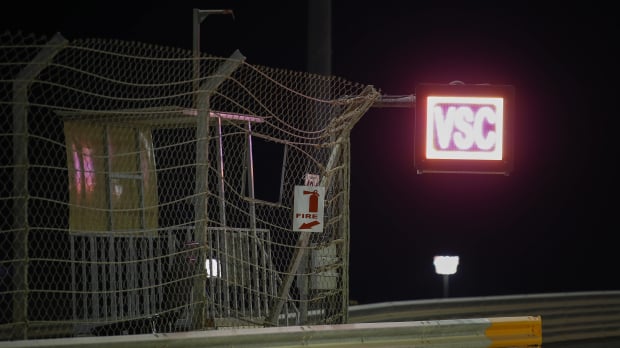
The virtual safety car (VSC) is different in that it does not bunch the field together. If this system is used, the race director has determined that any recovery work can safely be carried out with drivers lapping at a significantly reduced pace.
This, again, is shown through the use of yellow flags and VSC being shown on the illuminated signs.
Drivers are required to stick to a specific lap delta that is between 30-40 percent off their normal pace, and the idea is that they keep the gaps between them the same as before the VSC was called.
Who drives the safety car?
Bernd Maylander has driven the F1 safety car for over 25 years now, starting the role back in 2000.
Before being the safety car driver, Maylander was a racer himself, having previously raced in the Deutsche Tourenwagen Masters (DTM), and finishing second in his class at the 1999 24 Hours of Le Mans race.
Abu Dhabi 2021: Michael Masi and the most famous safety car of all
The confusion and controversy surrounding the 2021 Abu Dhabi Grand Prix was caused by a blurring of the lines between the unofficial 'let them race' principle that had been requested by teams and the regulations.
When Nicholas Latifi crashed on lap 53, Lewis Hamilton led Max Verstappen by 11.9 seconds. At this point, both drivers were on hard tyres.
Verstappen elected to pit to bolt on a set of soft tyres, something that put him behind some traffic but maintained his second position. Hamilton could also have stopped but did not.
At this point, it was not mandatory in the regulations for race director Michael Masi to allow the lapped cars to unlap themselves, meaning that he could restart the race at the drop of a hat.
Mercedes team principal Toto Wolff and Red Bull sporting director Jonathan Wheatley were both on the radio with Masi, arguing their cases, either not for resuming the race or for allowing lapped cars past. In this respect, Wolff has since conceded that this communication went too far.
On lap 57 of 58, Masi then indicated that only the five lapped cars between Hamilton and Verstappen could overtake. Ignoring the requirement to complete an additional lap before returning to green flag conditions, Masi immediately followed this with the announcement that the safety car would return to the pits at the end of that lap.
He later defended this decision, saying that teams had previously agreed that it was desirable for races to end under green flag conditions, referencing the let them race principle, but he would ultimately be removed from his position ahead of the 2022 season for the decision.
The last-lap shootout for world title honours was subsequently won by Verstappen, with Mercedes electing not to pursue a lengthy legal procedure despite initially protesting the outcome of the race.
READ MORE: F1 World Champions: The full list from Farina to new king Lando Norris
Related
More F1 news
Latest F1 news


Recommended by the editors
 Australian Grand Prix
Lewis Hamilton is the biggest winner from the Australian Grand Prix - this is why
 Australian Grand Prix
F1 Australian Grand Prix 2026 results: Final classification with penalties applied
 F1 2026
F1’s new cars in 2026 are how much slower? Australian Grand Prix confirms the sad truth
 F1 Explained
F1 Engine Compression Ratio - What is it and why is it so controversial?







Races
-
 Grand Prix of Australia 2026
-
 Grand Prix of China 2026
-
 Grand Prix of Japan 2026
-
 Grand Prix of Bahrain 2026
-
 Saudi Arabian Grand Prix 2026
-
 Miami Grand Prix 2026
-
 Grand Prix du Canada 2026
-
 Grand Prix De Monaco 2026
-
 Gran Premio de Barcelona-Catalunya 2026
-
 Grand Prix of Austria 2026
-
 Grand Prix of Great Britain 2026
-
 Grand Prix of Belgium 2026
-
 Grand Prix of Hungary 2026
-
 Dutch Grand Prix 2026
-
 Grand Prix of Italy 2026
-
Gran Premio de España 2026
-
 Grand Prix of Azerbaijan 2026
-
 Grand Prix of Singapore 2026
-
Grand Prix of the United States 2026
-
 Gran Premio de la Ciudad de Mexico 2026
-
 Grande Prêmio de São Paulo 2026
-
Las Vegas Grand Prix 2026
-
 Qatar Grand Prix 2026
-
 Grand Prix of Abu Dhabi 2026
Follow us on your favorite social media channel
Editorial & corporate information

Avenue HQ
10–12 East Parade
Leeds
LS1 2BH
United Kingdom Regional correspondence
View contact page