





Red Bull's incredible aero feature EXPLAINED by F1 expert
GPFans' aerodynamics expert Shubham Sangodkar has done a deep dive on the floor of the RB19
In the first part, we understood how the front floor acts like a lateral diffuser using the front strakes, keel, front floor kick and floor edge winglets. We dived into the potential aero mechanisms at play and how they combined together to create the first lateral diffuser.
In this article we will identify the features of the second lateral diffuser and speculate, via some CFD results, the aero mechanism driving it.
The Second Lateral Diffuser
Most motorsport fans understand how diffusers work in general. They are open venturi systems that result in the drop of static pressure at the throat before the diffuser starts expanding. The higher the expansion the higher the drop in static pressure.
To maximise and support the flow expansion within a limited design space, F1 engineers use vortex structures to maximise flow expansion. However, the larger the expansion, the higher the adverse pressure gradient that the vortex needs to travel through, and vortices don't like adverse pressure gradients.
They become lossy, or in the worst case burst as they travel through the diffuser in adverse pressure gradients, but F1 teams have found ways around it. In the sections below let us capture some of the features of the second lateral diffuser and discuss them in detail.
1. The relative position of the tyre circulation (adds inwash to feed the floor)
2. Floor edge wing (adds vorticity)
3. Mouse Hole (adds axial velocity to the vortex supporting it in APG)
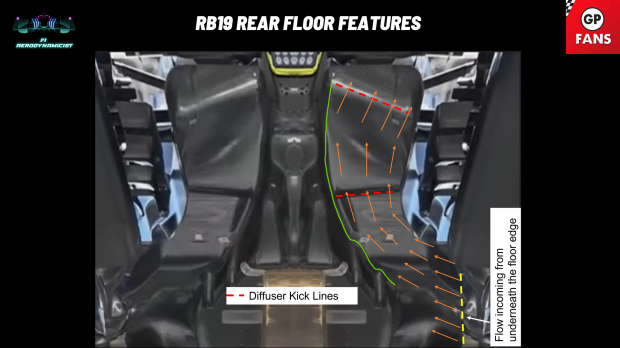
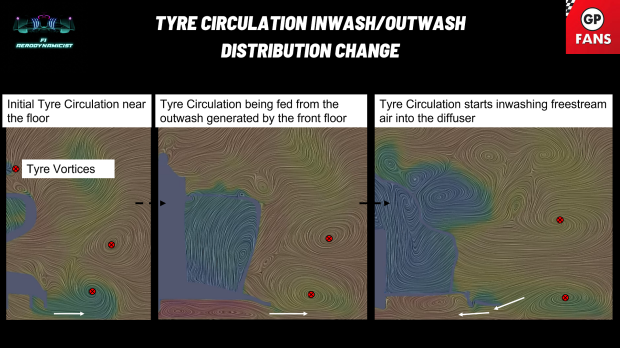
The Relative Position of the Tyre Circulation
The rotating tyre of an F1 car majorly creates two counter-rotating pair of vortex structures behind it. These vortex structures transition in strength, position and inwash/outwash pattern as they travel downstream towards the rear tyre.
Of particular interest to us is the lower vortex structure close to the ground. It is initially counter-rotating, and then feeds off the outwash that is created by the front floor along the front floor edge as discussed in part 1.
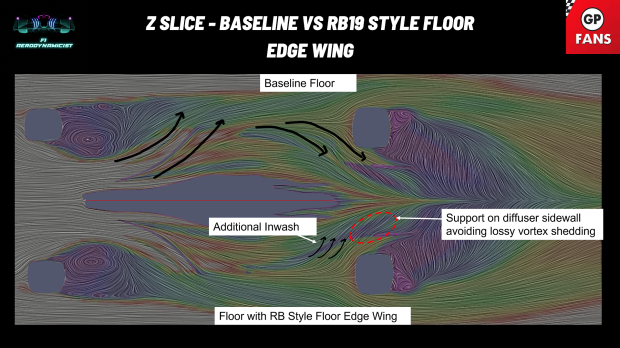
However, as the vortex travels downstream, due to the combined effect of the stagnation pressure from the rear tyre and the image-system effect of vortices near a wall this vortex starts inwashing, feeding airflow into the floor as the vortex moves away from the floor.
Added to this is the natural tendency of the airflow to seep into the floor around the floor edges due to the difference in pressure on the upper and lower surface. Both these combined effects act as the inlet to the second lateral diffuser.
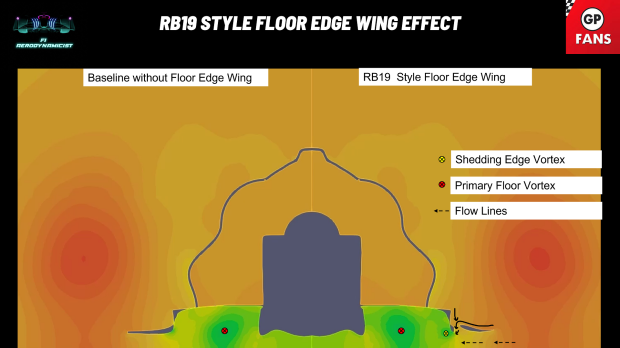
Floor Edge Wing
The floor edge wing is an interesting device, with multiple functions. Going back to our discussion on vortices and how they need support in adverse pressure gradients that they face as the diffuser expands, the question arises: how can we support them?
One solution is to add more vorticity to the vortex systems. However, this vorticity addition has to happen at the right moment. Think of this as climbing a hill and having a small energy drink. If you drink it at the beginning, it's not that effective. Drinking it too late is also useless. You want to have it at the right moment to maximise its benefits, so that you can climb the hill in the fastest way possible.
What’s the best moment to inject vorticity into our system? Well, that depends on what teams are seeing in their high-fidelity CFD with regards to vortex health and breakdown, but one thing is for sure – they need this boost to maximise the performance from the diffuser.
The floor edge wing creates an additional shedding edge, which is in close proximity to the primary floor vortex system. Such additional geometric features allow an F1 team to optimise the injection of vorticity at just the right time as per their CFD simulations.
The floor edge wing also preserves the floor planform area used to generate downforce while changing the shedding edge position. This is why this design is smarter than simply regressing the floor edge inwards as we go rearwards, as this would result in a loss of floor planform area.
Additionally, shedding the floor edge vorticity early on helps to offload the vortex structure shed from the diffuser sidewall which is in close proximity to the rear tyre contact patch. Depending on your aero philosophy this might be a good or bad thing, but at least the floor edge wing provides a control parameter to this effect.
What effect does the diffuser sidewall vortex have? To begin with, this vortex builds up in an adverse pressure gradient, so it’s not the cleanest. In addition to that, it sits low down inwashing all the rear tyre squish loss into the diffuser, which is never a good idea. So, there is merit in trying to offload this vortex structure.
All this is to say that the floor edge wing design plays an integral part in ensuring vorticity is added to the second lateral diffuser in the correct manner, such that it allows teams to push their rear floor design and diffuser design to consistently generate high downforce across a range of ride height conditions.
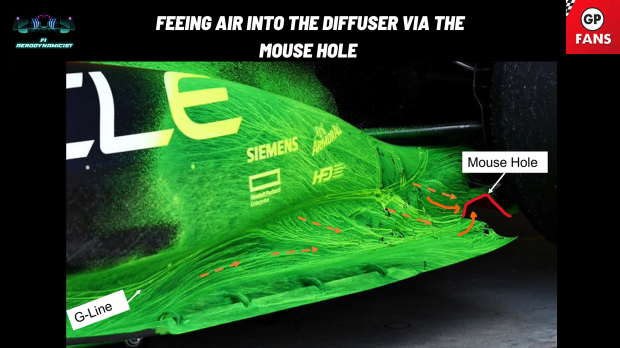
Mouse Hole Effect
When Red Bull started performing their flow viz on their sidepods, one thing was clear, they were really focusing on delivering high-energy air to the rear of the car via the g-line (The transition region between the chassis and the floor).
Further examination of the flow viz pictures showed that they were doing this by feeding airflow into the diffuser via a cutout present on the diffuser sidewall, which is now commonly referred to as the “mousehole”. Aerodynamically, to ensure that the diffuser works for a range of ride height conditions, vortex health is the most important factor.
Vortex health, as we have discussed in the previous article, depends on a factor known as “Swirl", which is the ratio of tangential velocity and axial velocity of the vortex.
When the rear ride height is high, as the vortex travels through a higher adverse pressure gradient inside the diffuser, it starts losing its axial velocity and thus changes the swirl parameter out of its ideal range initiating vortex breakdown.
When the rear ride height is lower, the tangential velocity of the vortex increases again, changing the swirl parameter outside its ideal window initiating a vortex breakdown. The mousehole basically helps feed the axial velocity to the vortex inside the diffuser so that it can work under a wide range of ride height conditions and maximize the diffuser lateral expansion.
Summing Up the Second Lateral Diffuser
The second lateral diffuser doesn't just work as conventionally as you might have thought. It takes in air not only from the underfloor tunnels, but also by empowering the tyre circulation to generate inwash into the floor.
To ensure that the primary floor vortex can handle the aggressive diffuser expansion, the floor edge wing is used to shed vorticity strategically to add vorticity to the primary vortex. To maintain the health of the primary vortex across a large range of ride height conditions, the mouse hole is used to add axial velocity to the primary vortex which maintains the swirl of the vortex.
Exploiting these potential aero mechanisms to their limit is part of how the RB19 has become the class of the field.
Shubham Sangodkar is a former F1 Aerodynamicist with a Master's in Racing Car Design specialising in F1 Aerodynamics and F1 Data Analysis. He also posts aerodynamics content on his YouTube channel, which can be found here.
READ MORE: Who is Helmut Marko? The genius behind Red Bull rise to power
Related
More F1 news
Latest F1 news



Recommended by the editors
 Max Verstappen
Max Verstappen accused of 'throwing toys out of pram' over F1 criticism
 Max Verstappen
Max Verstappen series switch confirmed as F1 champion heads Nurburgring entry list
 Latest F1 News
Red Bull car is 30kg overweight? F1 fan 'exposes FIA data' in shocking images
 Aston Martin
Aston Martin replacing Adrian Newey as team principal the inevitable outcome







Races
-
 Grand Prix of Australia 2026
-
 Grand Prix of China 2026
-
 Grand Prix of Japan 2026
-
 Grand Prix of Bahrain 2026
-
 Saudi Arabian Grand Prix 2026
-
 Miami Grand Prix 2026
-
 Grand Prix du Canada 2026
-
 Grand Prix De Monaco 2026
-
 Gran Premio de Barcelona-Catalunya 2026
-
 Grand Prix of Austria 2026
-
 Grand Prix of Great Britain 2026
-
 Grand Prix of Belgium 2026
-
 Grand Prix of Hungary 2026
-
 Dutch Grand Prix 2026
-
 Grand Prix of Italy 2026
-
Gran Premio de España 2026
-
 Grand Prix of Azerbaijan 2026
-
 Grand Prix of Singapore 2026
-
Grand Prix of the United States 2026
-
 Gran Premio de la Ciudad de Mexico 2026
-
 Grande Prêmio de São Paulo 2026
-
Las Vegas Grand Prix 2026
-
 Qatar Grand Prix 2026
-
 Grand Prix of Abu Dhabi 2026
Follow us on your favorite social media channel
Editorial & corporate information

Avenue HQ
10–12 East Parade
Leeds
LS1 2BH
United Kingdom Regional correspondence
View contact page