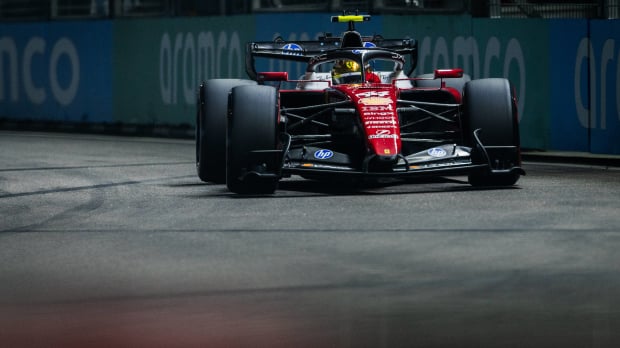

Singapore Grand Prix: A Graveyard for the Favourites
Formula 1 heads to Singapore for one of the most demanding races of the season, with Max Verstappen arriving at Marina Bay carrying renewed confidence after Red Bull Ford's breakthrough victory at Sepang.
The Dutchman has spent years establishing himself as one of the sport's most formidable drivers. He has won at circuits across the calendar and built a reputation for extracting extraordinary performance from his machinery. And yet, Singapore remains a glaring exception.
Four podium finishes are there, but they are three second places and a third, without a win at the famous circuit. He has been close to victory without ever being able to deliver the top step.
Verstappen is definitely not the favourite to win the 2026 Drivers' Championship, but he remains the leading name in F1 Grand Prix Singapore odds.
The upcoming Singapore Grand Prix is a test of whether his latest success represents a genuine turning point for Red Bull Ford, or simply a spectacular result produced by unusually favourable conditions.
The rain-affected Grand Prix at Sepang demonstrated the potential of the team's first works power unit, but Marina Bay presents an entirely different challenge. The circuit is bumpy, physically punishing, technically demanding and unforgiving of mistakes.
Red Bull Ford's Sepang Breakthrough Raises Expectations
Winning a Grand Prix is always significant, but Red Bull Ford's victory at Sepang carried additional importance.
In its first season operating with its own works power unit, the team secured its maiden victory with the new engine programme, a major milestone in its technical development.
Verstappen captured the achievement succinctly after the race: "To win our first race in our first year with our own power unit is pretty impressive."
The result is an encouraging response to questions about whether RB Ford could establish itself as a genuine contender while building its own power unit programme.
Developing an engine capable of competing at F1's highest level requires more than outright speed. Reliability, energy deployment, drivability, cooling and integration with the chassis all influence performance, and the early stages of a new project inevitably involve compromises.
Sepang showed the package is beginning to come together. However, the conditions surrounding the victory leave important questions unanswered.
Wet-weather races can reward a driver's judgement, confidence and ability to identify grip, while reducing the importance of certain performance differences between cars. A driver who reads changing conditions correctly can overcome shortcomings that would be exposed on a dry track.
Verstappen's contribution should not be dismissed simply because the race was wet, though. Rain introduces its own technical and strategic challenges, from tyre selection and visibility to aquaplaning and rapidly changing grip levels.
Nevertheless, the Singapore GP will offer a more revealing assessment of Red Bull Ford's overall progress.
The Marina Bay circuit demands a car that responds predictably through slow corners, rides bumps without unsettling the driver, and provides sufficient traction when accelerating out of tight turns.
Strong braking stability is essential, and confidence over a long stint is the difference between maintaining a position and losing ground.
For Verstappen, a competitive qualifying session and convincing race pace would strengthen the argument that RB Ford is moving in the right direction.
Why Singapore Has Been So Difficult for Verstappen
Verstappen has conquered circuits that once appeared beyond his reach, but Singapore has remained stubbornly resistant.
His four podium finishes demonstrate that he can compete at Marina Bay, but the absence of a victory is unusual for a driver with his record and a stain on his legacy thus far.
The challenge is partly architectural in nature. Unlike permanent circuits with broad run-off areas, Singapore's street layout leaves little room to recover from a mistake.
A slightly misplaced braking point, an awkward encounter with a kerb or a loss of traction can compromise an entire sequence of corners. Drivers must operate close to the limit while preserving enough margin to avoid the barriers.
Singapore also rewards a particular balance of aggression and patience. Overtaking opportunities are limited compared with many conventional circuits, so qualifying position and race strategy carry enormous importance.
A driver can have excellent pace but still struggle to convert it into a victory if the car cannot follow closely through the corners or if traffic disrupts the intended pit-stop window.
The physical demands are also pronounced, as high humidity, warm temperatures and the continuous concentration required to navigate the walls can leave drivers exhausted.
The cockpit becomes a punishing environment in which every braking zone, gear change and steering correction demands precision.
Verstappen's three second-place finishes show how narrow the margin can be between success and frustration.
Singapore has not exposed a fundamental weakness in his driving, but it has repeatedly denied him the combination of car performance, strategy, qualifying position and race circumstances required to win.
Could 2026 finally be the year?
Marina Bay Punishes Every Mistake
The Marina Bay Street Circuit measures 4.927 kilometres and features 19 corners across a demanding 62-lap Grand Prix.
The total race distance is 305.337 kilometres, meaning drivers must maintain concentration and physical resilience for an extended period despite the relatively low average speeds.
The layout originally contained 23 corners, but changes introduced in 2023 reduced that number to 19 by removing a technically demanding section and replacing it with a longer straight.
The revised configuration created a more useful overtaking opportunity and helped improve lap times, although the circuit remains one of the most intricate challenges on the calendar.
Bumps are a defining characteristic of the track. Unlike a purpose-built racing facility, Marina Bay runs across public roads that must accommodate everyday traffic for much of the year.
Changes in surface, uneven patches and aggressive kerbs can unsettle a car, especially when drivers attack corners at the limit.
The sheer physical environment of the city is a challenge on its own. Temperatures around 30°C and high humidity create tough conditions even though the race takes place at night.
Drivers can lose up to three kilograms of body weight during the event through sweating and dehydration. Maintaining hydration and preserving concentration are essential parts of race preparation, more so than elsewhere on the calendar.
Safety-car interruptions are common at Singapore, and a neutralisation can transform the competitive order by allowing drivers to pit with a smaller time loss.
Teams must balance the benefits of an early stop against the danger of being caught out by a later incident. A well-timed pit stop can create a winning opportunity, while a poorly timed one can leave a driver trapped behind slower cars.
A Graveyard for Favourites
Singapore has developed a reputation as a graveyard for race favourites. It is a race where championship contenders and seemingly comfortable race leaders can find their plans overturned by strategy, technical problems or the unforgiving nature of the circuit.
At the same time, the winners have been different in previous years.
The list of recent winners at Singapore shows that Sergio Pérez won for Red Bull in 2022, Sainz triumphed for Ferrari in 2023, Lando Norris took victory for McLaren in 2024, and George Russell won for Mercedes in 2025.
Four races produced four winners for different teams, a variety that makes 2026 particularly interesting.
Going back to the supposed curse, Lewis Hamilton's experience in 2025 is an infamous example. Despite dealing with brake problems, the British driver set the fastest race lap at 1:33.808.
The performance demonstrated the speed he could still extract under difficult circumstances, but the mechanical issue ultimately prevented him from converting that pace into a stronger finishing result.
Charles Leclerc's disappointment in 2019 remains another memorable illustration of how Singapore can complicate an apparently straightforward victory.
Leclerc started from pole position for Ferrari, only for the team's undercut strategy to hand the win to team-mate Sebastian Vettel.
Vettel pitted earlier, produced a sufficiently strong out-lap and emerged ahead after Leclerc made his stop.
Ferrari secured a one-two finish, but the result left Leclerc frustrated. He had controlled qualifying and expected to be in contention for victory, yet the strategic decision changed the outcome.
It was a reminder that even the quickest driver over a single lap cannot assume that the race will unfold according to plan.
Red Bull's dominance was also interrupted here in 2023. Carlos Sainz won for Ferrari, ending the team's remarkable run of consecutive victories that had continued throughout the season.
The circuit has repeatedly rewarded the team that best understands its unique demands rather than simply the one with the strongest overall package.
Verstappen might be the favourite in the Singapore predictions, but Marina Bay never offers guarantees.
Will the trend continue with a fifth different winner in five years, or will Verstappen finally add his name to the list of Singapore Grand Prix champions?
Drivers' and Constructors' Championship Standings
The championship situation places Verstappen in an unusual position. He remains a serious contender for individual race victories, but the Drivers' Championship is becoming increasingly difficult to recover.
Kimi Antonelli leads the F1 season 2026 outrights, with Verstappen 132 points behind and 183 points still available across the remaining championship opportunities.
Mathematically, the Dutchman remains in contention. Practically, however, his route to the title is exceptionally narrow.
Verstappen would need to win almost everything left on the calendar while Antonelli collected fewer than approximately 50 additional points.
That would require sustained excellence from Red Bull Ford and a substantial reversal in Antonelli's results. Even a strong Singapore weekend would not erase the deficit, but it could help maintain pressure and keep Verstappen's title hopes alive for longer.
The more immediate contest concerns the positions behind the championship leader. Verstappen is level with Lando Norris on 188 points, leaving the battle from second through fourth place open.
Singapore could be a valuable opportunity to separate himself from Norris and improve his position. A victory would deliver a major points haul and reinforce his reputation as a driver who capitalises when circumstances align.
Conversely, a difficult weekend could leave him further behind in the fight for the remaining podiums.
While the Drivers' Championship offers a difficult mathematical challenge, the Constructors' battle presents Red Bull Ford with a more immediate and realistic objective.
The team is 18 points behind McLaren in the fight for third place. That gap is small enough for a strong weekend to make a meaningful difference, particularly if both cars contribute to the result.
A victory for Verstappen combined with points from Isack Hadjar could substantially improve Red Bull Ford's position.
Red Bull Ford's first works power unit victory at Sepang has raised expectations, but Singapore will help determine whether the team can sustain that progress.
With McLaren only 18 points ahead, Red Bull Ford has a clear incentive to pursue strong results, but reliability remains crucial. A technical failure or costly incident could erase the gains from an otherwise successful weekend.
Weather Could Change Everything Again
Weather is likely to remain one of the weekend's major talking points. Forecast conditions point towards temperatures around 30°C, with a 35% chance of rain on both Saturday and Sunday.
That possibility creates an interesting contrast with Sepang. Red Bull Ford's recent victory came in wet conditions, but Singapore's combination of tight corners, painted surfaces, road markings and barriers makes rain particularly treacherous.
Water can reduce grip dramatically, while visibility becomes more difficult when cars follow closely through narrow streets.
A wet qualifying session could scramble the grid and give Verstappen an opportunity to demonstrate his ability to find grip in changing conditions.
Rain during the race could also create strategic openings, forcing teams to decide when to switch tyres and whether the conditions justify an early stop.
The team still needs to show that its car performs competitively in dry conditions, where the differences in traction, aerodynamic balance and tyre management can become more apparent.
With the championship battles tightening and the possibility of rain adding uncertainty, Singapore offers plenty for F1 fans to follow throughout the weekend.
Stake has qualifying, race-winner predictions, podium markets and head-to-head driver match-ups that can all provide different perspectives on how the event might unfold.
Fans should approach the race as an unpredictable sporting contest, compare available odds carefully, and bet only within affordable limits.
Marina Bay has humbled favourites before, and it will humble unsuspecting racing pundits, too!






 Grand Prix of Australia 2026
  Grand Prix of China 2026
  Grand Prix of Japan 2026
  Saudi Arabian Grand Prix 2026
  Miami Grand Prix 2026
  Grand Prix du Canada 2026
  Grand Prix De Monaco 2026
  Gran Premio de Barcelona-Catalunya 2026
  Grand Prix of Austria 2026
  Grand Prix of Belgium 2026
  Grand Prix of Hungary 2026
  Grand Prix of Italy 2026
  Grand Prix of Azerbaijan 2026
  Grand Prix of Bahrain 2026
  Grand Prix of Singapore 2026
  Gran Premio de la Ciudad de Mexico 2026
  Grande Prêmio de São Paulo 2026
  Qatar Grand Prix 2026
  Grand Prix of Abu Dhabi 2026