


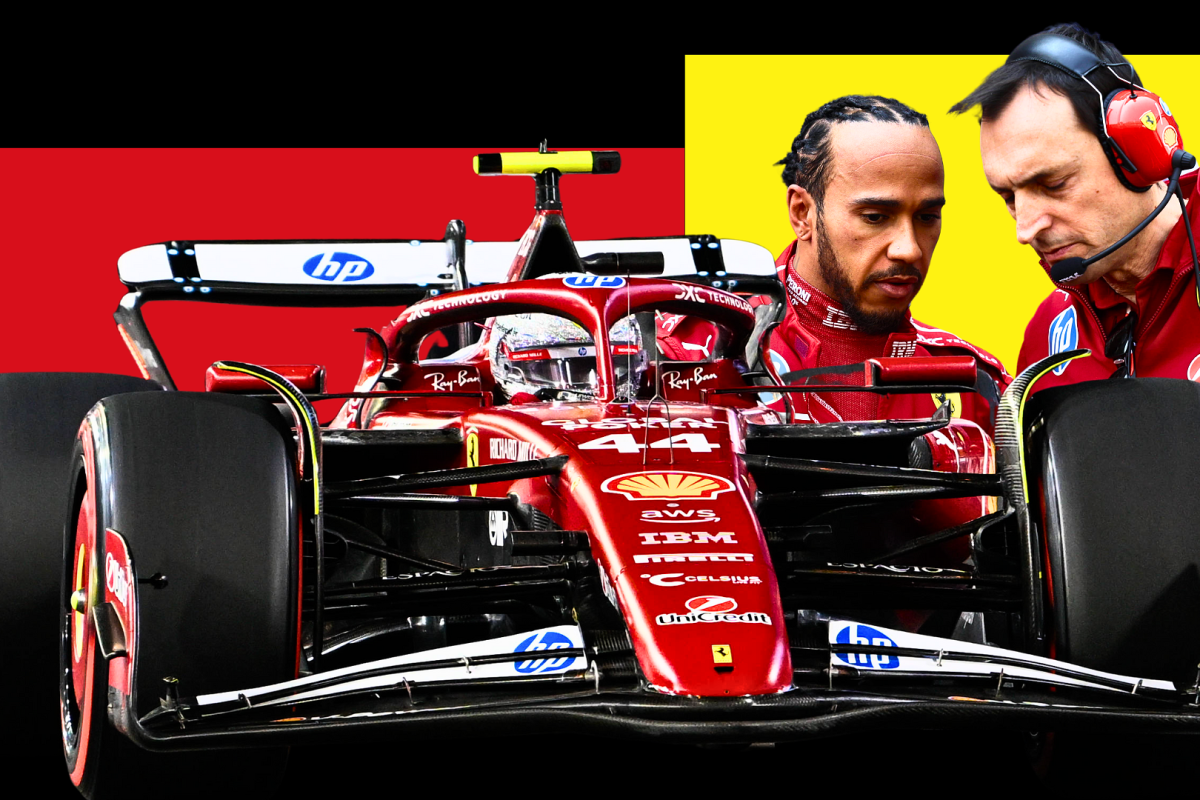
Lewis Hamilton race engineer fumble could cost Ferrari severely

Day 41 in the Big Ferrari House...and Lewis Hamilton still doesn't have a permanent F1 race engineer.
What's the big deal though? Carlo Santi will be on hand to guide him through the first few races of the season, mainly to save Bryan Bozzi from spinning more plates than a circus acrobat. And anyway, surely there's someone else in the pipeline who can takeover midway through the season?
But therein lies the problem. You see, Riccardo Adami stepped down — you only have to look at his breakdown in communication with Hamilton last year to guess why — so that the champion could build a better relationship with another engineer to help his quest for an eighth world title etcetera, etcetera.
Yet this new engineer hasn't arrived, and it doesn't bode well for the future that Hamilton hasn't begun to work on this relationship. How precisely could this hinder him however? One answer. Those pesky 2026 cars.
READ MORE: Verstappen slammed by F1 icon - 'someone else will replace him'
Can old-school Hamilton master 2026 cars?
To answer this question, it's time to lean on the expertise of the good doctor, not David Tennant, but Dr Riccardo Ceccarelli.
The Italian has worked in F1 since 1989, founding the Formula Medicine team who have assisted drivers and legendary squads (including Fernando Alonso's championship winning Renault team), with the medical and physical demands of being a racing driver.
So, Ceccarelli's experience and expertise means he's incredibly well qualified on the topic of driver performance. In conversation with Motorsport.com's Italian offshoot, he delved into the new cars and how 'old school drivers', such as Alonso and Hamilton, will cope with the 2026 cars.
When asked whether drivers will struggle with managing energy recharge and active aerodynamics, he said: "Those who come from an old-school driver mentality like Lewis Hamilton or Fernando Alonso clearly find themselves in a big, very difficult situation.
"I spoke to the engineers, and they assure me that managing the electric car's energy will be very complicated because it won't be enough to cover an entire lap, and it will be up to the technicians to provide precise instructions for the launch lap, the qualifying lap, and, obviously, the race."
Clear, precise instructions. Notoriously, that's exactly how Hamilton likes to be kept abreast of developments in the race car. It was what Adami was so poor at last year, and arguably held Hamilton back.
And look, Santi, or whoever Hamilton's next engineer is going to be, could arrive and instantly have a great rapport with the champion. But the brutal reality is, that these relationships take time to nurture and develop. And that time has run out. We approach the first race of the 2026 season and Hamilton is no closer to establishing that bulletproof bond, right when he needs it the most.
Ceccarelli continues that in 2026: "The driver will be subjected to a greater mental load: he won't be able to afford car management errors that could penalise performance.
"Before qualifying, he will have to be careful not to make a mistake on the launch lap, otherwise he risks finding himself without electrical power during the timed lap. It's clear that, at least initially, performance will be the result of improved collaboration between the driver and the team."
That is the key term here, 'collaboration between driver and team'. How on earth can Hamilton achieve such levels of synergy, if he hasn't had any experience with his new race engineer?
Even Hamilton himself admitted the 'missing link' could hurt him in 2026. If each race instead becomes a learning curve for his side of the garage, performance will be sacrificed because of ill preparation.
One wrong word, one communication mishap could undo a qualifying lap. A string of blunders could undo a season. Ferrari's race engineer fumble could cost Lewis Hamilton the chance of fighting for an eighth world title.
READ MORE: Hamilton and Ferrari F1 under threat at Australian GP
Related

Latest News

George Russell hits back at Max Verstappen attack on F1
- 58 minutes ago

Lewis Hamilton race engineer fumble could cost Ferrari severely
- 1 hour ago

F1 chief brands new 2026 cars a 'waste' and in danger of 'steep decline'
- 2 hours ago

F1 News Today: Christian Horner Drive to Survive revelations as George Russell talks sex toys
- 3 hours ago

The Red Bull superstition the entire team must do before EVERY race
- 3 hours ago

The biggest blocker to Lewis Hamilton winning an 8th F1 title is inside Ferrari
- Today 09:55
Most read

Lewis Hamilton finally breaks his silence on Kim Kardashian dating rumours
- 12 february

F1 2026 WAGs: Lewis Hamilton latest, Norris and Antonelli breakups
- 19 february

FIA 'will ban' Mercedes engine trick following rivals uproar
- 16 february

F1 Drive to Survive Season 8: Netflix release time, episodes and big storylines
- Yesterday 22:00

F1 Testing 2026: Bahrain schedule, start times and how to watch live
- 12 february

Shrewd Christian Horner decision could prove detrimental to Aston Martin
- 21 february

F1 Standings




Races
-
 Grand Prix of Australia 2026
-
 Grand Prix of China 2026
-
 Grand Prix of Japan 2026
-
 Grand Prix of Bahrain 2026
-
 Saudi Arabian Grand Prix 2026
-
 Miami Grand Prix 2026
-
 Grand Prix du Canada 2026
-
 Grand Prix De Monaco 2026
-
 Gran Premio de Barcelona-Catalunya 2026
-
 Grand Prix of Austria 2026
-
 Grand Prix of Great Britain 2026
-
 Grand Prix of Belgium 2026
-
 Grand Prix of Hungary 2026
-
 Dutch Grand Prix 2026
-
 Grand Prix of Italy 2026
-
Gran Premio de España 2026
-
 Grand Prix of Azerbaijan 2026
-
 Grand Prix of Singapore 2026
-
Grand Prix of the United States 2026
-
 Gran Premio de la Ciudad de Mexico 2026
-
 Grande Prêmio de São Paulo 2026
-
Las Vegas Grand Prix 2026
-
 Qatar Grand Prix 2026
-
 Grand Prix of Abu Dhabi 2026
Follow us on your favorite social media channel
Corporate information
 Innovatieweg 20C
7007 CD, Doetinchem, Netherlands
+31 6 455 168 60
See the Contact page for regional correspondence addresses