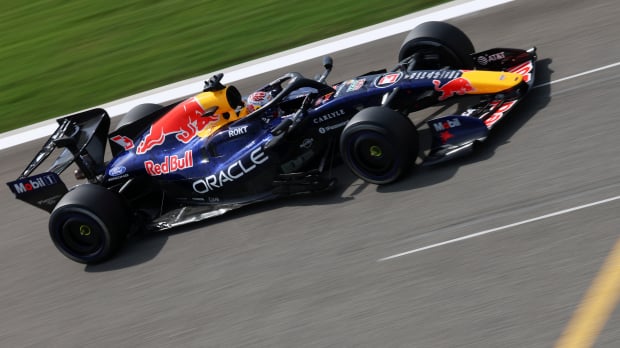

F1 2026 Regulations: What is Recharge mode
There are plenty of new terms to wrap your head around in F1 ahead of the 2026 championship

The 2026 F1 season is seeing the biggest overhaul of the chassis and power unit regulations in the sport's modern history.
The cars are both smaller and lighter and are powered by new power units. The PUs will still be a 1.6-litre V6 turbo hybrid - as they have been since 2014 - but the 2026 versions have seen the emphasis on electrical energy output tripled.
The latest F1 regulations cycle has introduced an almost 50/50 power split between the internal combustion engine (ICE) and the 350kW electrical MGU-K system, after the MGU-H was removed altogether.
This change means drivers now have to turn their attention to a much more advanced form of energy management, with an increased focus on energy recovery through braking and 'super clipping', which was a hot topic of discussion among some of the sport's biggest names at 2026 pre-season testing.
F1 2026 Regulations: What has happened to the MGU-H?
What is F1 Recharge mode?
Naturally, you may be wondering, 'what is super clipping', what is 'Recharge mode' and 'what does lift and coast mean?' Well don't worry, GPFans are here to answer all the questions you may have about the new power units.
Thanks to the new regulations, the energy recovery system (ERS) could originally recharge the new battery to power the new hybrid unit with twice as much energy per lap as it could in 2025, with drivers able to recharge it up to 9MJ per lap.
These elements of energy management are often automated and will therefore play a significant role in helping the drivers to manage their battery capacity throughout a lap and across a grand prix distance.
Recharge mode is when a driver refills the battery on their new cars using recovered energy, using a range of strategies to capture the energy and send it back to the battery, something previously referred to as 'harvesting'.
This can be done a number of ways, including through braking, when partly on the throttle, when lifting and coasting or when a driver is super clipping, although the effectiveness of each strategy will depend on the engine map, the circuit profile, and the overall Recharge energy allowance for that circuit, which will vary from track to track.
Most of the time, the Recharge will be automated by use of selectable Recharge maps and targets, which mean braking, part throttle and super clipping will all be automated functions controlled by the engine control unit (ECU).
The only Recharge mode the driver will have control of personally will be the lift-off regen (just another term for lift and coast) which is when a driver lifts off the accelerator early before a braking zone, allowing their car to coast, something which allows the MGU-K to harvest the energy and recharge the battery.
Adopting this tactic will disable the active devices on the new cars, whereas super clipping will allow the active aero to remain open due to the process taking place whilst a driver is still at full throttle.
'Super clipping' is when the cars automatically power from the ICE to redirect it to the battery at various points around the track when a driver is at full throttle, which results in the car automatically slowing down due to the loss of power, particularly to the rear wheels.
The more that any of the above processes take place, the more energy will be available within the car's battery to allow things such as overtake mode to take place. If a driver burns too much energy attacking during a grand prix or through overtaking, they may run out of it later at a vital moment in their race, hence why energy management and recharge will be crucial in 2026.
FIA changes to energy recharging as of Miami GP
Following the FIA's rule tweaks ahead of the Miami Grand Prix, however, there have been adjustments to energy management parameters for qualifying.
In a statement they explained: "Adjustments to energy management parameters, including a reduction in maximum permitted recharge from 8MJ to 7MJ, aimed at reducing excessive harvesting and encouraging more consistent flat-out driving. This change targets a maximum superclip duration reduced to approximately 2-4 seconds per lap.
"Peak superclip power increased to 350 kW, previously being 250kW, further reducing the time spent recharging, and reducing driver workload on energy management. This will also be applied in race conditions.
"The number of events where alternative lower energy limits may apply has been increased from eight to 12 races, allowing greater adaptation to circuit characteristics."
When does the 2026 F1 season start?
All 11 teams will be back in action when the 2026 season starts in Melbourne for the Australian Grand Prix.
The first race of the year takes place on Sunday, March 8, at 3pm local time (AEDT), 4am GMT, and 11pm ET.
F1 2026 Regulations: What is active aero?






 Grand Prix of Australia 2026
  Grand Prix of China 2026
  Grand Prix of Japan 2026
  Saudi Arabian Grand Prix 2026
  Miami Grand Prix 2026
  Grand Prix du Canada 2026
  Grand Prix De Monaco 2026
  Gran Premio de Barcelona-Catalunya 2026
  Grand Prix of Austria 2026
  Grand Prix of Belgium 2026
  Grand Prix of Hungary 2026
  Grand Prix of Italy 2026
  Grand Prix of Azerbaijan 2026
  Grand Prix of Bahrain 2026
  Grand Prix of Singapore 2026
  Gran Premio de la Ciudad de Mexico 2026
  Grande Prêmio de São Paulo 2026
  Qatar Grand Prix 2026
  Grand Prix of Abu Dhabi 2026