


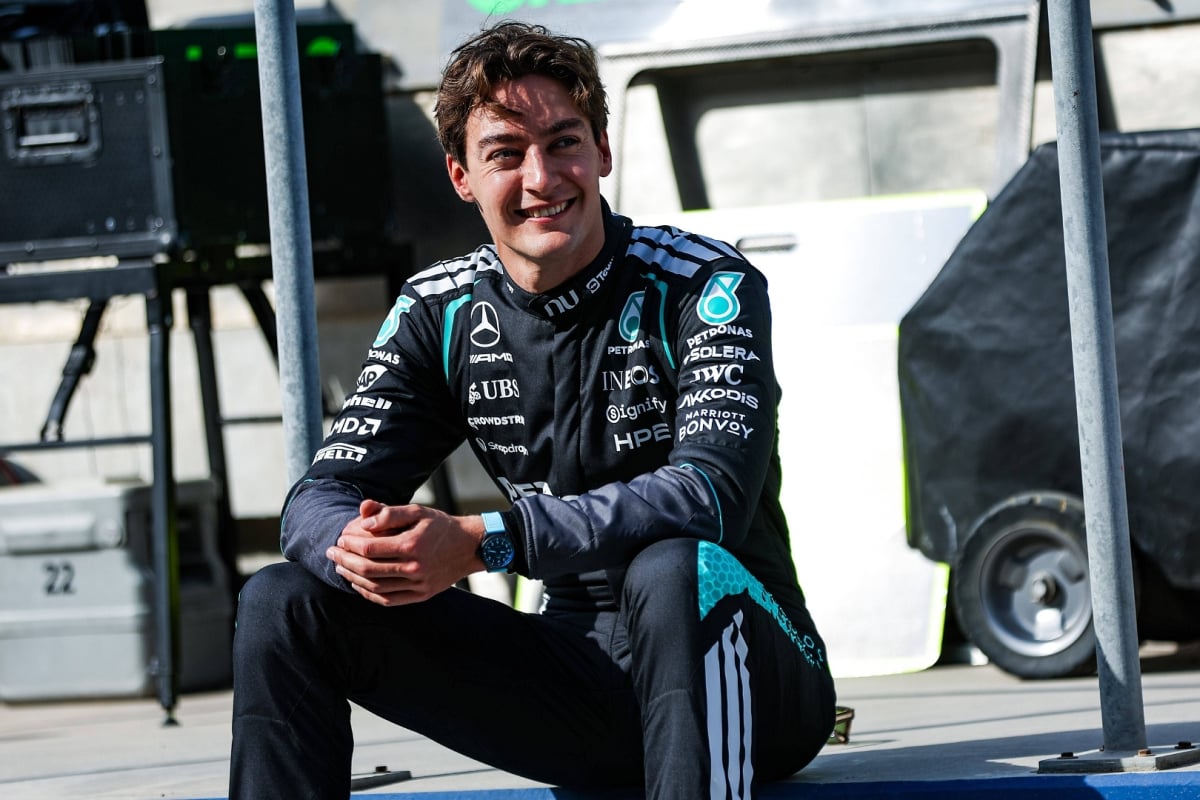
F1 Explained: What is sandbagging?

As F1 continues to throw new vocabulary at you like an overenthusiastic English teacher, we're on hand to explain the latest lexical mystery you may hear in testing - sandbagging.
Unlike our other explainers on straight mode, overtake mode and the boost button, sandbagging isn't limited to the new set of 2026 regulations and has been in F1 for a long time.
Most recently you may have heard the term in relation to Mercedes after Max Verstappen accused them of using 'diversion tactics' and concealing how much power they have. Which is just a verbose way of claiming they are sandbagging.
Mercedes' power has been the subject of much debate in the off-season, and it is believed their engine trick in relation to their geometric compression ratio could give them a 0.3 second advantage. But that's a whole different explainer, we're here to talk about sandbagging.
Let's get stuck into it then! What is sandbagging, and fundamentally why do F1 teams employ the tactic.
F1 2026 Regulations: What is active aero?
What is sandbagging?
In testing, sandbagging refers to a team or driver deliberately concealing their maximum performance. A team may slow their performance down to throw their rivals with inaccurate data or to catch them off guard at the first race of the season.
This can be achieved in multiple ways, from putting more fuel than is necessary in the car, to running a low power engine setting or simply...driving really slowly. Of course, for teams it is a fine balance between actually collecting useful data and sandbagging.
Former Ferrari, Williams and Jordan engineer Rob Smedley told F1 in 2019: "You want to get the car on a reasonable level of fuel, 40kg maximum, get some soft-ish tyres on and push the car just to see how it behaves and get that information.
"On the other hand, you quite often see that the top teams will run around all week on 50kg and never get the car below that. There’s absolutely merit and validity in doing that because all they're doing is collecting as much data as they can, and then they know that that’s going to put them in a much more favourable position by the time they get to Australia."
Smedley then added: "Honestly, I don’t think people actively sandbag. Because frankly, what’s the point? Take the Brawn situation in 2009. They turned up and, I think, surprised even themselves.
"It became wholly apparent by the end of their first day of running that they had this incredible beast that was probably not only going to win the first race but clean up for the first few before people caught up – and it did. If they’d sandbagged, what would it have changed?"
Nevertheless in 2019, it was Ferrari who looked quick in pre-season testing, but Charles Leclerc cottoned on to his rivals tactics and suspected they were sandbagging. Surely enough, Mercedes went on to win 15 races in that year.
A gentle reminder to take all times in testing with a massive pinch of salt.
When does the 2026 F1 season start?
Th second round of testing in Bahrain continues this week from February 18 until February 20.
The F1 2026 season officially starts in Melbourne for the Australian Grand Prix. The first race of the year takes place on March 8 at 3pm local time (AEDT), 4am GMT, and 11pm ET.
F1 Engine Compression Ratio: What is it and why is it so controversial?
Related

Latest News

F1 start procedure explained - why is it so controversial in 2026?
- 4 minutes ago

F1 Explained: What is sandbagging?
- 1 hour ago

F1 track replaces iconic venue in calendar rotation agreement
- 3 hours ago

Fernando Alonso gives 'confidence' verdict after Adrian Newey's Aston Martin testing disaster
- Today 11:55

VOTE: Who's more likely to retire from F1 first - Lewis Hamilton or Fernando Alonso?
- Today 10:59

Zak Brown confirms ‘strategic’ use of papaya rules
- Today 09:59
Most read

Daniel Ricciardo is back in F1, but this time it's different
- 31 january

Lewis Hamilton finally breaks his silence on Kim Kardashian dating rumours
- 12 february

Lewis Hamilton split prompts major Angela Cullen decision
- 5 february

F1 2026 WAGs: Lewis Hamilton is 'dating Kim Kardashian'?
- 2 february

F1 Testing 2026: Bahrain schedule, start times and how to watch live
- 12 february

F1 Testing Results: Bahrain timesheets as Lewis Hamilton suffers late Ferrari blow
- 13 february

F1 Standings




Races
-
 Grand Prix of Australia 2026
-
 Grand Prix of China 2026
-
 Grand Prix of Japan 2026
-
 Grand Prix of Bahrain 2026
-
 Saudi Arabian Grand Prix 2026
-
 Miami Grand Prix 2026
-
 Grand Prix du Canada 2026
-
 Grand Prix De Monaco 2026
-
 Gran Premio de Barcelona-Catalunya 2026
-
 Grand Prix of Austria 2026
-
 Grand Prix of Great Britain 2026
-
 Grand Prix of Belgium 2026
-
 Grand Prix of Hungary 2026
-
 Dutch Grand Prix 2026
-
 Grand Prix of Italy 2026
-
Gran Premio de España 2026
-
 Grand Prix of Azerbaijan 2026
-
 Grand Prix of Singapore 2026
-
Grand Prix of the United States 2026
-
 Gran Premio de la Ciudad de Mexico 2026
-
 Grande Prêmio de São Paulo 2026
-
Las Vegas Grand Prix 2026
-
 Qatar Grand Prix 2026
-
 Grand Prix of Abu Dhabi 2026
Follow us on your favorite social media channel
Corporate information
 Innovatieweg 20C
7007 CD, Doetinchem, Netherlands
+31 6 455 168 60
See the Contact page for regional correspondence addresses