




EXCLUSIVE: F1 banned tobacco but companies are still spending $40million on advertising
GPFans spoke exclusively to global industry watchdog STOP about F1 and tobacco sponsorship

Marlboro. Rothmans. Camel. Even if you're new to F1, chances are you can name or visualise the cars these tobacco brands sponsored. That is the power of tobacco advertising in F1, and it's still prevalent today.
The relationship between F1 and tobacco companies has not gone unnoticed. STOP (Stopping Tobacco Organisations and Products) is a global industry watchdog who 'expose the tactics' of the tobacco industry and the work that it's doing to 'undermine public health'.
According to STOP, 7million people still die from tobacco use all over the world every year. Through their network of academics, researchers and advocates, they expose what the industry is doing to the public. They work closely with the University of Bath's 'Tobacco Control Research Group' — the world's foremost experts in studying the tobacco industry — while also collaborating with governments and investigative journalists.
STOP also do their own investigative research, and they've been keeping a close eye on Formula 1. 'Big Tobacco' companies such as Philip Morris International (PMI) and British American Tobacco (BAT) still gain major exposure through F1, and a recent report showed that a significant $40 million, split across PMI and BAT, was spent in one year.
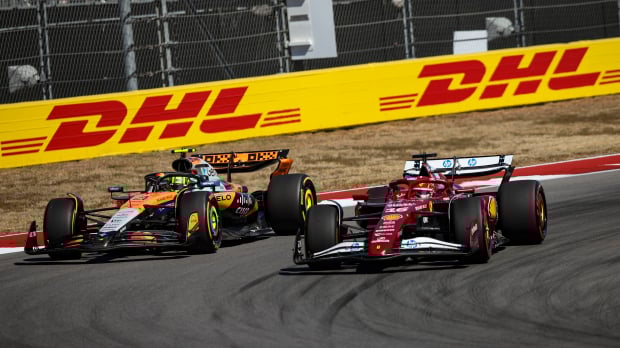
PMI recently signed a multi-year deal with Ferrari and their nicotine pouches Zyn are now displayed on Lewis Hamilton and Charles Leclerc's 2026 racesuits. BAT's Velo brand has also featured on the McLaren car in recent years. Both brands are allowed to advertise because they are nicotine products however, not tobacco.
But, Jorge Alday (Director of STOP at Vital Strategies) has claimed these nicotine products are still a danger to public health, which is difficult to navigate due to the lack of science on the products.
Speaking exclusively to GPFans, Alday said: "One of the most important things that I've learned about the tobacco industry is that wherever there's a gap in the science or in regulation, they jump into that gap.
"We know that cigarettes cause cancer. That science has been around since 1964. We don't have that science for Velo we don't have that science for Zyn. These products have just not been around long enough, and they haven't been studied independently for us to know.
"With that gap, the tobacco companies can just market unless we put restrictions on those products. Because pouches are different, it gives them a loophole to continue getting them onto the market. Once you get things onto the market and they're addictive, it's very hard to roll it back."
"Many regulators haven't figured out how to deal with it yet, even though the nicotine can be derived from tobacco or may be synthetic. But because there are no product regulations, we don't necessarily know. And so it's a wild west out there that the companies get to exploit in the meantime."
The revitalised relationship between F1 and tobacco companies is also of interest to STOP. According to F1, there are now 827 million fans of the sport globally, with 43 per cent of the fanbase under the age of 35 and 42 per cent are female.
F1 has deliberately sought a younger audience with Netflix docu-series Drive to Survive and children specific broadcasts such as 'F1 Kids'. Alday believes the interests of F1 have aligned with that of Big Tobacco companies, who are also after the demographic.
He referenced F1's Global Fan Survey from 2025, as an indicator of the direction of sales. 76 per cent of the 100,000 respondents said that sponsors enhance the sport. 1 in 3 said that they're more likely to purchase from F1 partners with that favourability rising to 40 per cent among Gen Z respondents.
Alday then said: "If you think about the millions of people that are watching F1, they're essentially getting a younger audience. Then you see that you're creating this market for tobacco company branding and for tobacco product branding to reach younger people.
"If you know that many people are watching, a subset are going to buy after they become interested and they search for it, and they get exposed to it over and over again. Basic marketing suggests that they're priming people to buy, and eventually they'll try it.
"What's particularly dangerous about tobacco products is you only have to try it once or twice, and then you need it. The marketing is largely aimed at getting people into the pipeline, because then the product does the rest. Everything they sell is addictive.
"The work is getting people that aren't addicted to these products, regardless of whether they're cigarettes, heated tobacco products, pouches, etc and then it's a wide open field for those customers for the rest of their life.”
We then asked what STOP's message to F1 was regarding the tobacco industry's sponsorship, to which he replied: "They need to put the brakes on it. It's not okay to market these products to kids, and any role that the sport plays in that is complicity.
"We're not saying that the sport has total control, but they certainly have a role. To abdicate from that role is becoming part of the problem. And we've seen no signs from F1, from the FIA that they're willing to take a stand here and put any pressure on this board or on the teams to make a change as far as accepting tobacco sponsorship."
DRIVE to SURVIVE: Season 8 release date and big storylines
Hamilton and Norris have a role to play
It's not just the teams and F1 who are promoting brands like Zyn and Velo, but drivers Lewis Hamilton and Lando Norris will wear these brands on their apparel and will stand in front of billboards with these names at fan engagement events.
Hamilton and Norris are two of the biggest names in F1, both with young fanbases and Alday believes individual athletes should take a stand.
"In other sports there are high profile athletes who take a stand. In all of those cases, it's not necessarily that they're obliged to, but they recognise that they have a role to play that they influence, particularly younger people," he said.
"Some of those athletes want to present themselves in a way that's going to be positive, and we're just not seeing that from F1 drivers, in the same way that we see it in other sports. There's a lot of room for people, who are essentially heroes, to recognise that they have a role in carrying the message, not just of what they're saying, but what they're wearing."
Alongside health concerns, STOP also highlights the negative impact of the tobacco industry on the environment. F1 themselves have placed increased emphasis on sustainability and aim to become Net Zero by 2030.
PMI and BAT, who are behind cigarettes such as Marlboro, Pall Mall and Rothmans, first and foremost produce cigarettes, which take a huge toll on the environment. Every minute people dispose of 8.5 million cigarette butts, which is enough to fill an Olympic-sized swimming pool in under an hour.
Cigarette butts can also leach toxins into the environment and degrade into microplastics, which have been found in water, the air, human organs and even in breast milk. Cigarette filters contain a plastic called cellulose acetate and butts are the most common type of plastic litter worldwide, ahead of plastic bags, bottles, straws and food wrappers.
While the Tobacco Advertising and Promotion Act put an end to cigarette advertising in sports, the enduring image of '90s F1 is associated with cigarette brands.
Alday said that this still benefits the tobacco industry today, and added: "F1 has this treasure trove of footage from past races, which were, from the perspective of the cigarette companies, the glory days of branding and advertising.
"You could have a whole car painted red, white and Marlboro, and now, due to increased interest in the sport, they've found a way to essentially resurface that archival footage. And it's like they're getting their money's worth all over again.
"We have to think ultimately about the business strategies of both F1 and the tobacco companies and they align on several levels. The first is that both have (in the case of F1 had) a generally aging audience. So they both need to get younger in order to survive and to thrive.
"From a long term perspective, they both want to attract women. They both want to find younger customers. They both want to expand to countries and regions where there are younger customers and untapped segments of the population, and because they meet there, they can meet on marketing.
"That means that as they've identified new marketing techniques or platforms, they've both been able to jump in and take advantage of that. Netflix being a great example, because Netflix is delivering into homes in a way that they can't do through advertising anymore. Not only are they circumventing bans on advertising, they're using their old advertising to do it."
Ending the advertising efforts of tobacco companies entirely is a difficult endeavour, but Alday calls for the 'cross border collaboration' to regulate tobacco companies advertising.
"We need cross border collaboration between governments to regulate the content that is coming into their country, regardless of the channel," he concluded.
"We're trying to create some of those mechanisms to make it easier for the government of, say Kenya, to collaborate with the government of Australia. So if a race is being broadcast in one place, it's going to be attuned to the regulations in that other country.
"It gets complicated pretty quickly, as you can imagine, and you have a very strong lobby everywhere that is trying to make sure that doesn't happen."
GPFans has approached F1, Philip Morris International and British American Tobacco for comment.
To read STOP's 'Driving Addiction' report you can find it here.
To find out more about the environmental impact of the tobacco industry you can also discover additional information here.
REVEALED: Who are F1's richest team?
Related
More F1 news
Latest F1 news


Recommended by the editors
 Japanese Grand Prix Qualifying
F1 Qualifying Results: Mercedes on pole as Lewis Hamilton loses out at Japanese Grand Prix
 Japanese Grand Prix Qualifying
Max Verstappen suffers Red Bull humiliation at Japanese Grand Prix
 Japanese Grand Prix
F1 2026 Japanese Grand Prix weather forecast - latest from Suzuka
Max Verstappen
Max Verstappen rages at Red Bull: 'Everywhere is just s***'







Races
-
 Grand Prix of Australia 2026
-
 Grand Prix of China 2026
-
 Grand Prix of Japan 2026
-
 Grand Prix of Bahrain 2026
-
 Saudi Arabian Grand Prix 2026
-
 Miami Grand Prix 2026
-
 Grand Prix du Canada 2026
-
 Grand Prix De Monaco 2026
-
 Gran Premio de Barcelona-Catalunya 2026
-
 Grand Prix of Austria 2026
-
 Grand Prix of Great Britain 2026
-
 Grand Prix of Belgium 2026
-
 Grand Prix of Hungary 2026
-
 Dutch Grand Prix 2026
-
 Grand Prix of Italy 2026
-
Gran Premio de España 2026
-
 Grand Prix of Azerbaijan 2026
-
 Grand Prix of Singapore 2026
-
Grand Prix of the United States 2026
-
 Gran Premio de la Ciudad de Mexico 2026
-
 Grande Prêmio de São Paulo 2026
-
Las Vegas Grand Prix 2026
-
 Qatar Grand Prix 2026
-
 Grand Prix of Abu Dhabi 2026
Follow us on your favorite social media channel
Editorial & corporate information

Avenue HQ
10–12 East Parade
Leeds
LS1 2BH
United Kingdom Regional correspondence
View contact page