


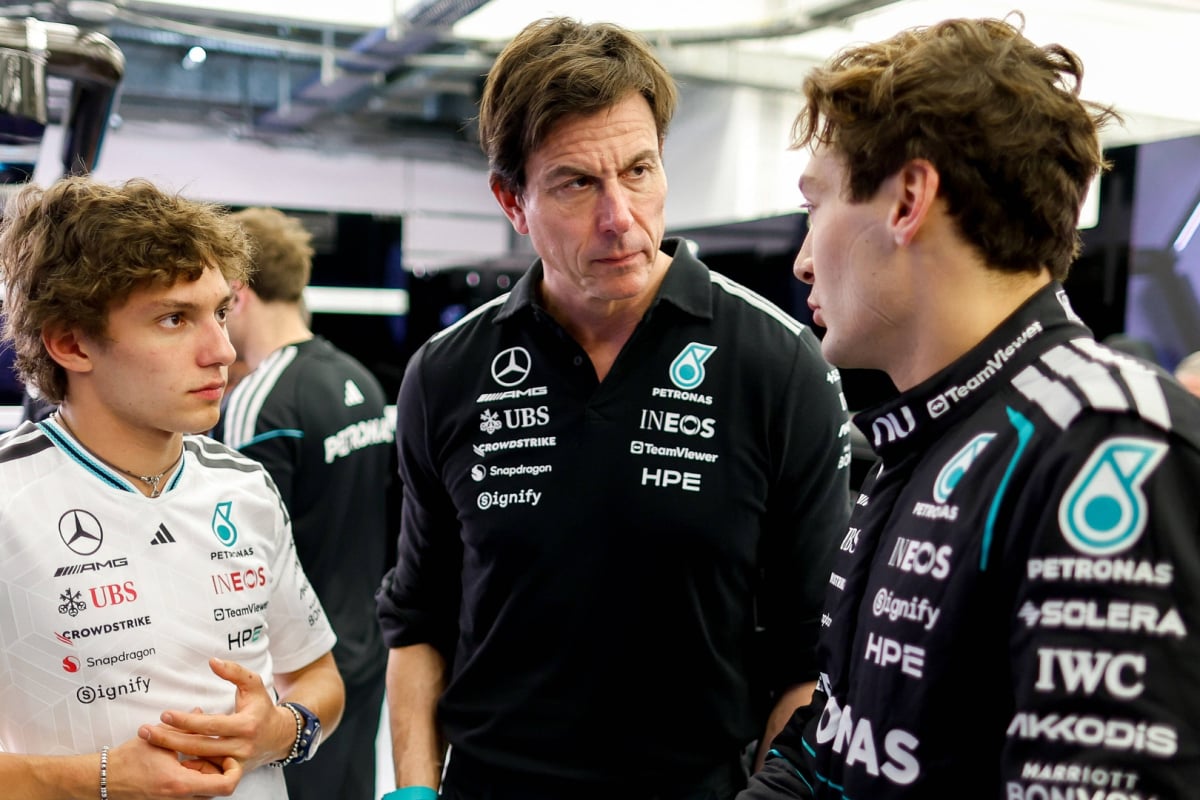


Mercedes the biggest losers over F1 race cancellations
Mercedes have started the season as the dominant team

The cancellations of the two race weekends in April could hit Mercedes the hardest in F1 2026.
Mercedes have started the season as the dominant outfit on the F1 grid, having claimed one-twos in both grand prix qualifying sessions so far, and both grands prix in Australia and China.
Their drivers George Russell and Kimi Antonelli have traded grand prix victories so far, and are looking likely to be in a world championship battle.
Mercedes are currently top of the constructors' championship by 31 points, with Ferrari hoping to close the gap in performance and chase them down in those standings.
And the cancellation of the Bahrain and Saudi Arabian Grands Prix could hamper Mercedes' hopes of staying ahead of Ferrari.
Before the season even started, an FIA verdict following a vote between the five power unit manufacturers saw Mercedes' clever geometric compression ratio trick outlawed in the sporting regulations, and they have until June 1 to change it - ahead of the Monaco GP weekend.
This meant that they were set to have seven grands prix with their current power unit - which is so superior to their rivals' - but the cancellation of the two race weekends because of the war in the Middle East means that they're only going to have five race weekends, with two of those already completed.
F1 Engine Compression Ratio: What is it and why is it so controversial?
What is Mercedes' geometric compression ratio trick?
Mercedes' clever power unit trick was designed so that the compression ratio within the unit could be at the allowed 16:1 when the engine is stationary, but then increase to the previously allowed 18:1 when moving, with the original sporting regulations only stating that the ratios would be measured when the car was stationary.
This is thought to be worth anywhere between 20-30 brake horsepower (bhp), although Toto Wolff has previously played it down by suggesting that it's worth less than five bhp.
Following the vote between the five power unit manufacturers, which only required a 4-1 majority, the sporting regulations were changed ahead of the year, stating that from June 1, the ratios would be measured at both ambient and operational temperatures.
How much could the FIA's geometric compression ratio ruling affect Mercedes?
The advantage being gained by Mercedes via their geometric compression ratio trick is said to be worth around 0.3 seconds per lap, but given their pole position time in Australia was 0.785 seconds faster than their nearest challenger and 0.351 seconds in China, they could well still be the fastest team on the grid post-Monaco.
But if the pack is more condensed, then there is less margin for error, and something small like Russell's car problem in Q3 in China could be the difference between P2 and P8 in a more tightly-packed grid.
And with the season now only being 22 race weekends long, Mercedes' geometric compression ratio design quirk is only giving them an advantage for five race weekends.
Presuming that Mercedes would have got a one-two in both Saudi Arabia and Bahrain, that's a huge 86 points that they could be missing out on because of the cancellation of the two races.
Their nearest challengers Ferrari, however, are only likely missing out on an extra 54 points - again, presuming that they would have finished third and fourth in the two race weekends.
With the gap between the two teams still only at 31 points despite Mercedes' flying start to the season, F1's decision to cancel the Bahrain and Saudi Arabian GPs could have a major impact on the constructors' championship.
F1 2026 Regulations: Every new rule and car change explained
Related
More F1 news
Latest F1 news

Recommended by the editors
 Japanese Grand Prix
F1 stars braced for Japanese Grand Prix weather chaos
 Mercedes
Mercedes the biggest losers over F1 race cancellations
 F1 News & Gossip
'Disrespectful': Max Verstappen told to stop punching down in F1 criticism
 F1 News Today
F1 News Today: Aston Martin to swap drivers as team handed FIA lifeline







Races
-
 Grand Prix of Australia 2026
-
 Grand Prix of China 2026
-
 Grand Prix of Japan 2026
-
 Grand Prix of Bahrain 2026
-
 Saudi Arabian Grand Prix 2026
-
 Miami Grand Prix 2026
-
 Grand Prix du Canada 2026
-
 Grand Prix De Monaco 2026
-
 Gran Premio de Barcelona-Catalunya 2026
-
 Grand Prix of Austria 2026
-
 Grand Prix of Great Britain 2026
-
 Grand Prix of Belgium 2026
-
 Grand Prix of Hungary 2026
-
 Dutch Grand Prix 2026
-
 Grand Prix of Italy 2026
-
Gran Premio de España 2026
-
 Grand Prix of Azerbaijan 2026
-
 Grand Prix of Singapore 2026
-
Grand Prix of the United States 2026
-
 Gran Premio de la Ciudad de Mexico 2026
-
 Grande Prêmio de São Paulo 2026
-
Las Vegas Grand Prix 2026
-
 Qatar Grand Prix 2026
-
 Grand Prix of Abu Dhabi 2026
Follow us on your favorite social media channel
Editorial & corporate information

Avenue HQ
10–12 East Parade
Leeds
LS1 2BH
United Kingdom Regional correspondence
View contact page