


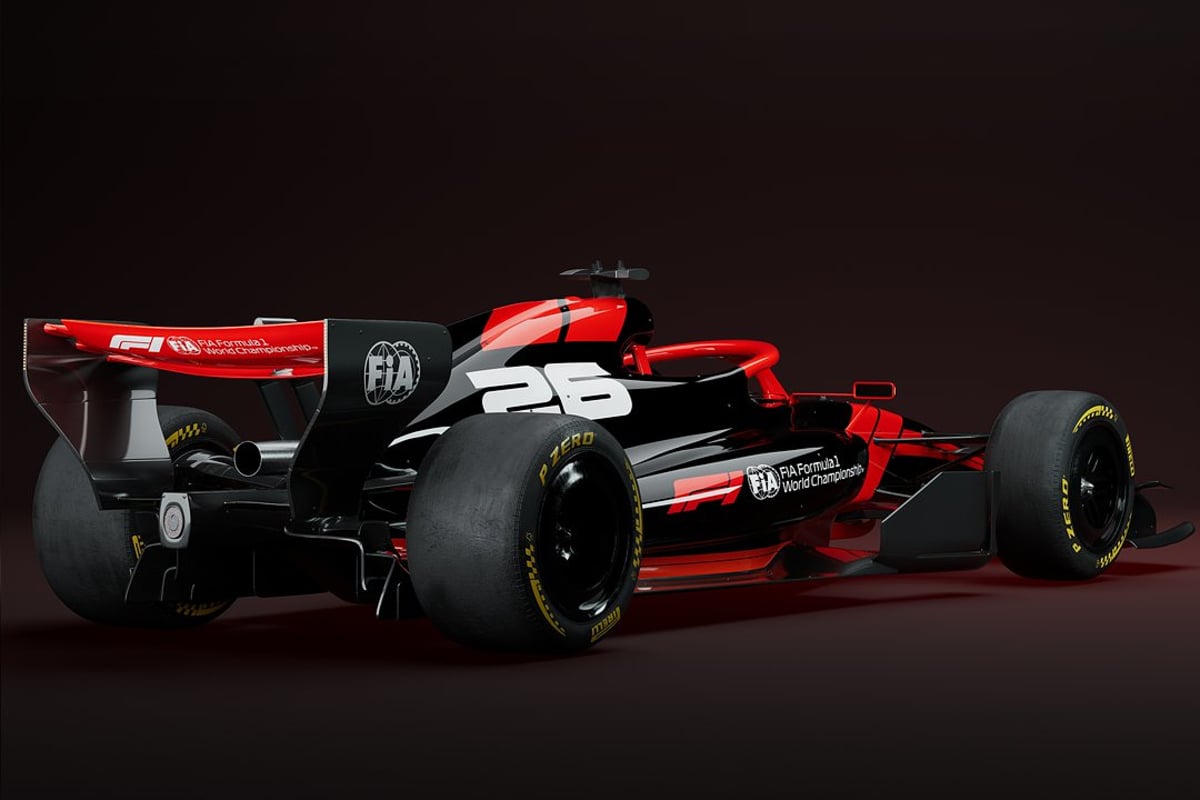
How big are the new F1 cars? 2026 regulations explained


2026's F1 cars will look and sound a little different when they line up for the season-opening Australian Grand Prix.
The new power unit rules mean that there is a heavier reliance on electrical energy within the power units, and they will sound different than in 2025, but these new power units have also led to completely revised chassis designs.
F1 cars in 2026 look different too, with reduced dimensions and a narrower front wing design compared to F1 of the past.
Cars are smaller, lighter, narrower and more nimble, rule changes that are designed to improve racing between the cars and supposedly lead to more opportunities to overtake, particularly on narrow street circuits.
But how small are the new 2026 cars?
F1 2026 Regulations: How much does an F1 car weigh?
How big is an F1 car?
F1 cars have a wheelbase of 340 centimetres, or 3.4 meters. This has been reduced by 20cm, condensing the cars for 2026 to try and make them more nimble and better to drive.
The width of the F1 cars in 2026 has also been reduced, and they are now 190 centimetres in width (1.9 meters).
This represents a reduction of 10 centimetres length-wise, and so the dimensions of the 2026 cars are 340cm x 190cm.
How big are F1 car tyres?
Of course, a condensed chassis design is likely to lead to smaller tyres, and the new Pirelli tyres have been shrunk in order to fit the new cars.
While the diameter of the tyre has remained at 18 centimetres, the width has been reduced.
Front tyres have decreased in width by 25mm, while the rear tyres are 30mm narrower. This means that the total width of the front tyres are now 275mm.
Rear tyres are bigger on an F1 car than the front tyres, and in 2026 rear tyre width is sat at 375mm.
How much does an F1 car weigh?
All of these changes mean that F1 cars are now lighter than they have been in previous years, again helping with their nimbleness.
Overall, an F1 car in 2026 has a minimum weight of 768kg, this is without fuel and is in an ideal world for F1 teams, with them likely being heavier than this in the early weeks of the season.
That minimum weight has been reduced by 32kg compared to 2025, in an attempt to reverse the direction of travel that had seen 200kg of weight added to F1 cars in the last 20 years.
F1 2026 Regulations: What has happened to the MGU-H?
Related

Latest News

F1 teams forced into last-minute travel changes ahead of Australian Grand Prix
- 31 minutes ago

How big are the new F1 cars? 2026 regulations explained
- 1 hour ago

F1 2026 Merch: Red Bull launch fresh off-duty looks on eve of new season
- 2 hours ago

F1 2026 Regulations: Strengthened roll hoop explained
- 3 hours ago

FIA president confirms he is 'assessing' Middle East F1 races after Iran missile attacks
- Today 13:56

F1 News Today: Lewis Hamilton shocked as Christian Horner reveals Toto Wolff message
- Today 13:00
Most read

Lewis Hamilton finally breaks his silence on Kim Kardashian dating rumours
- 12 february

F1 News Today: Lewis Hamilton issues warning over ‘real test’ as Ferrari fumble could cost 2026 title
- 28 february

Where do F1 drivers currently live and why do many of them choose Monaco?
- Yesterday 22:03

F1 2026 WAGs: Lewis Hamilton latest and Charles Leclerc got MARRIED
- 28 february

Best F1 Fantasy 2026 Team Names: Funny names and puns for the new season
- 24 february

FIA 'will ban' Mercedes engine trick following rivals uproar
- 16 february

F1 Standings




Races
-
 Grand Prix of Australia 2026
-
 Grand Prix of China 2026
-
 Grand Prix of Japan 2026
-
 Grand Prix of Bahrain 2026
-
 Saudi Arabian Grand Prix 2026
-
 Miami Grand Prix 2026
-
 Grand Prix du Canada 2026
-
 Grand Prix De Monaco 2026
-
 Gran Premio de Barcelona-Catalunya 2026
-
 Grand Prix of Austria 2026
-
 Grand Prix of Great Britain 2026
-
 Grand Prix of Belgium 2026
-
 Grand Prix of Hungary 2026
-
 Dutch Grand Prix 2026
-
 Grand Prix of Italy 2026
-
Gran Premio de España 2026
-
 Grand Prix of Azerbaijan 2026
-
 Grand Prix of Singapore 2026
-
Grand Prix of the United States 2026
-
 Gran Premio de la Ciudad de Mexico 2026
-
 Grande Prêmio de São Paulo 2026
-
Las Vegas Grand Prix 2026
-
 Qatar Grand Prix 2026
-
 Grand Prix of Abu Dhabi 2026
Follow us on your favorite social media channel
Corporate information
 Innovatieweg 20C
7007 CD, Doetinchem, Netherlands
+31 6 455 168 60
See the Contact page for regional correspondence addresses