
Ferrari F1 hopes come crashing down over 'soul-destroying' 2026 upgrades
Has Lewis Hamilton's F1 team already reached the peak of their progress in 2026?

Ferrari brought a whopping 11 upgrades to the Miami Grand Prix last time out, and after a five-week enforced break from the calendar, many expected the Italian team to take a leap forward.
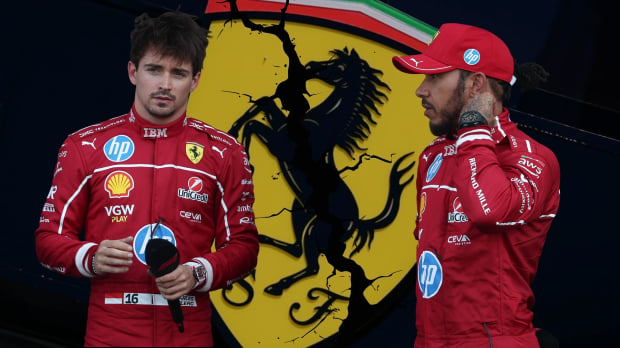
But when Lewis Hamilton and Charles Leclerc got out on track in Miami to show off those upgrades, they appeared no closer to the frontrunners.
In fact, not only did the Scuderia seem to suffer an underwhelming round of upgrades, but they also showed signs at the fourth round of the season that they could be set to be overtaken by their rivals in the competitive order.
For 2026, the chassis and power unit regulations have been completely overhauled, with Mercedes coming out on top as the strongest of the pack.
The Silver Arrows currently lead both the constructors' championship and the drivers' standings thanks to Kimi Antonelli, whose weak point remains his race starts.
This initially worked to Ferrari's advantage given their lightning fast starting procedure handed them an early launch off the line on more than one occasion, but over the course of a a full-length grand prix, they are still behind their competitors.
And some event think things could be about to get worse for the Maranello-based squad with McLaren tipped to overtake them.
READ MORE: Lewis Hamilton donates personalised Mercedes to Silverstone that belonged to his dog Roscoe
What's next for Ferrari after Miami F1 disappointment?
Following some underwhelming results in Miami, Jake Humphrey, Otmar Szafnauer and Rob Smedley discussed the situation at the Scuderia on the High Performance Racing Podcast.
Ex-Alpine F1 boss Szafnauer kicked off the discussion, saying: "I think McLaren soon will leapfrog Ferrari in the championship. They're still behind, but they had a strong weekend McLaren."
Podcast host Humphrey later asked whether Ferrari will be feeling depressed considering the vast amount of upgrades they brought to Miami seemingly didn't help to improve their performance.
Former Ferrari race engineer Smedley then replied: "100 per cent it is. It's slightly soul-destroying because from a technical point of view, it starts essentially like this negative loop that you've then got to [ask], 'What did you bring? What's working? What's not working?'
"If it's not correlating, as in like the wind tunnel or your simulation tools are not matching what's on track, you've then got to do this whole reverse engineering process where you go back to the tunnel and that holds up all of the development in the tunnel that you should be doing."
Szafnauer then weighed in: "Two things that happen. You have finite resources and now you're putting those resources on correlation, not making the car go faster. And the reason you're doing that is because if you don't have good correlation, it's only luck that you make the car go faster, right? So you've got to fix that if that's what their issue is first and foremost.
"But the same engineers that would be looking at performance on track performance are now looking at correlation issues. Right? Different teams have different groups."
"If you've got perfect correlation, no problem. But if you wake up and you don't and you only have three people in APG (Aero Performance Group), you're going to struggle. Then what happens is just what I described. You get your aerodynamicist looking at correlation and now they're not looking at making the car go faster. So it is a problem."
Smedley, who was Felipe Massa's race engineer at the Scuderia between 2006 and 2014, then concluded: "Tunnel and simulation time which is limited through the aerodynamic testing regulations, the ATR, you're only allowed so much, it's a mix of wind tunnel time and CFD time, computational fluid dynamics, and if you have to spend that on working out why your car isn't correlating on track rather than developing the car to be faster and faster, in technical terms, you’re f*****."
F1 HEADLINES: Hamilton 'back to his best' as Mercedes chief delivers Ferrari warning




 Grand Prix of Australia 2026
 Grand Prix of China 2026
 Grand Prix of Japan 2026
 Saudi Arabian Grand Prix 2026
 Miami Grand Prix 2026
 Grand Prix du Canada 2026
 Grand Prix De Monaco 2026
 Gran Premio de Barcelona-Catalunya 2026
 Grand Prix of Austria 2026
 Grand Prix of Belgium 2026
 Grand Prix of Hungary 2026
 Grand Prix of Italy 2026
 Grand Prix of Azerbaijan 2026
 Grand Prix of Bahrain 2026
 Grand Prix of Singapore 2026
 Gran Premio de la Ciudad de Mexico 2026
 Grande Prêmio de São Paulo 2026
 Qatar Grand Prix 2026
 Grand Prix of Abu Dhabi 2026