
Lando Norris questions result-changing Brazilian Grand Prix penalty
It was a busy weekend for the stewards in Sao Paulo

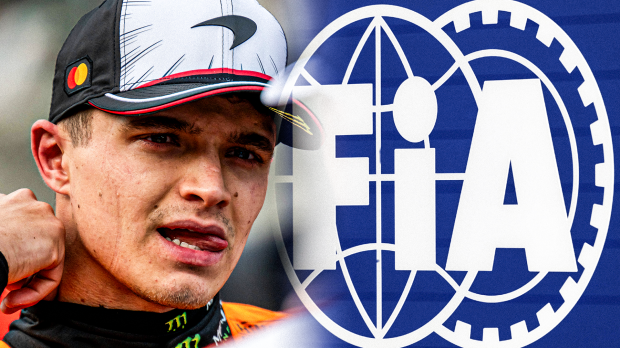
McLaren star Lando Norris has revealed that he disagrees with an FIA penalty that saw the race result changed late on Sunday at the Brazilian Grand Prix.
It was an incredibly busy weekend for the stewards in Sao Paulo, with a string of grid penalties ahead of the race start and a flurry of activity in the stewards' room following Norris' victory in tricky conditions.
Two of the drivers summoned to see the stewards post-race were Ferrari driver Charles Leclerc and Racing Bulls' Liam Lawson after their skirmish in the closing stages of the grand prix.
The pair battled for P7 over the last couple of laps, and Leclerc made contact with Lawson's car into turn 12 as he ran out of space on the inside. Lawson initially kept his position, but Leclerc was able to stay close and got past on the next lap, securing seventh and demoting Lawson to eighth.
F1 HEADLINES: 'Devastated' Hamilton seeks Ferrari answers as John Elkann steps in
Lando Norris disagrees with FIA penalty
Ultimately, the stewards decided that Leclerc had crossed the line by making contact with the Racing Bulls car, handing him a five-second time penalty on Sunday evening. This saw the race result changed, with Lawson reinstated to P7 and Leclerc moving down to P8 in his place.
Norris has now revealed that he disagrees with the stewards' interpretation of the incident in Sao Paulo, arguing that it was just racing. Speaking on a live stream in which he and a friend, Max Fewtrell, were opening F1 cards, as Lawson was packed, Norris asked, "Why did Lawson get a five-second [penalty]?"
"Now I'd say that incident was the absolute limit of a love tap you can give in racing," Fewtrell replied. "Yeah, that was just racing though," Norris argued.
"Proper racing, but the limit, though," Fewtrell concluded. "I think any more of a nudge and he'd lose more time and then [it's] not fair."
"Yeah," Norris agreed.
Stewards explain Charles Leclerc penalty
In their official reasoning for the penalty, the stewards revealed that Leclerc's punishment came as it was a breach of Appendix L, Chapter IV, Article 2 d) of the FIA International Sporting Code.
"The Stewards heard from the driver of Car 16 (Charles Leclerc), the driver of Car 30 (Liam Lawson), team representatives and reviewed positioning/marshalling system data, video and in-car video evidence and determined that Car 16 made contact with Car 30 at turn 12," the stewards wrote.
"While the contact was minor and Car 30 was able to maintain the lead thereafter, the driver of Car 30 claimed that the contact damaged the rear left rim of his car and also enabled Car 16 to get closer to him on track and then eventually overtake him 5 corners later. Furthermore, under the Driving Standard Guidelines, Car 30 had the right to the corner and it was for Car 16 to take the necessary steps to avoid a collision.
"The driver of Car 16 claimed that it was a minor contact with no obvious sporting consequence. While we acknowledge that the contact was minor, having examined the fight on track between the two cars, we conclude that Car 16 was able to get closer to and thereafter overtake Car 30 because of the contact.
"The contact clearly disrupted Car 30 and allowed Car 16 to pull up alongside when it was further away before the contact. This was an obvious sporting consequence. In mitigation, the wet conditions coupled with the nature of the contact (ie minor) were taken into account in imposing a 5-second time penalty as opposed to a 10-second time penalty."
READ MORE: Martin Brundle responds to Hamilton vs Leclerc claim with blunt four-word verdict
READ MORE: Ted Kravitz raises alarm over absent Red Bull figure: 'This isn't usual'




 Grand Prix of Australia 2026
 Grand Prix of China 2026
 Grand Prix of Japan 2026
 Saudi Arabian Grand Prix 2026
 Miami Grand Prix 2026
 Grand Prix du Canada 2026
 Grand Prix De Monaco 2026
 Gran Premio de Barcelona-Catalunya 2026
 Grand Prix of Austria 2026
 Grand Prix of Belgium 2026
 Grand Prix of Hungary 2026
 Grand Prix of Italy 2026
 Grand Prix of Azerbaijan 2026
 Grand Prix of Bahrain 2026
 Grand Prix of Singapore 2026
 Gran Premio de la Ciudad de Mexico 2026
 Grande Prêmio de São Paulo 2026
 Qatar Grand Prix 2026
 Grand Prix of Abu Dhabi 2026