


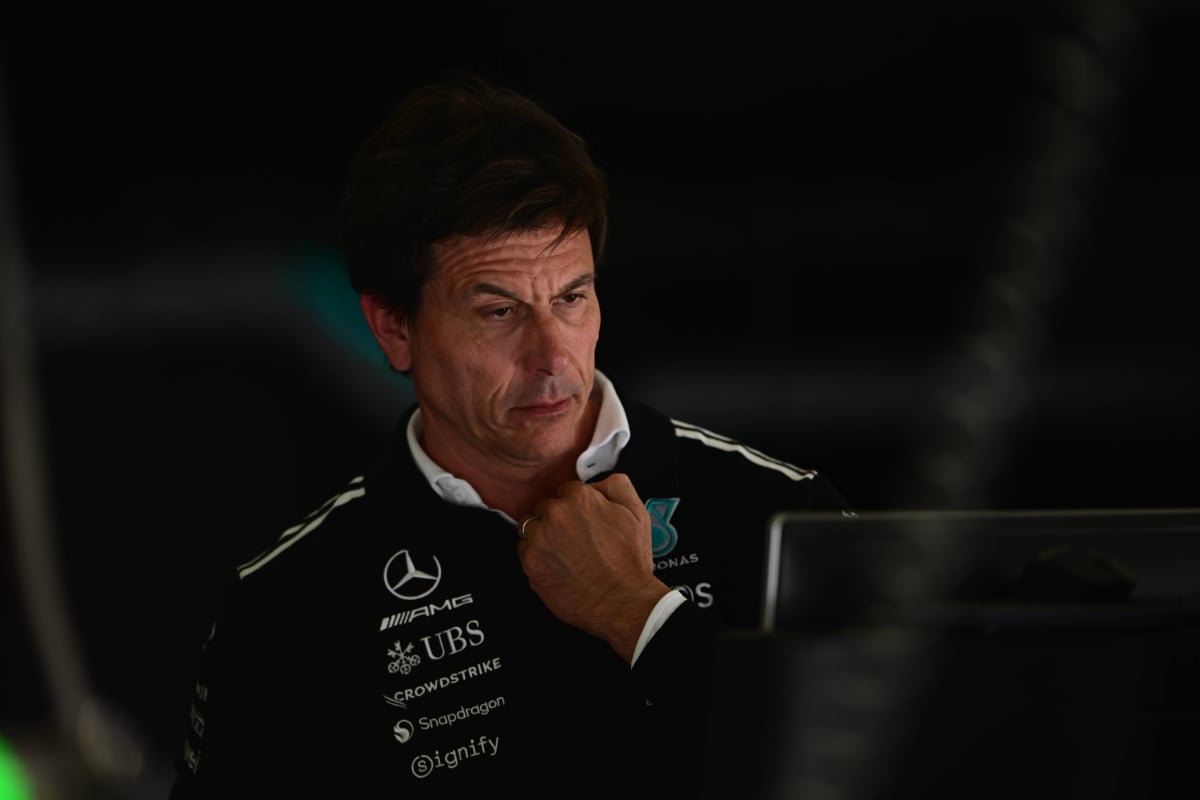

Toto Wolff makes incredible claim about F1 speeds in 2026
Toto Wolff suggested that 2026 cars may well go 400 kph

Mercedes boss Toto Wolff has insisted that next year's F1 cars could reach 400kph (248.5mph), but will avoid doing so for racing reasons.
2026 will see a raft of rule changes enter the sport, with chassis and power units getting a redesign – the latter becoming more reliant on electrical energy.
The power units will also be able to be run entirely on sustainable fuels, as F1 looks to the future and their 2030 Net Zero goal.
Mercedes are understood to be best placed to master these new engine regulations, and they will be supplying three other teams on the grid - McLaren, Williams and Alpine.
The new power units will remain a 1.6-litre V6 turbo hybrid, but the internal combustion engine output has been cut and electrical power tripled, basically meaning there is now a 50-50 split between the two power sources.
And this increased ERS capacity, as well as a new 'overtake mode' which is replacing DRS, led Wolff to say earlier this year that we could see F1 cars reach over 400kph for the first time, and he has now doubled down on that claim.
Wolff has said that he initially said that to boost the excitement for the new power units, but that he believes it to be a genuine possibility, even if it would mean not optimising speed over the whole lap.
"Well, I felt like we needed to give that engine a little bit of a marketing boost, because people were talking it down and it's such an amazing piece of kit," Wolff told the Beyond The Grid podcast.
"If you put it all together, we could do 400km/h or maybe even exceed it, but obviously you're going to run out of energy for the next straight and then not be quick enough."
F1 introduce new aero rules
As well as the changing power units, F1 are also making lots of changes to car chassis in 2026, with new aero rules, and smaller, more nimble racing cars.
F1's smaller cars are aimed at creating more exciting racing, particularly at narrow tracks on the circuit such as the Monaco Grand Prix.
Cars will be lighter by 30kg in 2026, the wheelbase will be reduced by 20cm and the car width will be reduced by 10cm.
The maximum floor width will also be reduced by 15cm, while the width of the front tyres will be decreased by 2.5cm and the rears by 3cm. Pirelli and the F1 grid recently tested the new tyres on mule cars during the post-season tyre test in Abu Dhabi.
F1 front wings will be 10cm narrower and will feature a two element active flap. The rear wing will then have a three element flap and the lower beam wing has been removed.
The removal of this is key, to ensure that a following car will encounter less turbulence or 'dirty air', a major impediment to overtaking this past year.
In-washing wheel wake control boards will sit on the front of the side pods to assist with the control of the wheel wake - which also produces dirty or turbulent air. Therefore with better control, the aim is to make following easier and improve the overtaking spectacle.
READ MORE: Lewis Hamilton retirement verdict revealed by F1 insider
Related
More F1 news
Full News Feed


Recommended by the editors
 Christian Horner
Christian Horner and Geri Halliwell receive planning verdict amid neighbour dispute over $12.3m home
 Japanese Grand Prix
Japanese Grand Prix gets ‘Mario Kart’ twist after F1 driver complaints
 Latest F1 News
American F1 team Haas to run epic 'Godzilla' car livery at Japanese Grand Prix
 F1 Miami Grand Prix
Miami Grand Prix could get ‘Taylor Swift effect’ with Kim Kardashian presence




Races
-
 Grand Prix of Australia 2026
-
 Grand Prix of China 2026
-
 Grand Prix of Japan 2026
-
 Grand Prix of Bahrain 2026
-
 Saudi Arabian Grand Prix 2026
-
 Miami Grand Prix 2026
-
 Grand Prix du Canada 2026
-
 Grand Prix De Monaco 2026
-
 Gran Premio de Barcelona-Catalunya 2026
-
 Grand Prix of Austria 2026
-
 Grand Prix of Great Britain 2026
-
 Grand Prix of Belgium 2026
-
 Grand Prix of Hungary 2026
-
 Dutch Grand Prix 2026
-
 Grand Prix of Italy 2026
-
Gran Premio de España 2026
-
 Grand Prix of Azerbaijan 2026
-
 Grand Prix of Singapore 2026
-
Grand Prix of the United States 2026
-
 Gran Premio de la Ciudad de Mexico 2026
-
 Grande Prêmio de São Paulo 2026
-
Las Vegas Grand Prix 2026
-
 Qatar Grand Prix 2026
-
 Grand Prix of Abu Dhabi 2026
Follow us on your favorite social media channel
Editorial & corporate information

Avenue HQ
10–12 East Parade
Leeds
LS1 2BH
United Kingdom Regional correspondence
View contact page